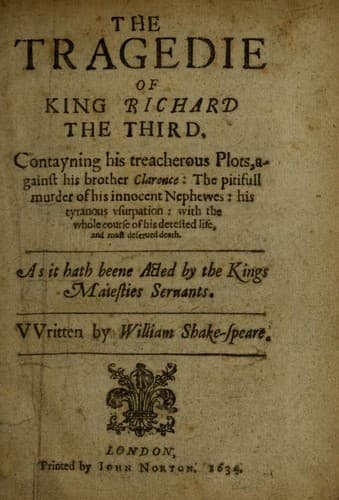
The authoritative edition of Richard III from The Folger Shakespeare Library, the trusted and widely used Shakespeare series for students and general readers. In Richard III, Shakespeare invites us on a moral holiday. The play draws us to identify with Richard and his fantasy of total control of self and domination of others. Not yet king at the start of the play, Richard presents himself as an enterprising villain as he successfully plans to dispose of his brother Clarence. Richard achieves similar success in conquering the woman he chooses to marry. He carves a way to the throne through assassination and executions. This edition includes: -The exact text of the printed book for easy cross-reference -Hundreds of hypertext links for instant navigation -Freshly edited text based on the best early printed version of the play -Newly revised explanatory notes conveniently linked to the text of the play -Scene-by-scene plot summaries -A key to the play’s famous lines and phrases -An introduction to reading Shakespeare’s language -An essay by a leading Shakespeare scholar providing a modern perspective on the play -Fresh images from the Folger Shakespeare Library’s vast holdings of rare books -An annotated guide to further reading Essay by Phyllis Rackin The Folger Shakespeare Library in Washington, DC, is home to the world’s largest collection of Shakespeare’s printed works, and a magnet for Shakespeare scholars from around the globe. In addition to exhibitions open to the public throughout the year, the Folger offers a full calendar of performances and programs. For more information, visit Folger.edu.
Add to your library to track progress and write reviews
Find King Richard III William Shakespeare in PDF, EPUB, ebook, audiobook, print, or library editions.
Shakespeare's Minor Tetralogy

15 books in catalog
Dramatizing the psychological strain of political ambition, murder, and moral decay, Hamlet and Macbeth set enduring standards for Renaissance tragedy through complex soliloquies and dramatic structure. William Shakespeare produced these works alongside a expansive repertoire of dramatic and poetic literature in late sixteenth- and early seventeenth-century England. Often called the Bard of Avon and England's national poet, his surviving output includes roughly 38 plays, 154 sonnets, and several narrative poems. Translated into every major living language, his plays are performed more frequently worldwide than those of any other playwright.
Baptized on April 26, 1564, in Stratford-upon-Avon, Shakespeare was the son of John Shakespeare, a prosperous glove maker and wool dealer, and Mary Arden. He likely received his early education at the King Edward VI Grammar School in Stratford, where he studied Latin grammar, classical rhetoric, and Roman drama. At age eighteen, he married Anne Hathaway, and the couple had three children: Susanna, born in 1583, and twins Judith and Hamnet, born in 1585. By the early 1590s, he had established himself in London as an actor, playwright, and joint partner in the Lord Chamberlain's Men, a prominent theatrical company later known as the King's Men under King James I.
Shakespeare's career revolved around two key locations: Stratford, where he purchased substantial property and maintained his family home, and London, the hub of English professional theater. His dramatic output spanned genres, from early slapstick comedies like The Comedy of Errors to historical plays including Richard III, Henry IV, Part 2, and Henry V, as well as domestic comedies such as The Merry Wives of Windsor. He continued to write and act in London until retiring to Stratford around 1613, where he died on April 23, 1616.
Shakespeare's writing is noted for its linguistic vitality, innovative blank verse, and deep character development. He contributed significantly to the evolution of the English language, coining or first recording over 1,700 words by combining everyday speech with classical poetic techniques. His dramatic works often blend comic and tragic elements within a single play, exploring universal themes of governance, romantic devotion, jealousy, betrayal, and human vulnerability.
Beyond his plays, The Sonnets reflect his mastery of poetic form, examining love, time, mortality, and artistic expression across 154 interconnected poems. In tragedies such as Othello, Romeo and Juliet, and Julius Caesar, Shakespeare utilized dramatic irony, multi-layered plots, and psychological introspection to create stage texts that remain deeply influential in performance and literary study.