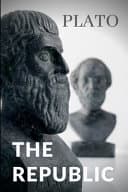
There is a well-known saying that the whole of Western Philosophy is footnotes of Plato. This is because his writings have set the schema that philosophy can be said to have followed ever since. Following under the teachings of Socrates, Plato's works are among the world's greatest literature. The Republic is the centre around which the other Dialogues may be grouped; here philosophy reaches the highest point to which ancient thinkers ever attained. Plato among the Greeks, like Bacon among the moderns, was the first who conceived a method of knowledge, although neither of them always distinguished the bare outline or form from the substance of truth; and both of them had to be content with an abstraction of science which was not yet realized. He was the greatest metaphysical genius whom the world has seen; and in him, more than in any other ancient thinker, the germs of future knowledge are contained. Please Note: This book is easy to read in true text, not scanned images that can sometimes be difficult to decipher. The Microsoft eBook has a contents page linked to the chapter headings for easy navigation. The Adobe eBook has bookmarks at chapter headings and is printable up to two full copies per year.
Add to your library to track progress and write reviews
Find The Republic of Plato Plato in PDF, EPUB, ebook, audiobook, print, or library editions.

4 books in catalog
The foundational corpus of Western philosophy relies on the dramatic dialogue, a form of intellectual inquiry where philosophical arguments unfold through structured conversations between distinct speakers. Written in Classical Athens, the seminal text Republic explores justice, the structure of an ideal city-state, and the nature of human knowledge. Plato pioneered this literary and philosophical method during the fourth century BCE, casting his mentor Socrates as the central figure across dozens of probing works that address ethics, political theory, epistemology, and metaphysics.
Through works such as Menon, these texts examine whether virtue can be taught and how human beings acquire genuine understanding rather than mere opinion. Scholars and general readers continue to study these foundational texts to engage with enduring questions concerning truth, morality, governance, and the human soul.
Born around 428 or 427 BCE into an aristocratic Athenian family, Plato was the son of Ariston and Perictione, whose ancestry traced back to the early Athenian lawmaker Solon. Raised during the tumultuous years of the Peloponnesian War near the end of the Golden Age of Athens, he originally observed Athenian governance before dedicating himself to philosophy under the guidance of Socrates. Following the trial and execution of Socrates, Plato traveled widely before returning to Athens to establish the Academy, an institution dedicated to academic research and higher learning that functioned as one of the earliest organized philosophical schools in the Western world.
At the Academy, Plato dedicated decades to research, teaching, and writing until his death in 348 or 347 BCE at around eighty years of age. His most famous student, Aristotle, spent twenty years studying at the Academy before developing his own philosophical systems. Plato's surviving writings comprise approximately twenty-five or more philosophical dialogues along with epistles, preserved today in collections such as The collected dialogues of Plato, including the letters.
Plato's intellectual method relies heavily on dialectic, a conversational procedure that tests hypotheses through persistent question-and-answer exchanges. Rather than delivering systematic treatises in a single authorial voice, he framed his inquiries as dramatic encounters between historical or literary personages. His dialogues synthesize philosophical influences from Heraclitus, Parmenides, and the Pythagoreans while retaining Socrates as the primary mouthpiece for investigating ethical definitions, logical consistency, and abstract principles.
Central themes across his works include epistemology, political philosophy, the immortality of the soul, and the theory of forms, which posits that non-physical essences represent the ultimate reality behind sensible phenomena. Later cosmic and mythic works, such as Timaeus and Critias, expand these conceptual inquiries into natural philosophy, cosmology, and the legendary narrative of Atlantis.
Диалози