SSansFiction
The libraryCollectionsJournalStatsFor authors
Sign inJoin now
Sansfiction,

A digital library for books. Made by readers, for readers.

v 2.0 · 2026
The library
  • Discover
  • Collections
  • Book tracker
  • Journal
  • Stats
For authors
  • SF Links
  • Analytics
  • How it works
  • FAQ
Elsewhere
  • X / @sansfiction
  • Privacy
  • Terms
  • Contact
© 2026 SansFiction · Digital · GlobalA quiet room for your reading life.
The libraryCollectionsJournalStatsFor authors
Sign inJoin now →
Navigation
Library
Bookshelf
Journal
Discover
Collections
Tierlists
Stats
Profile
Author Page
Link Builder
Account
Sign in
S
G
BooksaliensRedshirts
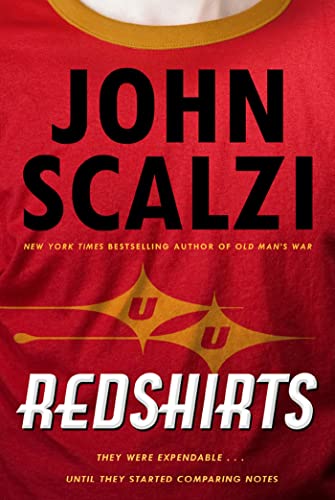
Cover of Redshirts by John Scalzi

Redshirts,

by John Scalzi

Ask AI
Rating3.9/ 5
Ratings730
Pages318
Reading Hours7h
Published2012
LanguageEnglish

§Synopsis

01

Ensign Andrew Dahl has just been assigned to the Universal Union Capital Ship Intrepid, flagship of the Universal Union since the year 2456. It’s a prestige posting, and Andrew is thrilled all the more to be assigned to the ship’s Xenobiology laboratory.

Life couldn’t be better…until Andrew begins to pick up on the fact that: (1) every Away Mission involves some kind of lethal confrontation with alien forces (2) the ship’s captain, its chief science officer, and the handsome Lieutenant Kerensky always survive these confrontations (3) at least one low-ranked crew member is, sadly, always killed.

Not surprisingly, a great deal of energy below decks is expended on avoiding, at all costs, being assigned to an Away Mission. Then Andrew stumbles on information that completely transforms his and his colleagues’ understanding of what the starship Intrepid really is…and offers them a crazy, high-risk chance to save their own lives.

§Our take

Redshirts starts with a joke everyone knows, then asks what that joke means to the people dying. Scalzi makes the pattern visible through the junior crew: every away mission brings lethal trouble, while the captain, chief science officer and Lieutenant Kerensky survive. The early banter moves fast, and when the danger lands, the deaths stop feeling like a gag.

The craft is uneven. Kirkus called the main story predictable, with thin characters and codas that do little to anchor it; other reviewers found the premise funny and the expendable crew affecting. That split is the book's appeal. It won the 2013 Hugo, yet even admirers said it was not Scalzi's strongest work. The three codas, shifting among first-, second- and third-person narration, are the gamble: some readers call them the emotional peak, while others find the second-person coda gimmicky and the tonal change badly timed.

§Themes

Death as a running gag
The familiar away-mission death pattern becomes the moral center once the junior crew recognizes what it means.
Survival and agency
Dahl and his colleagues face a system that treats their lives as expendable, forcing choices about risk, loyalty and self-preservation.
Free will and story control
The novel pushes against the idea that people must simply accept the roles assigned to them.
Changing the narrator's distance
Three codas switch among first, second and third person, altering both the reader's distance and the book's tone.
Star Trek, affectionately
Star Trek-style tropes drive the comedy without requiring knowledge of any particular episode, though readers split over tribute versus undercut.

§How it was received

Redshirts won the 2013 Hugo Award for Best Novel, but the critical response was far from unanimous. Kirkus called it a mild, juvenile-tinged diversion that failed as metafiction, faulting the predictable main story, thin characters and ineffective codas. Other reviewers and genre readers found the jokes sharp and the doomed crew genuinely affecting, while a Portland Book Review critic felt it undersold Star Trek's optimism.

§Read it if

  • You know Star Trek-style tropes and enjoy seeing them examined from the expendable crew's side
  • You like fast, banter-led comedy that turns cruel jokes into real emotional stakes
  • You want a book that makes the reader argue with its ending; the three codas split readers sharply

§Skip it if

  • You need a deep, original cast. Kirkus and some readers found the characters thin and the middle predictable.
  • Changing narrative voice sounds like a gimmick. Several reviewers disliked the second-person coda most.

§Before you start

Reading experience
The dialogue-led main story moves quickly, then gives way to three shorter codas that change narrative voice; Star Trek familiarity helps, but no episode knowledge is needed.
Reading order
Standalone novel, outside Scalzi's Old Man's War and Interdependency series. No sequel is known.
Content notes
Blood and gore, including serious bodily injury; Deaths of friends and a recounted death of a spouse; Explosions and gun violence; Frequent profanity; Some sexual references.

§Common questions

Do I need to know Star Trek to enjoy Redshirts?
No. Familiarity with Star Trek-style tropes helps, but no particular episode knowledge is required.
Is Redshirts part of a series?
No. It's a standalone novel, not connected to Scalzi's Old Man's War or Interdependency series, and no sequel is known.
What are the three codas?
The main story resolves about two-thirds of the way through, followed by short codas in first, second and third person. Readers divide sharply over whether the shift adds heart or gets in the way.

§If you liked this

  • The Hitchhiker's Guide to the Galaxy by Douglas Adams — Douglas Adams set the benchmark for comic SF that deflates genre conventions, and Redshirts is often measured against it.
  • Old Man's War by John Scalzi — The same author's brisker, more conventional military SF story offers a useful contrast to Redshirts' meta-comedy.
  • Space Opera by Catherynne M. Valente — Another affectionate comic send-up of space-opera conventions, this one with a more stylized voice.
  • The Eyre Affair by Jasper Fforde — Comic metafiction about characters inside a story, another natural shelf-mate for readers drawn to fiction that knows what it is.
Sources
  • Wikipedia
  • The Hugo Awards (official site)
  • The Hugo Awards (official site)
  • Kirkus Reviews
  • Diabolical Plots (David Steffen)
  • Goodreads (blogger review)
  • Portland Book Review
  • SFFaudio (Rob Zak)
  • SFFaudio (second reviewer)
  • GeekDad (Wired)
  • Trigger Warning Database
  • Whatever (John Scalzi's blog)

Track this book

Add to your library to track progress and write reviews

§Genres
aliens1family1fantasy1first contact1humor1science fiction1
§Moods
funny2adventurous1dark1emotional1feel-good1hopeful1lighthearted1
§Tags
#diverse characters1#loveable characters1#not diverse characters1#plot driven1#umor1#unloveable characters1

§About the Author

John Scalzi
John Scalzi

11 books in catalog

Military science fiction and humorous space opera have been transformed by fast-paced storytelling, biting satire, and character-driven space adventures. John Scalzi established his presence in speculative fiction with his acclaimed 2005 debut novel Old Man's War, which reimagined classic military science fiction themes for contemporary audiences.

Career & Background

Born in California in 1969, Scalzi attended the Webb Schools of California and graduated from the University of Chicago in 1991 with a degree in philosophy. He began his professional writing career in 1991 as a film critic and general columnist for the Fresno Bee newspaper, where his reviews and columns were nationally syndicated. In 1996, he moved to Washington, D.C., to work as an in-house editor for America Online (AOL). By 1998, he transitioned into full-time freelance writing and launched his popular blog, Whatever, which earned him the Hugo Award for Best Fan Writer in 2008. Beyond fiction and journalism, he has worked as a consultant on writing, editing, and marketing for major corporate clients including The Walt Disney Company, AOL, Oppenheimer Funds, US Trust, Zagat, and Network Solutions. Scalzi also served as president of the Science Fiction and Fantasy Writers of America.

Scalzi's contributions extend across multimedia, television, and gaming. He served as a creative consultant for the television series Stargate Universe, wrote a long-running science fiction film column for FilmCritic.com, and authored the story for the video game Midnight Star alongside its companion graphic novel Midnight Rises. His short stories have also been adapted for the Netflix animated anthology series Love, Death & Robots. He currently resides in Ohio with his wife, his daughter—who joined Whatever as a writer and editor in 2020—and an assortment of pets.

Writing Style & Themes

Scalzi is celebrated for his accessible prose, sharp dialogue, and pragmatic approach to classic science fiction tropes. His work frequently blends high-concept speculative ideas with workplace humor and bureaucratic reality, grounding interstellar warfare and cosmic conspiracies in believable human dilemmas. Whether exploring consciousness transfer in military conflict or satirizing tropes of television science fiction, his narratives prioritize momentum, clarity, and thematic accessibility. Over his career, his writing has earned prestigious honors including the Hugo Award, Locus Award, Audie Award, Robert A. Heinlein Award, Seiun Award, Dragon Award, and Kurd Lasswitz Prize, as well as the 2016 Governor's Award for the Arts in Ohio and the 2023 Budapest Grand Prize.

Major Works

  • Old Man's War — Published in 2005 following an earlier online serialization in 2002, this Hugo-nominated novel launched the popular Old Man's War series, following elderly citizens recruited into Earth's interstellar defense forces in genetically enhanced young bodies.
  • Redshirts — Winner of the 2013 Hugo Award for Best Novel, this meta-fictional satire follows low-ranking crew members on a starship who realize their high mortality rate is driven by narrative tropes typical of classic sci-fi television shows.
  • The Collapsing Empire — The opening novel of the Interdependency trilogy, followed by The Consuming Fire and The Last Emperox, detailing an interstellar empire facing collapse as the cosmic passageways connecting human systems begin to disappear.
  • Fuzzy Nation — A reimagining of H. Beam Piper's 1962 novel Little Fuzzy, this story follows a surveyor who discovers a sentient species on an alien planet, sparking a high-stakes legal battle over corporate exploitation.
  • The Kaiju Preservation Society — A fast-paced contemporary speculative novel following an unemployed worker recruited during a pandemic to assist a secret non-governmental organization protecting giant creatures on an alternate Earth.
  • Starter Villain — A humorous science fiction novel about a substitute teacher who unexpectedly inherits his estranged uncle's secret lair, sentient cats, and global supervillain syndicate.
§Genres
aliens1family1fantasy1first contact1humor1science fiction1
§Moods
funny2adventurous1dark1emotional1feel-good1hopeful1lighthearted1
§Tags
#diverse characters1#loveable characters1#not diverse characters1#plot driven1#umor1#unloveable characters1

Metadata

ISBN-139780765316998
ISBN-100765316994
ASIN0765316994

Editions and availability

Find Redshirts John Scalzi in PDF, EPUB, ebook, audiobook, print, or library editions.

View on Amazon
Bookshop.orgGoogle Play BooksBarnes & NobleOpen Library

Featured In Lists

Book cover from this collectionBook cover from this collectionBook cover from this collectionBook cover from this collection
Book cover from this collection

Hugo Award for Best Novel (1953 to 2025)

75 books
Book cover from this collectionBook cover from this collectionBook cover from this collectionBook cover from this collection
Book cover from this collection

Sword And Laser

134 books
Book cover from this collectionBook cover from this collectionBook cover from this collectionBook cover from this collection
Book cover from this collection

Hugo Award Best Novel Nominees and Winners ( 1953 - present )

348 books
Book cover from this collectionBook cover from this collectionBook cover from this collectionBook cover from this collection
Book cover from this collection

Locus Award for Best Science Fiction Novel (1971 to 2025)

57 books
Book cover from this collectionBook cover from this collectionBook cover from this collectionBook cover from this collection
Book cover from this collection

Recommendations

26 books
Book cover from this collectionBook cover from this collectionBook cover from this collectionBook cover from this collection
Book cover from this collection

The Esquire 75 Best Sci-Fi Books of All Time

74 books