BooksRalph Waldo Emerson

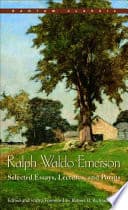
A new, wide-ranging selection of Ralph Waldo Emerson's most influential writings, this edition captures the essence of American Transcendentalism and illustrates the breadth of one of America's greatest philosophers and poets.The writings featured here show Emerson as a protester against social conformity, a lover of nature, an activist for the rights of women and slaves, and a poet of great sensitivity. As explored in this volume, Emersonian thought is a unique blend of belief in individual freedom and in humility before the power of nature. "I become a transparent eyeball," Emerson wrote in Nature, "I am nothing; I see all; the currents of the Universal Being circulate through me; I am part or particle of God." Written over a century ago, this passage is a striking example of the passion and originality of Emerson's ideas, which continue to serve as a spiritual center and an ideological base for modern thought.From the Paperback edition.
A new, wide-ranging selection of Ralph Waldo Emerson's most influential writings, this edition captures the essence of American Transcendentalism and illustrates the breadth of one of America's greatest philosophers and poets.The writings featured here show Emerson as a protester against social conformity, a lover of nature, an activist for the rights of women and slaves, and a poet of great sensitivity. As explored in this volume, Emersonian thought is a unique blend of belief in individual freedom and in humility before the power of nature. "I become a transparent eyeball," Emerson wrote in Nature, "I am nothing; I see all; the currents of the Universal Being circulate through me; I am part or particle of God." Written over a century ago, this passage is a striking example of the passion and originality of Emerson's ideas, which continue to serve as a spiritual center and an ideological base for modern thought.From the Paperback edition.
Add to your library to track progress and write reviews
Add to your library to track progress and write reviews
Find Ralph Waldo Emerson Ralph Waldo Emerson in PDF, EPUB, ebook, audiobook, print, or library editions.
Find Ralph Waldo Emerson Ralph Waldo Emerson in PDF, EPUB, ebook, audiobook, print, or library editions.
3 books in catalog
Ralph Waldo Emerson was an American philosopher, essayist, and poet, best remembered for leading the Transcendentalist movement of the mid-19th century. His teachings directly influenced the growing New Thought movement of the mid-1800s. He was seen as a champion of individualism and a prescient critic of the countervailing pressures of society.
Emerson gradually moved away from the religious and social beliefs of his contemporaries, formulating and expressing the philosophy of Transcendentalism in his 1836 essay, Nature. As a result of this ground-breaking work he gave a speech entitled The American Scholar in 1837, which Oliver Wendell Holmes, Sr. considered to be America's "Intellectual Declaration of Independence". Considered one of the great orators of the time, Emerson's enthusiasm and respect for his audience enraptured crowds. His support for abolitionism late in life created controversy, and at times he was subject to abuse from crowds while speaking on the topic. When asked to sum up his work, he said his central doctrine was "the infinitude of the private man."
(Source)
3 books in catalog
Ralph Waldo Emerson was an American philosopher, essayist, and poet, best remembered for leading the Transcendentalist movement of the mid-19th century. His teachings directly influenced the growing New Thought movement of the mid-1800s. He was seen as a champion of individualism and a prescient critic of the countervailing pressures of society.
Emerson gradually moved away from the religious and social beliefs of his contemporaries, formulating and expressing the philosophy of Transcendentalism in his 1836 essay, Nature. As a result of this ground-breaking work he gave a speech entitled The American Scholar in 1837, which Oliver Wendell Holmes, Sr. considered to be America's "Intellectual Declaration of Independence". Considered one of the great orators of the time, Emerson's enthusiasm and respect for his audience enraptured crowds. His support for abolitionism late in life created controversy, and at times he was subject to abuse from crowds while speaking on the topic. When asked to sum up his work, he said his central doctrine was "the infinitude of the private man."
(Source)