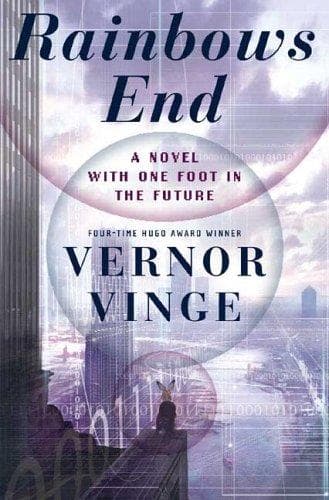
The information revolution of the past thirty years blossoms into a web of conspiracies that could destroy Western civilisation. At the centre of the action is Robert Gu, a former Alzheimer's victim who has regained his mental and physical health through radical new therapies, and his family. His son and daughter-in-law are both in the military - but not a military we would recognise - while his middle school-age granddaughter is involved in perhaps the most dangerous game of all, with people and forces more powerful than she or her parents can imagine. Filled with excitement and Vinge's trademark potpourri of fascinating ideas, Rainbows End is another triumphantly entertaining novel by one of the true masters of the field.
The information revolution of the past thirty years blossoms into a web of conspiracies that could destroy Western civilisation. At the centre of the action is Robert Gu, a former Alzheimer's victim who has regained his mental and physical health through radical new therapies, and his family. His son and daughter-in-law are both in the military - but not a military we would recognise - while his middle school-age granddaughter is involved in perhaps the most dangerous game of all, with people and forces more powerful than she or her parents can imagine. Filled with excitement and Vinge's trademark potpourri of fascinating ideas, Rainbows End is another triumphantly entertaining novel by one of the true masters of the field.
Add to your library to track progress and write reviews
Add to your library to track progress and write reviews
Find Rainbows End Vernor Vinge in PDF, EPUB, ebook, audiobook, print, or library editions.
Find Rainbows End Vernor Vinge in PDF, EPUB, ebook, audiobook, print, or library editions.
7 books in catalog
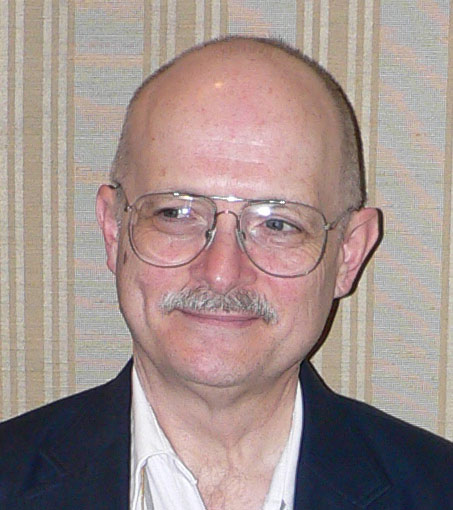
Conceptually pioneering hard science fiction through depictions of cyberspace and superhuman artificial intelligence, the space opera series Zones of Thought remains one of the most celebrated frameworks in modern speculative fiction. Vernor Vinge, a computer scientist and mathematics professor at San Diego State University, earned multiple Hugo Awards by combining rigorous technical extrapolation with expansive galactic settings. His seminal works, including A Fire Upon the Deep and A Deepness in the Sky, helped establish foundational concepts surrounding the technological singularity and networked human-machine interaction.
Born in Waukesha, Wisconsin, in 1944, Vernor Steffen Vinge published his first short story, "Apartness," in 1965. He pursued higher education at Michigan State University before joining the faculty at San Diego State University, where he taught mathematics and computer science for decades as a computer scientist and professor. Balancing academic responsibilities with creative writing, he gained widespread recognition in 1981 with his novella True Names, an early vision of virtual reality and cyberspace. He received Hugo Award nominations for his early novels The Peace War (1984) and its sequel Marooned in Realtime (1986). After retiring from SDSU in 2000 as a retired San Diego State University Professor of Mathematics to focus entirely on writing, he won Hugo Awards for the short fiction pieces Fast Times at Fairmont High (2001) and The Cookie Monster (2004), alongside his top novel honors.
Vinge was known for a rigorous hard science fiction approach that grounded speculative technology in logical computer science principles and mathematical physics. A recurring theme across his fiction is the technological singularity—the theoretical point where artificial intelligence surpasses human comprehension and radically alters civilization. His universe in the Zones of Thought series illustrates this concept physically by dividing the Milky Way into distinct regions where the limits of computation, intelligence, and faster-than-light travel vary based on galactic location. Beyond novel-length works, his short fiction collections The Collected Stories of Vernor Vinge and Tomorrow Happens explore ubiquitous computing, high-tech surveillance, and the social ramifications of accelerated technological progress.
7 books in catalog
Conceptually pioneering hard science fiction through depictions of cyberspace and superhuman artificial intelligence, the space opera series Zones of Thought remains one of the most celebrated frameworks in modern speculative fiction. Vernor Vinge, a computer scientist and mathematics professor at San Diego State University, earned multiple Hugo Awards by combining rigorous technical extrapolation with expansive galactic settings. His seminal works, including A Fire Upon the Deep and A Deepness in the Sky, helped establish foundational concepts surrounding the technological singularity and networked human-machine interaction.
Born in Waukesha, Wisconsin, in 1944, Vernor Steffen Vinge published his first short story, "Apartness," in 1965. He pursued higher education at Michigan State University before joining the faculty at San Diego State University, where he taught mathematics and computer science for decades as a computer scientist and professor. Balancing academic responsibilities with creative writing, he gained widespread recognition in 1981 with his novella True Names, an early vision of virtual reality and cyberspace. He received Hugo Award nominations for his early novels The Peace War (1984) and its sequel Marooned in Realtime (1986). After retiring from SDSU in 2000 as a retired San Diego State University Professor of Mathematics to focus entirely on writing, he won Hugo Awards for the short fiction pieces Fast Times at Fairmont High (2001) and The Cookie Monster (2004), alongside his top novel honors.
Vinge was known for a rigorous hard science fiction approach that grounded speculative technology in logical computer science principles and mathematical physics. A recurring theme across his fiction is the technological singularity—the theoretical point where artificial intelligence surpasses human comprehension and radically alters civilization. His universe in the Zones of Thought series illustrates this concept physically by dividing the Milky Way into distinct regions where the limits of computation, intelligence, and faster-than-light travel vary based on galactic location. Beyond novel-length works, his short fiction collections The Collected Stories of Vernor Vinge and Tomorrow Happens explore ubiquitous computing, high-tech surveillance, and the social ramifications of accelerated technological progress.