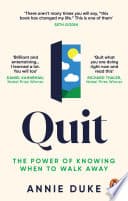
Discover when to grit, and when to quit We are often told that the secret to success is hard work, determination, and hours of practice. But in a fast-changing world, what if the really crucial skill is knowing when to stick at something and when to change track and walk away? Quit makes the under-appreciated case for quitting and also shows you how to get really good at it. Drawing on stories from elite athletes to Everest climbers, comedians to musicians, Annie Duke (who left a successful poker career) explains why learning to quit well is often crucial to success. She provides clear strategies for working out when to cut your losses from a business product that isn't working, a relationship turned toxic, or a career that won't take you where you want to go. You'll learn how to spot the blocks to good quitting behaviour -- escalation commitment, desire for certainty and the status quo bias -- and also how to use tools like quitting contracts, flexible goal-setting and premortems to help you quit cleanly and confidently. Whether you're facing a make-or-break business decision, a life-altering personal choice or simply wanting to take more control of your life, Quit provides a toolkit for change to help you make the best next move.
Add to your library to track progress and write reviews
Find Quit: The Power of Knowing When to Walk Away Annie Duke in PDF, EPUB, ebook, audiobook, print, or library editions.

4 books in catalog
Decision-making strategy under conditions of uncertainty forms the centerpiece of practical non-fiction exploring cognitive psychology and risk evaluation. Author and decision strategist Annie Duke bridges academic behavioral science and high-stakes real-world strategy to help readers navigate choices when outcome certainty is impossible. Her national bestseller, Thinking in Bets: Making Smarter Decisions When You Don't Have All the Facts, introduced general audiences to framing decisions through probabilistic thinking rather than emotional bias or hindsight.
Born Anne LaBarr Lederer on September 13, 1965, Duke pursued academic studies in cognitive psychology before embarking on a distinguished two-decade career in professional tournament poker. During her time in high-stakes competition, she amassed over $4 million in tournament earnings, won a World Series of Poker gold bracelet in 2004, and secured victories at the 2004 World Series of Poker Tournament of Champions and the 2010 National Heads-Up Poker Championship. Following her retirement from tournament poker after 2010, she transitioned into corporate consulting, public speaking, and venture capital, serving as a Special Partner focused on decision science at First Round Capital Partners while writing instructional books and mainstream decision-science works.
Duke combines insights from cognitive-behavioral decision science with practical frameworks derived from competitive risk management. A recurring theme across her writing is the distinction between decision quality and decision outcome, urging readers to eliminate outcome bias when evaluating past choices. In addition to analyzing risk and probability, her work focuses on overcoming cognitive biases, developing structured tools for evaluating options, and normalizing strategic stepping away—a key concept featured in Quit: The Power of Knowing When to Walk Away, which seeks to rehabilitate quitting as a rational decision tool.