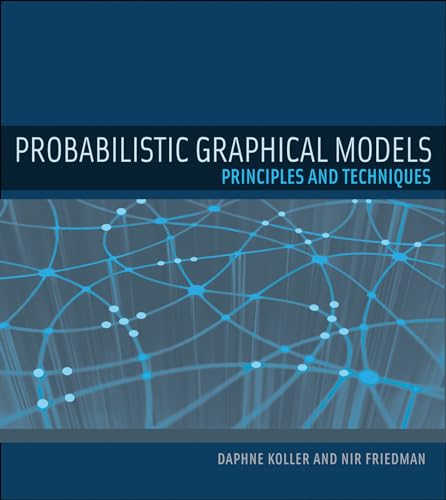
BooksProbabilistic Graphical Models: Principles and Techniques
Adaptive Computation and Machine Learning
Probabilistic Graphical Models: Principles and Techniques,
§Synopsis
01A general framework for constructing and using probabilistic models of complex systems that would enable a computer to use available information for making decisions. Most tasks require a person or an automated system to reason—to reach conclusions based on available information. The framework of probabilistic graphical models, presented in this book, provides a general approach for this task. The approach is model-based, allowing interpretable models to be constructed and then manipulated by reasoning algorithms. These models can also be learned automatically from data, allowing the approach to be used in cases where manually constructing a model is difficult or even impossible. Because uncertainty is an inescapable aspect of most real-world applications, the book focuses on probabilistic models, which make the uncertainty explicit and provide models that are more faithful to reality. Probabilistic Graphical Models discusses a variety of models, spanning Bayesian networks, undirected Markov networks, discrete and continuous models, and extensions to deal with dynamical systems and relational data. For each class of models, the text describes the three fundamental cornerstones: representation, inference, and learning, presenting both basic concepts and advanced techniques. Finally, the book considers the use of the proposed framework for causal reasoning and decision making under uncertainty. The main text in each chapter provides the detailed technical development of the key ideas. Most chapters also include boxes with additional material: skill boxes, which describe techniques; case study boxes, which discuss empirical cases related to the approach described in the text, including applications in computer vision, robotics, natural language understanding, and computational biology; and concept boxes, which present significant concepts drawn from the material in the chapter. Instructors (and readers) can group chapters in various combinations, from core topics to more technically advanced material, to suit their particular needs.
Track this book
Add to your library to track progress and write reviews