Blending satirical social commentary, dark comedy, and speculative elements, the groundbreaking 1969 novel Slaughterhouse-Five transformed modern American fiction by confronting war through a disjointed, non-linear lens. Its creator, Kurt Vonnegut, produced fourteen novels, short story collections, plays, and works of nonfiction across a career spanning more than five decades. His writing frequently used absurdist science fiction tropes to examine human cruelty, morality, and social inequality.
Career & Background
Born on November 11, 1922, in Indianapolis, Indiana, Kurt Vonnegut Jr. developed his early writing skills through student journalism, serving on the staff of Shortridge High School's paper, The Echo, and later working as managing editor for Cornell University's The Sun. The straightforward rules of reporting—focusing on facts and clear declarative sentences—permanently shaped his literary style. During World War II, Vonnegut served in the U.S. Army, was captured by German forces, and survived the 1945 Allied firebombing of Dresden as a prisoner of war. This horrific firsthand experience provided the core foundation for Slaughterhouse-Five (1969), which brought him widespread critical and commercial acclaim. He also served as honorary president of the American Humanist Association, reflecting his lifelong commitment to humanist principles until his death on April 11, 2007, in New York City.
Writing Style & Themes
Vonnegut's signature style relies on economical prose, short chapters, dark humor, and a skeptic's eye toward modern technology and institutional authority. His work frequently features recurring characters, such as the fictional science fiction writer Kilgore Trout, and fuses philosophical queries with surreal storytelling. In works like Cat's Cradle (1963) and Breakfast of Champions (1973), he satirized scientific arrogance, religious dogma, and economic disparity. By pairing bleak themes of destruction and human frailty with offbeat absurdity, Vonnegut offered a distinctly humanist critique of twentieth-century society.
Major Works
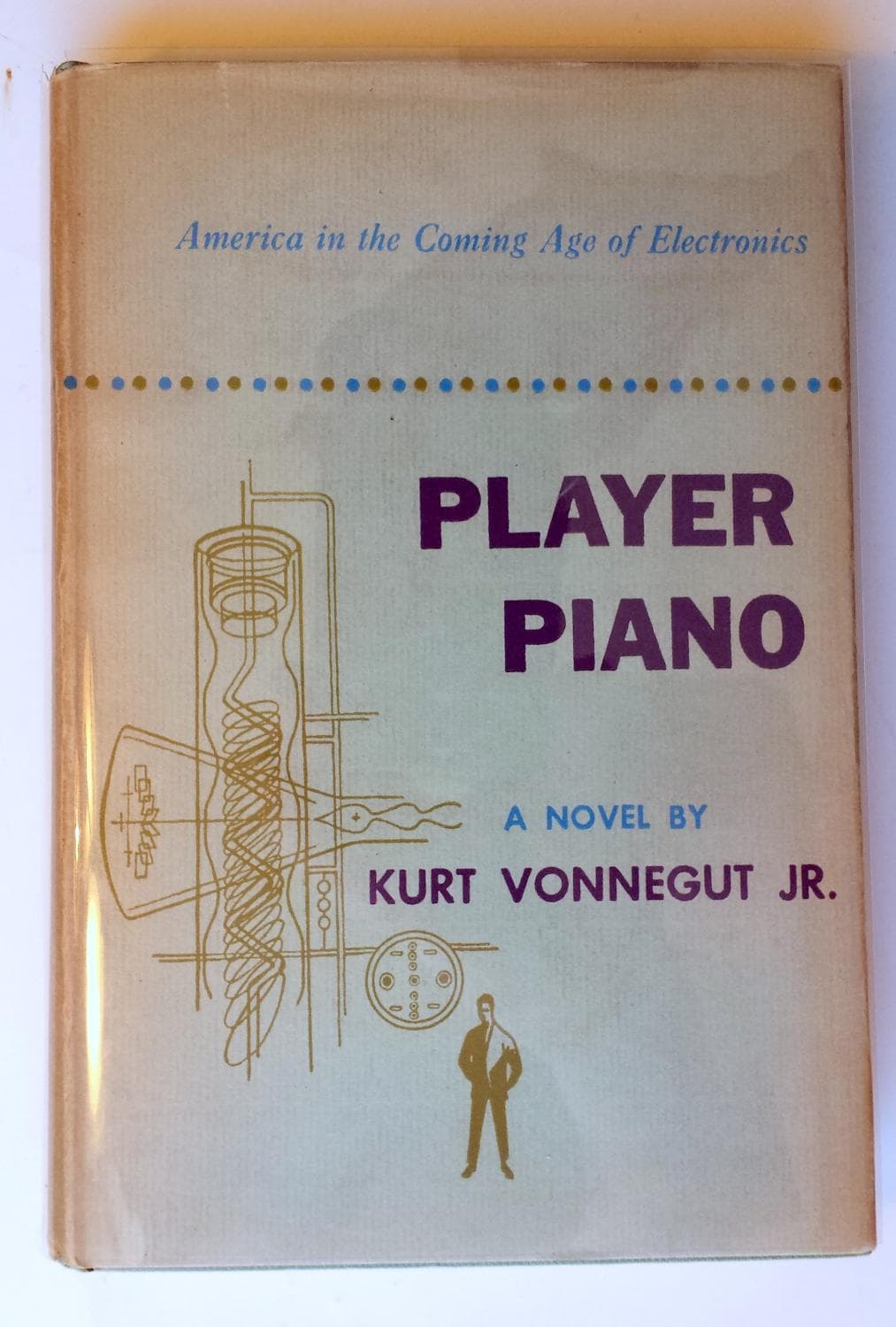
- Player Piano — Published in 1952, Vonnegut's debut novel depicts a dystopia where automation and technological progress replace human labor, driving social alienation.
- The Sirens of Titan — Published in 1959, this comic science fiction novel explores free will and human purpose across space travel between Earth and Saturn's moon Titan.
- Cat's Cradle — Published in 1963, this satirical novel critiques irresponsible scientific research and fanaticism through the invention of a dangerous substance called Ice-Nine.
- God Bless You, Mr. Rosewater — Published in 1965, this novel introduces the eccentric philanthropist Eliot Rosewater and examines wealth inequality and empathy in modern America.
- Slaughterhouse-Five — Published in 1969, this acclaimed semi-autobiographical novel follows Billy Pilgrim as he travels through time and survives the Allied firebombing of Dresden.
- Breakfast of Champions — Published in 1973, this experimental novel utilizes simple illustrations and dark satire to critique American culture and mental illness.
- Galápagos — Published in 1985, this speculative novel is narrated by a ghost millions of years in the future, observing human evolution after an apocalypse.