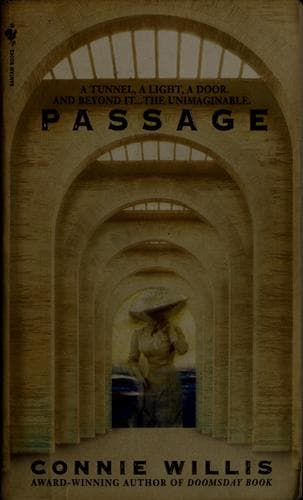
Sf thriller exploring our greatest journey and our greatest mystery -- death itself -- from the winner of both the Hugo and the Nebula awards. Psychologist Dr Joanna Lander has spent two years at Mercy General Hospital studying patients who have been declared clinically dead but then revived. Many have had near-death experiences, NDEs, which are remarkably similar the world over. Then brilliant young neurologist Richard Wright discovers a way to induce an NDE using psychoactive drugs. He's convinced that NDEs are a survival mechanism, and that through them more patients might be brought back from the edge of death. Patients like Joanna's young friend Masie, who is almost certain to die before she gets the heart transplant she desperately needs. So when Joanna realizes that Richard's project is under threat due to a shortage of suitable subjects, she volunteers to take the dangerous journey to the limits of knowledge herself. Immediately fascinated by her simulated near-death experiences, Joanna becomes increasingly desperate to discover the meaning behind the strangely familiar images and feelings she encounters. As she begins to unravel the mystery, her sense of dread grows. Becau
Sf thriller exploring our greatest journey and our greatest mystery -- death itself -- from the winner of both the Hugo and the Nebula awards. Psychologist Dr Joanna Lander has spent two years at Mercy General Hospital studying patients who have been declared clinically dead but then revived. Many have had near-death experiences, NDEs, which are remarkably similar the world over. Then brilliant young neurologist Richard Wright discovers a way to induce an NDE using psychoactive drugs. He's convinced that NDEs are a survival mechanism, and that through them more patients might be brought back from the edge of death. Patients like Joanna's young friend Masie, who is almost certain to die before she gets the heart transplant she desperately needs. So when Joanna realizes that Richard's project is under threat due to a shortage of suitable subjects, she volunteers to take the dangerous journey to the limits of knowledge herself. Immediately fascinated by her simulated near-death experiences, Joanna becomes increasingly desperate to discover the meaning behind the strangely familiar images and feelings she encounters. As she begins to unravel the mystery, her sense of dread grows. Becau
Add to your library to track progress and write reviews
Add to your library to track progress and write reviews
Find Passage Connie Willis in PDF, EPUB, ebook, audiobook, print, or library editions.
Find Passage Connie Willis in PDF, EPUB, ebook, audiobook, print, or library editions.

7 books in catalog
Time-traveling historians sent into pivotal eras of British history form the backbone of one of speculative fiction's most decorated bodies of work, beginning in earnest with the Oxford Time Travel series. Connie Willis established herself as a central figure in science fiction and fantasy through meticulously researched narrative arcs that blend historical tragedy, sharp comedic screwball elements, and deep human empathy. Her groundbreaking novels, such as Doomsday Book and To Say Nothing of the Dog, elevated the genre by exploring how ordinary individuals confront administrative chaos, crisis, and mortality across different centuries.
Born Constance Elaine Trimmer on December 31, 1945, in Denver, Colorado, Willis earned a Bachelor of Arts degree in English and elementary education from the University of Northern Colorado in Greeley in 1967. She spent over a decade teaching elementary and junior high school from 1967 through 1981 while developing her fiction. Her debut science fiction sale, 'The Secret of Santa Titicaca,' appeared in Worlds of Fantasy in 1970, followed by her first Hugo Award nomination for 'Daisy in the Sun' in 1979. A National Endowment for the Arts grant in 1982 allowed her to transition to full-time writing. In the years that followed, she achieved distinction by becoming the first author to win both the Hugo and Nebula Awards in all four fiction categories, ultimately winning eleven Hugo Awards and seven Nebula Awards for individual works. Her major contributions led to her induction into the Science Fiction Hall of Fame in 2009 and her designation as the 28th SFWA Grand Master in 2011.
Willis's fiction ranges from laugh-out-loud romantic comedies reminiscent of classic screwball cinema to harrowing, immersive survival stories set during historical disasters. A recurring thematic thread in her narrative landscape is the unpredictable friction between grand historical events and everyday human vulnerability, frequently depicted through administrative incompetence, miscommunication, and bureaucratic obstacles. Whether examining the devastation of the Black Death, the perils of the London Blitz, or near-death experiences in medical research, her stories balance detailed technical and historical research with engaging dialogue and profound character studies.
7 books in catalog
Time-traveling historians sent into pivotal eras of British history form the backbone of one of speculative fiction's most decorated bodies of work, beginning in earnest with the Oxford Time Travel series. Connie Willis established herself as a central figure in science fiction and fantasy through meticulously researched narrative arcs that blend historical tragedy, sharp comedic screwball elements, and deep human empathy. Her groundbreaking novels, such as Doomsday Book and To Say Nothing of the Dog, elevated the genre by exploring how ordinary individuals confront administrative chaos, crisis, and mortality across different centuries.
Born Constance Elaine Trimmer on December 31, 1945, in Denver, Colorado, Willis earned a Bachelor of Arts degree in English and elementary education from the University of Northern Colorado in Greeley in 1967. She spent over a decade teaching elementary and junior high school from 1967 through 1981 while developing her fiction. Her debut science fiction sale, 'The Secret of Santa Titicaca,' appeared in Worlds of Fantasy in 1970, followed by her first Hugo Award nomination for 'Daisy in the Sun' in 1979. A National Endowment for the Arts grant in 1982 allowed her to transition to full-time writing. In the years that followed, she achieved distinction by becoming the first author to win both the Hugo and Nebula Awards in all four fiction categories, ultimately winning eleven Hugo Awards and seven Nebula Awards for individual works. Her major contributions led to her induction into the Science Fiction Hall of Fame in 2009 and her designation as the 28th SFWA Grand Master in 2011.
Willis's fiction ranges from laugh-out-loud romantic comedies reminiscent of classic screwball cinema to harrowing, immersive survival stories set during historical disasters. A recurring thematic thread in her narrative landscape is the unpredictable friction between grand historical events and everyday human vulnerability, frequently depicted through administrative incompetence, miscommunication, and bureaucratic obstacles. Whether examining the devastation of the Black Death, the perils of the London Blitz, or near-death experiences in medical research, her stories balance detailed technical and historical research with engaging dialogue and profound character studies.