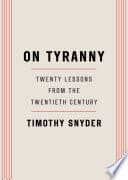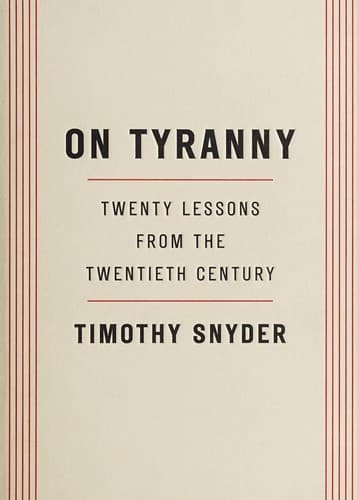
The Founding Fathers tried to protect us from the threat they knew, the tyranny that overcame ancient democracy. Today, our political order faces new threats, not unlike the totalitarianism of the twentieth century. We are no wiser than the Europeans who saw democracy yield to fascism, Nazism, or communism. Our one advantage is that we might learn from their experience.
On Tyranny is a call to arms and a guide to resistance, with invaluable ideas for how we can preserve our freedoms in the uncertain years to come.
Add to your library to track progress and write reviews
Find On Tyranny Timothy Snyder in PDF, EPUB, ebook, audiobook, print, or library editions.

3 books in catalog
Historical analysis of twentieth-century authoritarianism provides essential lessons for preserving democratic institutions today, as demonstrated in the widely read volume On Tyranny: Twenty Lessons from the Twentieth Century. Timothy Snyder, born August 18, 1969, is an American historian and scholar whose research into Central and Eastern European history, the Soviet Union, and the Holocaust connects historical atrocities with contemporary political vulnerabilities.
Snyder built his career as a leading historian specializing in Eastern European history and the mechanics of political tyranny. He served as the Richard C. Levin Professor of History at Yale University and holds a permanent fellowship at the Institute for Human Sciences in Vienna. He also holds the inaugural Temerty Chair in Modern European History at the Munk School of Global Affairs and Public Policy at the University of Toronto. Beyond his university appointments, Snyder is a member of the Council on Foreign Relations and served on the Committee on Conscience of the United States Holocaust Memorial Museum. Reading ten European languages and speaking five, he has written sixteen books published in forty languages.
Snyder's writing bridges rigorous archival research and accessible civic instruction, drawing direct connections between twentieth-century totalitarian systems and contemporary democratic challenges. His work analyzes how mass violence, state propaganda, and ideological extremism undermine human rights and democratic governance. In On Freedom, Snyder extends his political philosophy by exploring the positive conditions necessary for genuine personal and political liberty. Across his major writings, he emphasizes individual responsibility, critical historical literacy, and active participation as vital safeguards against tyrannical shifts.