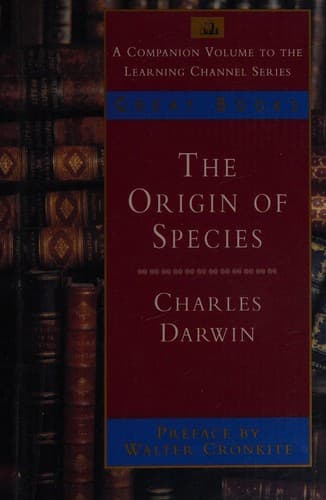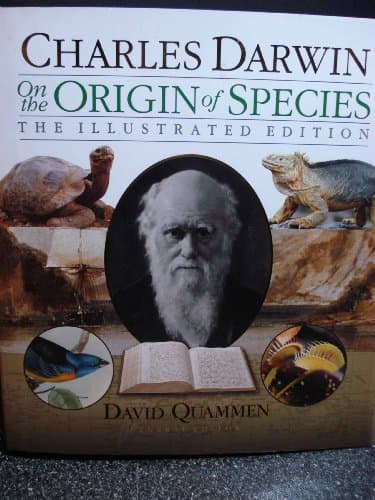
The classic that exploded into public controversy, revolutionized the course of science, and continues to transform our views of the world. --Signet Classics
The classic that exploded into public controversy, revolutionized the course of science, and continues to transform our views of the world. --Signet Classics
Add to your library to track progress and write reviews
Add to your library to track progress and write reviews
Find On the Origin of Species: The Illustrated Edition Charles Darwin in PDF, EPUB, ebook, audiobook, print, or library editions.
Find On the Origin of Species: The Illustrated Edition Charles Darwin in PDF, EPUB, ebook, audiobook, print, or library editions.

2 books in catalog
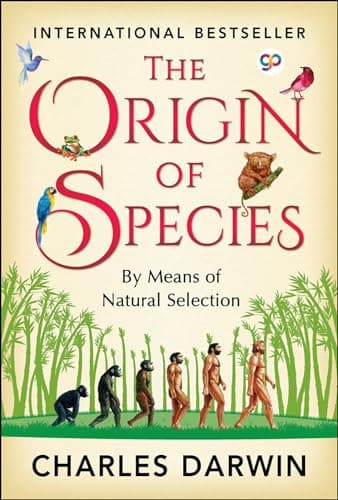
Foundational texts in evolutionary biology established the framework for modern life sciences by explaining how diverse organisms adapt to their environments through natural processes. The seminal 1859 treatise On the Origin of Species introduced the mechanism of natural selection and established that all species of life have descended from a common ancestor, a principle that is now generally accepted and considered a fundamental scientific concept. English naturalist, geologist, and biologist Charles Darwin authored this landmark inquiry, presenting scientific arguments that transformed nineteenth-century biology and reshaped how human beings understand the living world.
The enduring international reach of his research is reflected in translations such as El origen de las especies, which made his evolutionary framework accessible to Spanish-speaking scholars and readers around the world.
Born on February 12, 1809, in Shrewsbury, Shropshire, England, Charles Robert Darwin was the fifth of six children in a wealthy gentry family. His father, Robert Waring Darwin, was a physician and financier, and his grandfather was the philosopher and poet Erasmus Darwin. His mother, Susannah Wedgwood, died when he was eight years old. Darwin developed an early interest in the natural world, which eventually led to his pivotal role as a naturalist aboard HMS Beagle. His field observations during the voyage laid the groundwork for his scientific theories, which he later presented jointly with Alfred Russel Wallace before publishing his comprehensive findings.
Following the publication of his core theories, Darwin lived as an affable country gentleman in Downe, Kent. Although his nonreligious biology initially shocked religious Victorian society, his scientific framework quickly gained support among the rising class of professional scientists. He continued to publish extensive studies in biology and botany until his death on April 19, 1882, in Downe.
Darwin's writing is defined by rigorous empirical observation, systematic gathering of evidence, and a clear, persuasive scientific method. Rather than relying on speculative assertion, his works reconcile multiple distinct lines of evidence, including the progressive fossil record, the geographical distribution of species, recapitulative patterns in embryology, homologous structures, vestigial organs, and nesting taxonomic relationships.
A central theme across his scientific texts is the concept of natural selection, wherein the struggle for existence in nature produces an effect analogous to artificial selection in selective breeding. By detailing how branching patterns of evolution result from these continuous survival pressures, Darwin demonstrated how complex biological diversity arises from shared ancestral origins.
2 books in catalog
Foundational texts in evolutionary biology established the framework for modern life sciences by explaining how diverse organisms adapt to their environments through natural processes. The seminal 1859 treatise On the Origin of Species introduced the mechanism of natural selection and established that all species of life have descended from a common ancestor, a principle that is now generally accepted and considered a fundamental scientific concept. English naturalist, geologist, and biologist Charles Darwin authored this landmark inquiry, presenting scientific arguments that transformed nineteenth-century biology and reshaped how human beings understand the living world.
The enduring international reach of his research is reflected in translations such as El origen de las especies, which made his evolutionary framework accessible to Spanish-speaking scholars and readers around the world.
Born on February 12, 1809, in Shrewsbury, Shropshire, England, Charles Robert Darwin was the fifth of six children in a wealthy gentry family. His father, Robert Waring Darwin, was a physician and financier, and his grandfather was the philosopher and poet Erasmus Darwin. His mother, Susannah Wedgwood, died when he was eight years old. Darwin developed an early interest in the natural world, which eventually led to his pivotal role as a naturalist aboard HMS Beagle. His field observations during the voyage laid the groundwork for his scientific theories, which he later presented jointly with Alfred Russel Wallace before publishing his comprehensive findings.
Following the publication of his core theories, Darwin lived as an affable country gentleman in Downe, Kent. Although his nonreligious biology initially shocked religious Victorian society, his scientific framework quickly gained support among the rising class of professional scientists. He continued to publish extensive studies in biology and botany until his death on April 19, 1882, in Downe.
Darwin's writing is defined by rigorous empirical observation, systematic gathering of evidence, and a clear, persuasive scientific method. Rather than relying on speculative assertion, his works reconcile multiple distinct lines of evidence, including the progressive fossil record, the geographical distribution of species, recapitulative patterns in embryology, homologous structures, vestigial organs, and nesting taxonomic relationships.
A central theme across his scientific texts is the concept of natural selection, wherein the struggle for existence in nature produces an effect analogous to artificial selection in selective breeding. By detailing how branching patterns of evolution result from these continuous survival pressures, Darwin demonstrated how complex biological diversity arises from shared ancestral origins.