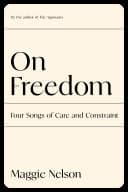
An expansive, exhilarating work of criticism by one of the most significant writers of our day So often deployed as a jingoistic, even menacing rallying cry, or limited by a focus on passing moments of liberation, the rhetoric of freedom both rouses and repels. Does it remain key to our autonomy, justice, and well-being, or is freedom’s long star turn coming to a close? Does a continued obsession with the term enliven and emancipate, or reflect a deepening nihilism (or both)? On Freedom examines such questions by tracing the concept’s complexities in four distinct realms: art, sex, drugs, and climate. Drawing on a vast range of material, from critical theory to pop culture to the intimacies and plain exchanges of daily life, Maggie Nelson explores how we might think, experience, or talk about freedom in ways responsive to the conditions of our day. Her abiding interest lies in ongoing “practices of freedom” by which we negotiate our interrelation with—indeed, our inseparability from—others, with all the care and constraint that entails, while accepting difference and conflict as integral to our communion. For Nelson, thinking publicly through the knots in our culture—from recent art-world debates to the turbulent legacies of sexual liberation, from the painful paradoxes of addiction to the lure of despair in the face of the climate crisis—is itself a practice of freedom, a means of forging fortitude, courage, and company. On Freedom is an invigorating, essential book for challenging times.
An expansive, exhilarating work of criticism by one of the most significant writers of our day So often deployed as a jingoistic, even menacing rallying cry, or limited by a focus on passing moments of liberation, the rhetoric of freedom both rouses and repels. Does it remain key to our autonomy, justice, and well-being, or is freedom’s long star turn coming to a close? Does a continued obsession with the term enliven and emancipate, or reflect a deepening nihilism (or both)? On Freedom examines such questions by tracing the concept’s complexities in four distinct realms: art, sex, drugs, and climate. Drawing on a vast range of material, from critical theory to pop culture to the intimacies and plain exchanges of daily life, Maggie Nelson explores how we might think, experience, or talk about freedom in ways responsive to the conditions of our day. Her abiding interest lies in ongoing “practices of freedom” by which we negotiate our interrelation with—indeed, our inseparability from—others, with all the care and constraint that entails, while accepting difference and conflict as integral to our communion. For Nelson, thinking publicly through the knots in our culture—from recent art-world debates to the turbulent legacies of sexual liberation, from the painful paradoxes of addiction to the lure of despair in the face of the climate crisis—is itself a practice of freedom, a means of forging fortitude, courage, and company. On Freedom is an invigorating, essential book for challenging times.
Add to your library to track progress and write reviews
Add to your library to track progress and write reviews
Find On Freedom: Four Songs of Care and Constraint Maggie Nelson in PDF, EPUB, ebook, audiobook, print, or library editions.
Find On Freedom: Four Songs of Care and Constraint Maggie Nelson in PDF, EPUB, ebook, audiobook, print, or library editions.

2 books in catalog
Combining memoir, cultural criticism, and queer theory, hybrid autotheory has reshaped contemporary nonfiction by bridging rigorous scholarship with deeply personal narrative. Maggie Nelson became a central figure in this movement through her acclaimed book The Argonauts, which examines pregnancy, queer family-making, and gender identity alongside critical philosophy. Her genre-crossing prose blends poetry and academic discourse to explore complex questions of embodiment, art, and ethics.
Maggie Nelson was born on March 12, 1973, in the San Francisco Bay Area and grew up in Marin County, California. She earned a B.A. from Wesleyan University in 1994 and completed a Ph.D. in English literature at the Graduate Center of the City University of New York in 2004. Over her academic career, Nelson taught literature and writing at institutions including the New School and Pratt Institute, served as director of the Creative Writing Program at the California Institute of the Arts after joining its faculty in 2005, and later joined the faculty at the University of Southern California. Her scholarly and creative accomplishments earned her a MacArthur Fellowship in 2016.
Nelson's early published works were predominantly poetry collections, including Shiner (2001), The Latest Winter (2003), and Something Bright, Then Holes (2007). In 2005, she published Jane: A Murder, a narrative documentary poem investigating the 1969 murder of her aunt, which became a finalist for the PEN/Martha Albrand Award for the Art of the Memoir. She expanded into critical prose with Women, the New York School, and Other True Abstractions (2007) and The Art of Cruelty: A Reckoning (2011), establishing a distinct approach rooted in personal reflection and rigorous aesthetic analysis.
Nelson's writing is characterized by its hybrid, genre-crossing style, often described as autotheory or vernacular scholarship. Drawing inspiration from poet Eileen Myles, Nelson engages with philosophical, feminist, and queer theory in ordinary language to demonstrate how abstract ideas operate in daily life. Her prose regularly integrates intimate personal memories with art criticism, psychological inquiry, and literary scholarship, examining broad themes such as suffering, desire, care, and artistic expression.
Her thematic focus frequently centers on embodiment, trauma, and the ethics of freedom and constraint. In Bluets (2009), she uses 240 numbered prose fragments to meditate on heartbreak, physical pain, and the color blue. Her critical inquiry extends into social and political philosophy in On Freedom: Four Songs of Care and Constraint (2021), where she analyzes how contemporary ideas of liberation intersect with mutual obligation, art, addiction, and climate anxiety.
2 books in catalog
Combining memoir, cultural criticism, and queer theory, hybrid autotheory has reshaped contemporary nonfiction by bridging rigorous scholarship with deeply personal narrative. Maggie Nelson became a central figure in this movement through her acclaimed book The Argonauts, which examines pregnancy, queer family-making, and gender identity alongside critical philosophy. Her genre-crossing prose blends poetry and academic discourse to explore complex questions of embodiment, art, and ethics.
Maggie Nelson was born on March 12, 1973, in the San Francisco Bay Area and grew up in Marin County, California. She earned a B.A. from Wesleyan University in 1994 and completed a Ph.D. in English literature at the Graduate Center of the City University of New York in 2004. Over her academic career, Nelson taught literature and writing at institutions including the New School and Pratt Institute, served as director of the Creative Writing Program at the California Institute of the Arts after joining its faculty in 2005, and later joined the faculty at the University of Southern California. Her scholarly and creative accomplishments earned her a MacArthur Fellowship in 2016.
Nelson's early published works were predominantly poetry collections, including Shiner (2001), The Latest Winter (2003), and Something Bright, Then Holes (2007). In 2005, she published Jane: A Murder, a narrative documentary poem investigating the 1969 murder of her aunt, which became a finalist for the PEN/Martha Albrand Award for the Art of the Memoir. She expanded into critical prose with Women, the New York School, and Other True Abstractions (2007) and The Art of Cruelty: A Reckoning (2011), establishing a distinct approach rooted in personal reflection and rigorous aesthetic analysis.
Nelson's writing is characterized by its hybrid, genre-crossing style, often described as autotheory or vernacular scholarship. Drawing inspiration from poet Eileen Myles, Nelson engages with philosophical, feminist, and queer theory in ordinary language to demonstrate how abstract ideas operate in daily life. Her prose regularly integrates intimate personal memories with art criticism, psychological inquiry, and literary scholarship, examining broad themes such as suffering, desire, care, and artistic expression.
Her thematic focus frequently centers on embodiment, trauma, and the ethics of freedom and constraint. In Bluets (2009), she uses 240 numbered prose fragments to meditate on heartbreak, physical pain, and the color blue. Her critical inquiry extends into social and political philosophy in On Freedom: Four Songs of Care and Constraint (2021), where she analyzes how contemporary ideas of liberation intersect with mutual obligation, art, addiction, and climate anxiety.