§Synopsis
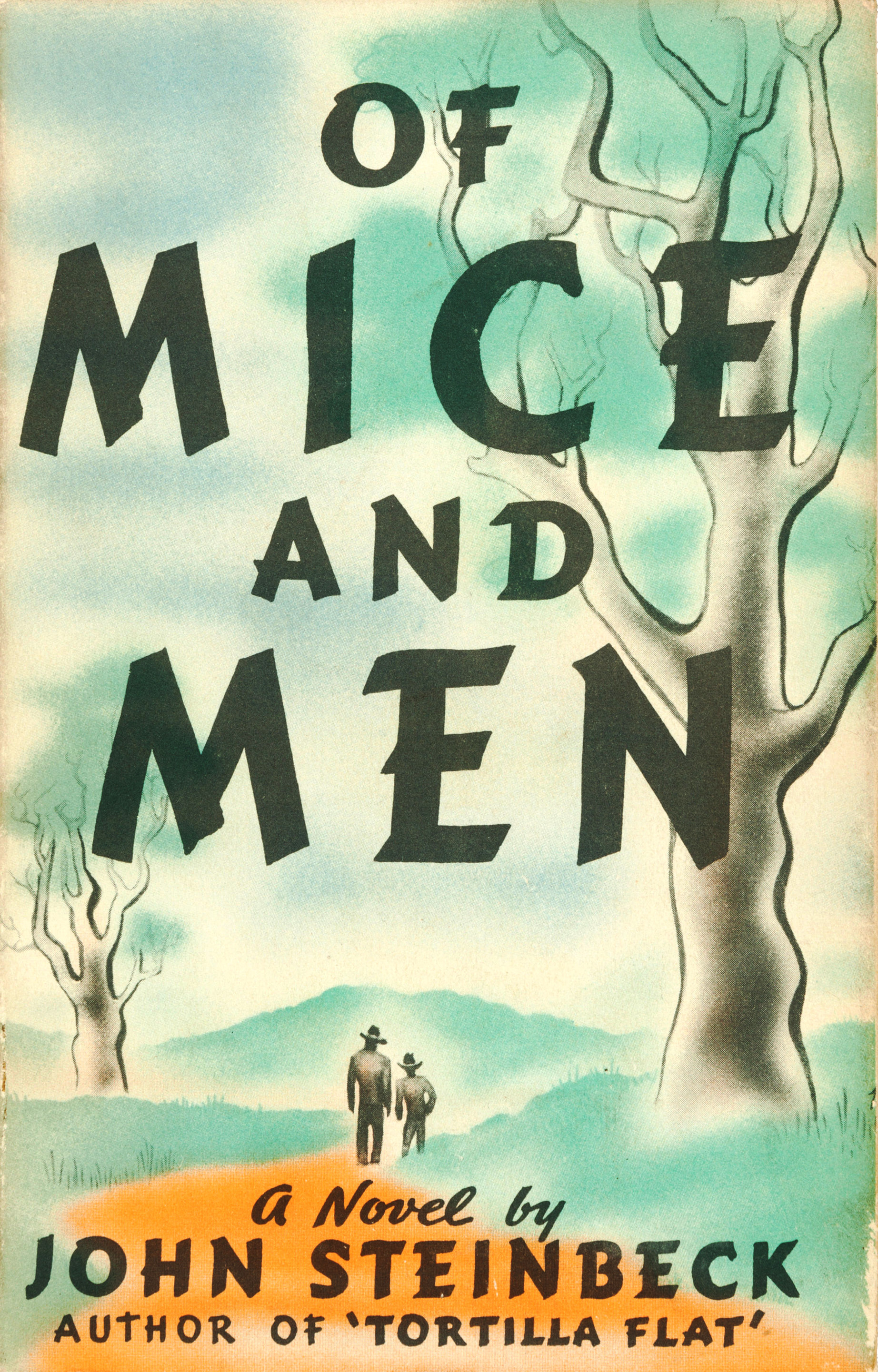
01The tragic story of George and Lennie, who move from one farm to another, looking for work. George is clever but Lennie's size and slowness is always getting him into trouble. One day the two men get a job on a farm. Things are going well until they meet Curley, the farm foreman and his unhappy wife.
§Our take
Steinbeck built this as a play in prose: three acts, two chapters each, every scene in a single location, the whole story compressed into three days. That theatrical skeleton is why it reads like a script and why the 1937 stage version beat Our Town for the Drama Critics' Circle prize. The book has been challenged from both sides for decades — profanity and an anti-business stance in older complaints, racial slurs and stereotypes more recently — and it ranked among the most challenged books of the 2000s. Readers still argue whether Curley's wife is blamed by the narrative or simply by the men around her, and critics have called the book both sentimental and a cold Darwinian fable. Many who hated it as assigned reading find it lands differently as adults. The friendship between George and Lennie remains the anchor; everything else orbits how little the world values it.
§Themes
- Loneliness as the default
- Almost everyone on the ranch is isolated by age, race, gender, or disability; George and Lennie's friendship stands out because the other men travel alone.
- The dream of a farm
- The plan to own a small place and live off the land is the book's version of the American Dream, a promise Depression-era laborers cannot reach through work alone.
- Race and marginalization
- Crooks, the Black stable hand, is barred from the bunkhouse and lives apart; the book shows his bitterness and how quickly others remind him of his lower status.
- Disability and fear
- Lennie's intellectual disability and great strength make others fear him; one critical guide argues that the fear and malice of others provoke the trouble around him.
- Foreshadowing as fate
- Small early incidents with soft animals signal what's coming; Steinbeck's working title framed the story as simply something that happened, nobody's fault.
§How it was received
On release it was the best-reviewed Steinbeck book to date, a Book-of-the-Month Club pick that spent the year near the top of best-seller lists. Contemporary critics praised its understatement and compressed power, though Edmund Wilson read it as a simple survival parable. In the 1930s some dismissed Steinbeck's migrant-labor fiction as leftist propaganda, and in the 1940s some critics re-read it as sentimental; since the 1980s it has settled into a lasting classic, taught widely and particularly successful in Japan and the UK.
§Read it if
- You want a short, dialogue-driven story that reads like a play and finishes in one sitting.
- You value a friendship that feels like the only decent thing in a cruel world.
- You're willing to sit with 1930s dialect and period attitudes to get at the human core.
§Skip it if
- You can't take a bleak, sad ending.
- Dated racial slurs, gender stereotypes, and depictions of intellectual disability will ruin the experience for you.
§Before you start
- Reading experience
- A dialogue-heavy novella you can finish in one sitting, written in 1930s rural dialect that takes a few pages to settle into.
- Content notes
- Frequent period profanity and a racial slur; Violence including a serious fight and deaths of animals and people; Racist treatment of a Black character including a lynching threat; Demeaning attitudes toward women and intellectual disability; References to brothel visits, drinking, and smoking.
§Common questions
- Is Of Mice and Men a novel or a novella?
- It's a novella of roughly 30,000 words, often called a novel because of its impact.
- Why is it so often banned or challenged?
- Challenges have cited profanity, a racial slur, euthanasia themes, anti-business stance, and stereotypes — objections from multiple directions across decades.
- Does the book blame Curley's wife for what happens?
- Readers split: some see the narrative blaming her, others argue it only reflects how the ranch men see her. Teaching guides stress her loneliness as the only woman in an all-male world.
§If you liked this
- The Grapes of Wrath by John Steinbeck — Steinbeck's full-length treatment of Depression-era migrant labor in California; critics re-judged the novella in its light.
- In Dubious Battle by John Steinbeck — The other 1930s Steinbeck novel about farmworkers, focused on a strike instead of two drifters; together the two drew charges of leftist propaganda.
- Winesburg, Ohio by Sherwood Anderson — Anderson's linked stories of lonely small-town lives; a 1937 critic said American fiction hadn't produced its equal since.
Sources
- Wikipedia
- Common Sense Media
- American Library Association
- American Library Association
- New York Drama Critics' Circle
- Steinbeck in the Schools (Center for Steinbeck Studies, San Jose State University)
- Steinbeck in the Schools (Center for Steinbeck Studies, San Jose State University)
- Encyclopedia.com (Novels for Students, Gale)
- LitCharts
- SwissEduc (English reading list)
- Goodreads
Track this book
Add to your library to track progress and write reviews







