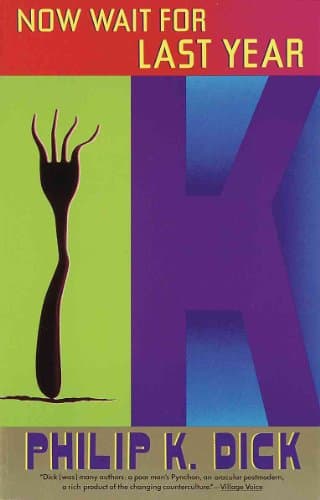
Now Wait for Last Year is a 1966 science fiction novel by American writer Philip K. Dick. It is set in 2055, when Earth is caught between two galactic powers in an interstellar conflict. Dr. Eric Sweetscent and his wife Kathy get addicted to a powerful drug that appears to cause time travel. The doctor's patient is the world leader, UN Secretary General. Of the twenty-eight novels Dick published in the 1960s and 1970s, this novel is one of the five chosen to represent this period of his career in The Library of America series, Volume Two.
Dr. Eric Sweetscent has problems. His planet is enmeshed in an unwinnable war. His wife is lethally addicted to a drug that whips its users helplessly back and forth across time -- and is hell-bent on making Eric suffer along with her. And Sweetscent's newest patient is not only the most important man on the embattled planet Earth but quite possibly the sickest. For Secretary Gino Molinari has turned his mortal illness into an instrument of political policy -- and Eric cannot tell if his job is to make the Male better or to keep him poised just this side of death.Now Wait for Last fear bursts through the envelope between the impossible and the inevitable. Even as ushers us into a future that looks uncannily LIKE the present, it makes the normal seem terrifyingly provisional -- and compels anyone who reads it to wonder if he really knows what time it is.From the Trade Paperback edition.
Now Wait for Last Year is a 1966 science fiction novel by American writer Philip K. Dick. It is set in 2055, when Earth is caught between two galactic powers in an interstellar conflict. Dr. Eric Sweetscent and his wife Kathy get addicted to a powerful drug that appears to cause time travel. The doctor's patient is the world leader, UN Secretary General. Of the twenty-eight novels Dick published in the 1960s and 1970s, this novel is one of the five chosen to represent this period of his career in The Library of America series, Volume Two.
Dr. Eric Sweetscent has problems. His planet is enmeshed in an unwinnable war. His wife is lethally addicted to a drug that whips its users helplessly back and forth across time -- and is hell-bent on making Eric suffer along with her. And Sweetscent's newest patient is not only the most important man on the embattled planet Earth but quite possibly the sickest. For Secretary Gino Molinari has turned his mortal illness into an instrument of political policy -- and Eric cannot tell if his job is to make the Male better or to keep him poised just this side of death.Now Wait for Last fear bursts through the envelope between the impossible and the inevitable. Even as ushers us into a future that looks uncannily LIKE the present, it makes the normal seem terrifyingly provisional -- and compels anyone who reads it to wonder if he really knows what time it is.From the Trade Paperback edition.
Add to your library to track progress and write reviews
Add to your library to track progress and write reviews
Find Now Wait for Last Year Philip K. Dick in PDF, EPUB, ebook, audiobook, print, or library editions.
Find Now Wait for Last Year Philip K. Dick in PDF, EPUB, ebook, audiobook, print, or library editions.

14 books in catalog
Speculative fiction that questions the nature of reality and human identity lies at the heart of iconic science fiction like Do Androids Dream of Electric Sheep? and The Man in the High Castle. Author Philip K. Dick crafted dozens of novels and over a hundred short stories during a career spanning three decades, creating narrative worlds where human perception is routinely altered by technology, authoritarian states, or psychological illusion.
Born in Chicago on December 16, 1928, Philip Kindred Dick lived most of his life in California. Before committing full-time to writing, he worked briefly in radio broadcasting and attended the University of California, Berkeley for one year. His professional publishing career launched in 1952 with the short story "Beyond Lies the Wub." Over the following thirty years, Dick maintained an extraordinary output, publishing regularly in science fiction magazines and completing dozens of novels prior to his death in Santa Ana, California, on March 2, 1982.
Throughout his career, Dick explored complex sociological, political, and metaphysical themes. His narratives frequently center on ordinary characters trapped in illusory environments, struggling against monopolistic corporations, oppressive government regimes, and altered states of consciousness. In his later years, his thematic focus shifted heavily toward theology and metaphysics, strongly reflecting his personal experiences with paranoia, drug abuse, schizophrenia, and transcendental visions. These deeply personal struggles directly informed semi-autobiographical works such as A Scanner Darkly and VALIS.
14 books in catalog
Speculative fiction that questions the nature of reality and human identity lies at the heart of iconic science fiction like Do Androids Dream of Electric Sheep? and The Man in the High Castle. Author Philip K. Dick crafted dozens of novels and over a hundred short stories during a career spanning three decades, creating narrative worlds where human perception is routinely altered by technology, authoritarian states, or psychological illusion.
Born in Chicago on December 16, 1928, Philip Kindred Dick lived most of his life in California. Before committing full-time to writing, he worked briefly in radio broadcasting and attended the University of California, Berkeley for one year. His professional publishing career launched in 1952 with the short story "Beyond Lies the Wub." Over the following thirty years, Dick maintained an extraordinary output, publishing regularly in science fiction magazines and completing dozens of novels prior to his death in Santa Ana, California, on March 2, 1982.
Throughout his career, Dick explored complex sociological, political, and metaphysical themes. His narratives frequently center on ordinary characters trapped in illusory environments, struggling against monopolistic corporations, oppressive government regimes, and altered states of consciousness. In his later years, his thematic focus shifted heavily toward theology and metaphysics, strongly reflecting his personal experiences with paranoia, drug abuse, schizophrenia, and transcendental visions. These deeply personal struggles directly informed semi-autobiographical works such as A Scanner Darkly and VALIS.