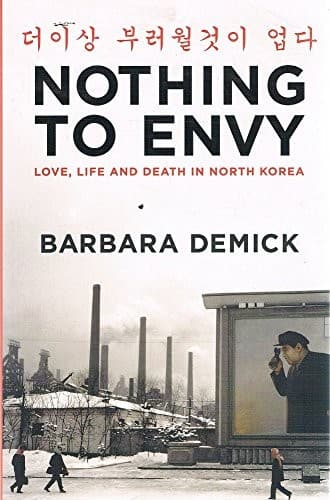
Follows the lives of six North Koreans over fifteen years, a chaotic period that saw the rise to power of Kim Jong Il and the devastation of a famine that killed one-fifth of the population, illustrating what it means to live under the most repressive totalitarian regime today.
Follows the lives of six North Koreans over fifteen years, a chaotic period that saw the rise to power of Kim Jong Il and the devastation of a famine that killed one-fifth of the population, illustrating what it means to live under the most repressive totalitarian regime today.
Add to your library to track progress and write reviews
Add to your library to track progress and write reviews
Find Nothing to Envy: Real Lives in North Korea Barbara Demick in PDF, EPUB, ebook, audiobook, print, or library editions.
Find Nothing to Envy: Real Lives in North Korea Barbara Demick in PDF, EPUB, ebook, audiobook, print, or library editions.
1 books in catalog
Narrative nonfiction focusing on closed regimes and war-torn regions offers readers unprecedented insight into daily survival under extreme conditions. Journalist Barbara Demick achieved widespread recognition for her deep human-centered reporting on totalitarian societies, particularly in her acclaimed book Nothing to Envy: Real Lives in North Korea. By recording the detailed personal histories of ordinary citizens, her work bridges the gap between high-level geopolitical conflicts and the lived experiences of individuals.
Demick grew up in Ridgewood, New Jersey, and earned a bachelor's degree in economic history from Yale College. She began her journalism career reporting on Wall Street, Washington, and the Middle East for The Philadelphia Inquirer. In 1993, she became a foreign correspondent in Eastern Europe, where she spent years reporting on the Bosnian War while living in Sarajevo. In 2001, she joined The Los Angeles Times, serving as bureau chief in Seoul, Beijing, and New York. During her fifteen years with the paper, she interviewed North Korean defectors and documented life across East Asia, later receiving a Cullman Fellowship at the New York Public Library.
Demick's reporting style relies on immersive, character-driven storytelling that reconstructs the daily lives of people living through political catastrophe, war, and oppression. Rather than focusing solely on political leaders or abstract state policy, she traces the choices, relationships, and survival strategies of ordinary citizens in closed or conflicted environments such as North Korea, wartime Bosnia, and Tibet. Her work frequently explores themes of human rights, propaganda, economic scarcity, state control, and individual resilience, turning complex historical and geopolitical crises into deeply personal narratives.
1 books in catalog
Narrative nonfiction focusing on closed regimes and war-torn regions offers readers unprecedented insight into daily survival under extreme conditions. Journalist Barbara Demick achieved widespread recognition for her deep human-centered reporting on totalitarian societies, particularly in her acclaimed book Nothing to Envy: Real Lives in North Korea. By recording the detailed personal histories of ordinary citizens, her work bridges the gap between high-level geopolitical conflicts and the lived experiences of individuals.
Demick grew up in Ridgewood, New Jersey, and earned a bachelor's degree in economic history from Yale College. She began her journalism career reporting on Wall Street, Washington, and the Middle East for The Philadelphia Inquirer. In 1993, she became a foreign correspondent in Eastern Europe, where she spent years reporting on the Bosnian War while living in Sarajevo. In 2001, she joined The Los Angeles Times, serving as bureau chief in Seoul, Beijing, and New York. During her fifteen years with the paper, she interviewed North Korean defectors and documented life across East Asia, later receiving a Cullman Fellowship at the New York Public Library.
Demick's reporting style relies on immersive, character-driven storytelling that reconstructs the daily lives of people living through political catastrophe, war, and oppression. Rather than focusing solely on political leaders or abstract state policy, she traces the choices, relationships, and survival strategies of ordinary citizens in closed or conflicted environments such as North Korea, wartime Bosnia, and Tibet. Her work frequently explores themes of human rights, propaganda, economic scarcity, state control, and individual resilience, turning complex historical and geopolitical crises into deeply personal narratives.