

"She described the sessions in a journal she created for her husband, John Gregory Dunne.
For several months, Didion recorded conversations with the psychiatrist in meticulous detail. The initial sessions focused on alcoholism, adoption, depression, anxiety, guilt, and the heartbreaking complexities of her relationship with her daughter, Quintana. The subjects evolved to include her work, which she was finding difficult to maintain for sustained periods. There were discussions about her own childhood—misunderstandings and lack of communication with her mother and father, her early tendency to anticipate catastrophe—and the question of legacy, or, as she put it, “what it’s been worth.” The analysis would continue for more than a decade.
Didion’s journal was crafted with the singular intelligence, precision, and elegance that characterize all of her writing. It is an unprecedentededly intimate account that reveals sides of her that were unknown, but the voice is unmistakably hers—questioning, courageous, and clear in the face of a wrenchingly painful journey."-- Provided by Amazon
"She described the sessions in a journal she created for her husband, John Gregory Dunne.
For several months, Didion recorded conversations with the psychiatrist in meticulous detail. The initial sessions focused on alcoholism, adoption, depression, anxiety, guilt, and the heartbreaking complexities of her relationship with her daughter, Quintana. The subjects evolved to include her work, which she was finding difficult to maintain for sustained periods. There were discussions about her own childhood—misunderstandings and lack of communication with her mother and father, her early tendency to anticipate catastrophe—and the question of legacy, or, as she put it, “what it’s been worth.” The analysis would continue for more than a decade.
Didion’s journal was crafted with the singular intelligence, precision, and elegance that characterize all of her writing. It is an unprecedentededly intimate account that reveals sides of her that were unknown, but the voice is unmistakably hers—questioning, courageous, and clear in the face of a wrenchingly painful journey."-- Provided by Amazon
Add to your library to track progress and write reviews
Find Notes to John Joan Didion in PDF, EPUB, ebook, audiobook, print, or library editions.
3 books in catalog
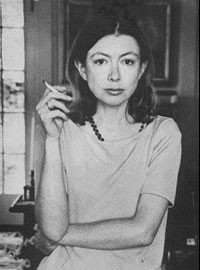
Literary journalism and essay writing were reshaped in the late twentieth century by reporting that captured the moral disintegration and cultural chaos of American life, notably in the essay collection Slouching Towards Bethlehem. Joan Didion established her reputation as a leading figure in the New Journalism movement, crafting incisive prose that examined personal experiences alongside broader social unrest and psychological fragmentation.
Born in Sacramento, California, in 1934, Didion grew up in the American West and spent several childhood years moving across the country due to her father's service in the Army Air Corps. She attended the University of California, Berkeley, earning a Bachelor of Arts in English in 1956. After winning an essay contest during her senior year, she relocated to New York City to write for Vogue. Over the following decades, she contributed articles, essays, and columns to publications such as Mademoiselle, Life, The Saturday Evening Post, National Review, and Esquire, co-writing magazine columns with her husband, writer John Gregory Dunne, whom she married in 1964.
Throughout a career spanning more than five decades, Didion produced five novels, five screenplays, and thirteen non-fiction books that encompassed personal essays, memoirs, cultural criticism, and political reportage. She lived and worked in both California and New York City, drawing heavily on her Western roots and personal history to analyze regional identity and national politics. She received the National Book Award for Nonfiction for her 2005 memoir and was named a finalist for the Pulitzer Prize, continuing her literary and journalistic work until her death in New York City in 2021 at the age of 87.
Didion's writing is characterized by a lucid, highly disciplined prose style that pairs precise observational detail with an underlying sense of anxiety and dread. Her central thematic focus remains the breakdown of social structures, the instability of narrative order, and the disintegration of traditional American morals and cultural norms. Whether covering counterculture movements in California, political turmoil abroad, or personal grief, her essays and fiction examine how individuals attempt to construct meaning within chaotic or fragmented environments.
3 books in catalog
Literary journalism and essay writing were reshaped in the late twentieth century by reporting that captured the moral disintegration and cultural chaos of American life, notably in the essay collection Slouching Towards Bethlehem. Joan Didion established her reputation as a leading figure in the New Journalism movement, crafting incisive prose that examined personal experiences alongside broader social unrest and psychological fragmentation.
Born in Sacramento, California, in 1934, Didion grew up in the American West and spent several childhood years moving across the country due to her father's service in the Army Air Corps. She attended the University of California, Berkeley, earning a Bachelor of Arts in English in 1956. After winning an essay contest during her senior year, she relocated to New York City to write for Vogue. Over the following decades, she contributed articles, essays, and columns to publications such as Mademoiselle, Life, The Saturday Evening Post, National Review, and Esquire, co-writing magazine columns with her husband, writer John Gregory Dunne, whom she married in 1964.
Throughout a career spanning more than five decades, Didion produced five novels, five screenplays, and thirteen non-fiction books that encompassed personal essays, memoirs, cultural criticism, and political reportage. She lived and worked in both California and New York City, drawing heavily on her Western roots and personal history to analyze regional identity and national politics. She received the National Book Award for Nonfiction for her 2005 memoir and was named a finalist for the Pulitzer Prize, continuing her literary and journalistic work until her death in New York City in 2021 at the age of 87.
Didion's writing is characterized by a lucid, highly disciplined prose style that pairs precise observational detail with an underlying sense of anxiety and dread. Her central thematic focus remains the breakdown of social structures, the instability of narrative order, and the disintegration of traditional American morals and cultural norms. Whether covering counterculture movements in California, political turmoil abroad, or personal grief, her essays and fiction examine how individuals attempt to construct meaning within chaotic or fragmented environments.