Rigorous hard science fiction centered on mathematical physics, quantum ontology, and digital consciousness defines a major body of late-twentieth and twenty-first-century speculative literature. Greg Egan, an Australian science fiction writer and mathematician, has earned widespread critical acclaim for intellectually demanding novels such as Permutation City and Diaspora, which explore the fundamental physics of reality and simulated human minds.
Career & Background
Born on August 20, 1961, in Perth, Western Australia, Gregory Mark Egan earned a Bachelor of Science in Mathematics from the University of Western Australia. He subsequently worked as a computer programmer while publishing speculative fiction. His debut novel, An Unusual Angle, appeared in 1983, followed by his first genre short story, "Artifact," in the same year. Over a career starting in the 1980s, Egan emerged as a premier author of hard science fiction, winning prestigious honours such as the Hugo Award, the John W. Campbell Memorial Award, and the Locus Award.
Writing Style & Themes
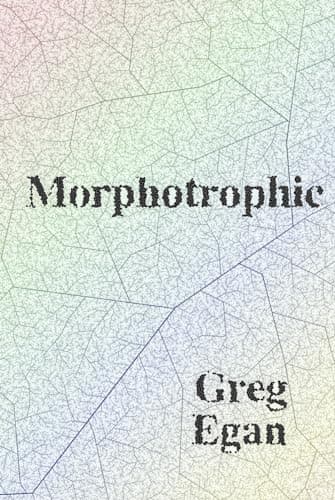
Egan's writing focuses on rigorous hard science fiction, incorporating sophisticated concepts from mathematics, theoretical physics, biology, cybernetics, and artificial intelligence. His narratives frequently investigate quantum ontology, mind transfer, simulated reality, posthumanism, genetics, and the philosophical implications of rational naturalism. Although third-party bibliographies sometimes group certain novels into a sequence called "The Subjective Cosmology Cycle," Egan clarified that those books share thematic similarities noticed in retrospect rather than an intentional series. Alongside full-length novels like Morphotrophic, Egan creates applets, science articles, and mathematical notes on his personal website to supplement his fiction.
Major Works
- Permutation City — This Hugo Award and John W. Campbell Memorial Award-winning novel explores simulated reality, virtual universes, and digital copies of human consciousness attempting to build self-sustaining existence.
- Diaspora — Set in a future where humanity has diverged into digital polises, genetically engineered biological beings, and robots, this hard science fiction novel examines posthumanism and higher-dimensional physics.
- Morphotrophic — A speculative science fiction novel that continues Egan's rigorous exploration of biological, physical, and technological transformations.