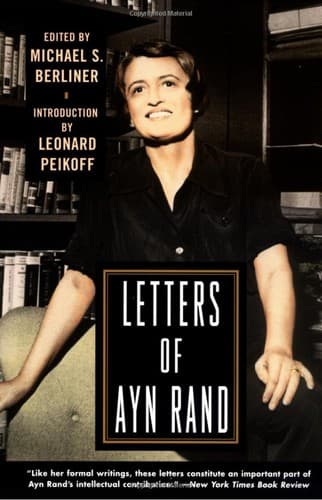
BooksLetters of Ayn Rand

These remarkable letters cover more than fifty-five years of Ayn Rand's extraordinary life, work, and thought. They begin in 1926, with a note from the twenty-year-old Ayn Rand newly arrived in Chicago from Soviet Russia, an impoverished unknown determined to realize the promise of a land of opportunity.
They move through her struggles and successes as a screenwriter, a playwright, and a novelist, her sensational triumph as the author of The Fountainhead and Atlas Shrugged, and her eminence as founder and shaper of Objectivism, one of the most challenging and important philosophies of our time. They are written to such famed contemporaries as Cecil B. DeMille, Frank Lloyd Wright, H. L. Mencken, Alexander Kerensky, Barry Goldwater, and Mickey Spillane. There are letters to philosophers, priests, publishers, and political columnists; to her beloved husband, Frank O'Connor; to her intimate circle of friends and her growing legion of followers; and to the readers who sent her their questions about and appreciations of her work, and were rewarded with letters of wisdom, sympathy, and brilliance.
Her letters range in tone from warm affection to icy fury, and in content from telling commentaries on the events of the day to unforgettably eloquent statements of her philosophical ideas.
These remarkable letters cover more than fifty-five years of Ayn Rand's extraordinary life, work, and thought. They begin in 1926, with a note from the twenty-year-old Ayn Rand newly arrived in Chicago from Soviet Russia, an impoverished unknown determined to realize the promise of a land of opportunity.
They move through her struggles and successes as a screenwriter, a playwright, and a novelist, her sensational triumph as the author of The Fountainhead and Atlas Shrugged, and her eminence as founder and shaper of Objectivism, one of the most challenging and important philosophies of our time. They are written to such famed contemporaries as Cecil B. DeMille, Frank Lloyd Wright, H. L. Mencken, Alexander Kerensky, Barry Goldwater, and Mickey Spillane. There are letters to philosophers, priests, publishers, and political columnists; to her beloved husband, Frank O'Connor; to her intimate circle of friends and her growing legion of followers; and to the readers who sent her their questions about and appreciations of her work, and were rewarded with letters of wisdom, sympathy, and brilliance.
Her letters range in tone from warm affection to icy fury, and in content from telling commentaries on the events of the day to unforgettably eloquent statements of her philosophical ideas.
Add to your library to track progress and write reviews
Add to your library to track progress and write reviews
Find Letters of Ayn Rand Ayn Rand in PDF, EPUB, ebook, audiobook, print, or library editions.
Find Letters of Ayn Rand Ayn Rand in PDF, EPUB, ebook, audiobook, print, or library editions.

4 books in catalog
Philosophical fiction set in dystopian or industrial landscapes often explores the conflict between individual freedom and state control, most prominently exemplified by the 1957 novel Atlas Shrugged. Author and philosopher Ayn Rand built a distinct literary and intellectual reputation around this central tension, combining dramatic narrative with explicit ideological discourse.
Born Alisa Zinovyevna Rosenbaum in St. Petersburg, Russia, Rand developed a philosophical system she named Objectivism, which advocated for reason, individualism, and laissez-faire capitalism while explicitly rejecting religion, altruism, and collectivism.
Born in 1905, Rand lived through the Russian Revolution of 1917, during which her family moved to Crimea. After graduating from university in Russia, she immigrated to the United States in 1926 to pursue screenwriting and fiction in Hollywood. After early works including We the Living (1936) and two Broadway plays, Rand achieved major commercial recognition with The fountainhead in 1943. Following the publication of Atlas Shrugged in 1957, she turned to writing non-fiction, delivering lectures, and teaching courses on Objectivism until her death in 1982. Her personal correspondence and collected writings were later published in volumes such as Letters of Ayn Rand.
Rand's fiction features heroic, highly principled protagonists—such as architects, inventors, and industrialists—who stand in opposition to collectivist societal pressure. Her narrative works serve as vehicles for Objectivism, placing primary emphasis on empirical reason, individual self-interest, and ethical self-realization in the Aristotelian tradition. While her novels achieved significant commercial success and continue to influence conservative and libertarian thinkers, her fiction received mixed critical reception, and her philosophical work was largely dismissed by academic philosophers.
4 books in catalog
Philosophical fiction set in dystopian or industrial landscapes often explores the conflict between individual freedom and state control, most prominently exemplified by the 1957 novel Atlas Shrugged. Author and philosopher Ayn Rand built a distinct literary and intellectual reputation around this central tension, combining dramatic narrative with explicit ideological discourse.
Born Alisa Zinovyevna Rosenbaum in St. Petersburg, Russia, Rand developed a philosophical system she named Objectivism, which advocated for reason, individualism, and laissez-faire capitalism while explicitly rejecting religion, altruism, and collectivism.
Born in 1905, Rand lived through the Russian Revolution of 1917, during which her family moved to Crimea. After graduating from university in Russia, she immigrated to the United States in 1926 to pursue screenwriting and fiction in Hollywood. After early works including We the Living (1936) and two Broadway plays, Rand achieved major commercial recognition with The fountainhead in 1943. Following the publication of Atlas Shrugged in 1957, she turned to writing non-fiction, delivering lectures, and teaching courses on Objectivism until her death in 1982. Her personal correspondence and collected writings were later published in volumes such as Letters of Ayn Rand.
Rand's fiction features heroic, highly principled protagonists—such as architects, inventors, and industrialists—who stand in opposition to collectivist societal pressure. Her narrative works serve as vehicles for Objectivism, placing primary emphasis on empirical reason, individual self-interest, and ethical self-realization in the Aristotelian tradition. While her novels achieved significant commercial success and continue to influence conservative and libertarian thinkers, her fiction received mixed critical reception, and her philosophical work was largely dismissed by academic philosophers.