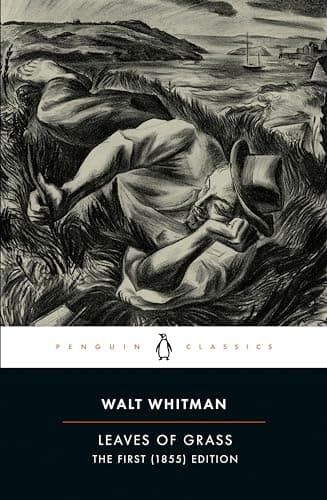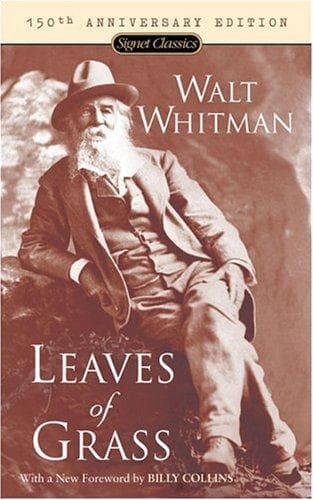
Leaves of Grass is a poetry collection by American poet Walt Whitman. First published in 1855, Whitman spent most of his professional life writing and rewriting Leaves of Grass, revising it multiple times until his death. There have been held to be either six or nine individual editions of Leaves of Grass, the count varying depending on how they are distinguished. This resulted in vastly different editions over four decades—the first edition being a small book of twelve poems, and the last, a compilation of over 400.
Leaves of Grass is a poetry collection by American poet Walt Whitman. First published in 1855, Whitman spent most of his professional life writing and rewriting Leaves of Grass, revising it multiple times until his death. There have been held to be either six or nine individual editions of Leaves of Grass, the count varying depending on how they are distinguished. This resulted in vastly different editions over four decades—the first edition being a small book of twelve poems, and the last, a compilation of over 400.
Add to your library to track progress and write reviews
Add to your library to track progress and write reviews
Find Leaves of Grass Walt Whitman in PDF, EPUB, ebook, audiobook, print, or library editions.
Find Leaves of Grass Walt Whitman in PDF, EPUB, ebook, audiobook, print, or library editions.

1 books in catalog
American poetry underwent a profound transformation with the 1855 publication of a self-published volume that discarded traditional meter and rhyme to capture the expansive spirit of democratic life. Walt Whitman introduced a distinctly personal yet sweeping poetic voice that embraced physical experience, natural landscapes, and the everyday reality of ordinary working people. His landmark volume, including the foundational text presented in Leaves of Grass: The First (1855) Edition, established a new vernacular for verse that broke sharply from European literary conventions.
Born on May 31, 1819, in West Hills, Long Island, Whitman grew up in Brooklyn, New York, as the second of eight surviving children in a working-class family. He left formal schooling around age eleven to help support his family, working as an office boy before serving an apprenticeship as a newspaper printer. Whitman subsequently worked as a journalist, essayist, editor, printer, and schoolteacher across Long Island and New York City, immersing himself in urban culture while voraciously self-educating through the works of Shakespeare, Dante, Homer, and the Bible.
During the American Civil War, Whitman traveled to Washington, D.C., where he spent years working as a volunteer nurse caring for wounded soldiers in military hospitals. His direct encounters with injured troops and the devastation of war deeply informed his prose writings and subsequent poetry collections. Whitman remained a dedicated journalist and humanist throughout his life, continuing to refine his central poetic masterwork through numerous revised editions until his death on March 26, 1892, in Camden, New Jersey.
Whitman was a pivotal figure in the transition between Transcendentalism and realism, incorporating both philosophical perspectives into his verse and prose. Often called the father of free verse, he relied on sprawling cadences, cataloging techniques, and open-ended rhythms rather than strict metric form to echo the natural patterns of human speech. His writing celebrated democracy, nature, physical love, comradeship, and human equality while maintaining an uninhibited portrayal of human sensuality and the body.
Because of its frank depiction of sexuality, Whitman's work was highly controversial in its time. Early critics frequently denounced his poetry collection Leaves of Grass as obscene for its overt sexuality. Despite this hostility, his innovative stylistic techniques and expansive vision established him as one of the most influential poets in American literature, inspiring generations of subsequent writers.
1 books in catalog
American poetry underwent a profound transformation with the 1855 publication of a self-published volume that discarded traditional meter and rhyme to capture the expansive spirit of democratic life. Walt Whitman introduced a distinctly personal yet sweeping poetic voice that embraced physical experience, natural landscapes, and the everyday reality of ordinary working people. His landmark volume, including the foundational text presented in Leaves of Grass: The First (1855) Edition, established a new vernacular for verse that broke sharply from European literary conventions.
Born on May 31, 1819, in West Hills, Long Island, Whitman grew up in Brooklyn, New York, as the second of eight surviving children in a working-class family. He left formal schooling around age eleven to help support his family, working as an office boy before serving an apprenticeship as a newspaper printer. Whitman subsequently worked as a journalist, essayist, editor, printer, and schoolteacher across Long Island and New York City, immersing himself in urban culture while voraciously self-educating through the works of Shakespeare, Dante, Homer, and the Bible.
During the American Civil War, Whitman traveled to Washington, D.C., where he spent years working as a volunteer nurse caring for wounded soldiers in military hospitals. His direct encounters with injured troops and the devastation of war deeply informed his prose writings and subsequent poetry collections. Whitman remained a dedicated journalist and humanist throughout his life, continuing to refine his central poetic masterwork through numerous revised editions until his death on March 26, 1892, in Camden, New Jersey.
Whitman was a pivotal figure in the transition between Transcendentalism and realism, incorporating both philosophical perspectives into his verse and prose. Often called the father of free verse, he relied on sprawling cadences, cataloging techniques, and open-ended rhythms rather than strict metric form to echo the natural patterns of human speech. His writing celebrated democracy, nature, physical love, comradeship, and human equality while maintaining an uninhibited portrayal of human sensuality and the body.
Because of its frank depiction of sexuality, Whitman's work was highly controversial in its time. Early critics frequently denounced his poetry collection Leaves of Grass as obscene for its overt sexuality. Despite this hostility, his innovative stylistic techniques and expansive vision established him as one of the most influential poets in American literature, inspiring generations of subsequent writers.