BooksLand: A Novel
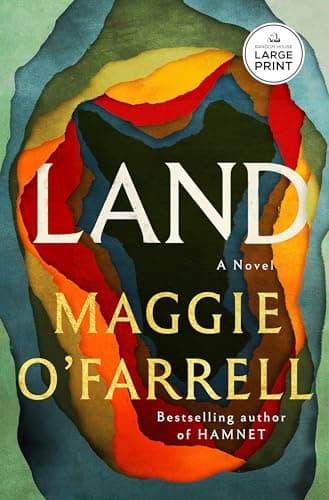
On a windswept peninsula stretching out into the Atlantic, Tomás and his reluctant son, Liam, are working for the great Ordnance Survey project to map the whole of Ireland. The year is 1865, and in a country not long since ravaged and emptied by the Great Hunger, the task is not an easy one. Tomás, however, is determined that his maps will be a record of the disaster.
The British soldiers in charge are due to arrive any day, expecting the work to be completed, but Tomás is unexpectedly sent off course by an unsettling encounter in a copse. His life, and the lives of those of his family, will never be the same again. Liam is terrified by the sudden change in his taciturn father. What was it that caused such cracks to open in Tomás, and how is Liam, aged only ten, going to finish the mapping and get them both home?
Land is a novel about separation and reunion, tragedy and recovery, colonization and rebellion. It is a story of buried treasure, overlapping lives, ancient woodland, persistent ghosts, a particularly loyal dog, and how, when it comes to both land and history, nothing ever goes away. As spellbinding and varied as the landscape that inspired it, Land is, above all, a story of survival, for our times and for all time.
Add to your library to track progress and write reviews
Find Land: A Novel Maggie O'Farrell in PDF, EPUB, ebook, audiobook, print, or library editions.

3 books in catalog
Literary fiction and historical reimagining are brought into vivid focus through emotionally nuanced narratives that examine memory, grief, family bonds, and lost lives. The award-winning 2020 novel Hamnet reimagines the grief surrounding the death of William Shakespeare's young son from bubonic plague and the domestic world of his wife Agnes, bringing intimate human depth to historical tragedy.
Maggie O'Farrell, an Irish-British novelist born in Northern Ireland, has built an acclaimed body of work spanning contemporary fiction, historical narratives, and personal memoirs. Her books frequently re-center overlooked personal histories, exploring how sudden loss, secrets, and physical vulnerability shape human relationships across generations.
Born in Northern Ireland in 1972, Maggie O'Farrell spent her childhood moving with her family to Bridgend, Wales, and later to Scotland. At the age of eight, a severe illness with encephalitis resulted in a long period of hospitalization and recovery away from school, during which she immersed herself deeply in literature. She went on to study English literature at Cambridge University and worked as a journalist, including serving as a literary editor at the Independent on Sunday, before devoting herself full-time to fiction. Her debut novel, After You'd Gone, earned the Betty Trask Award, establishing her career early on.
Over the following two decades, O'Farrell published a steady sequence of widely praised books. Her novel The Distance Between Us received a Somerset Maugham Award, and The Hand That First Held Mine won the 2010 Costa Novel Award. She received subsequent Costa nominations for Instructions for a Heatwave and This Must Be The Place. In 2017, she published the Sunday Times bestselling memoir I Am, I Am, I Am: Seventeen Brushes with Death, which detailed her personal experiences with mortality and illness. Her work on Hamnet achieved massive international success and awards, culminating in a theatrical stage version and a feature film adaptation co-written with director Chloé Zhao. O'Farrell is a Fellow of the Royal Society of Literature.
O'Farrell's fiction is distinguished by intricate multi-strand structures, precise emotional observation, and a persistent focus on domestic secrecy, family dynamics, and physical frailty. Her narratives often shift fluidly across timelines and perspectives to reveal how past events ripple through family generations. Whether examining mid-century London, contemporary Ireland, or Renaissance England, her prose emphasizes sensory detail and psychological realism while confronting themes of bereavement, madness, and identity.
Her recent historical fiction and upcoming work demonstrate a meticulous engagement with research and setting. In works such as Land: A Novel, O'Farrell explores themes of cartography and place, drawing inspiration from her own ancestral heritage after discovering her great-great grandfather was an Irish cartographer. Across both fiction and non-fiction, her writing balances quiet personal drama with broad thematic resonance.