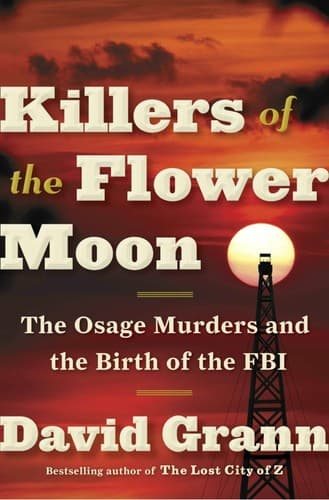
In the 1920s, the richest people per capita in the world were members of the Osage Nation in Oklahoma. After oil was discovered beneath their land, the Osage rode in chauffeured automobiles, built mansions, and sent their children to study in Europe.
Then, one by one, the Osage began to be killed off. The family of an Osage woman, Mollie Burkhart, became a prime target. One of her relatives was shot. Another was poisoned. And it was just the beginning, as more and more Osage were dying under mysterious circumstances, and many of those who dared to investigate the killings were themselves murdered.
As the death toll rose, the newly created FBI took up the case, and the young director, J. Edgar Hoover, turned to a former Texas Ranger named Tom White to try to unravel the mystery. White put together an undercover team, including a Native American agent who infiltrated the region, and together with the Osage began to expose one of the most chilling conspiracies in American history.
Add to your library to track progress and write reviews

2 books in catalog
Investigative narrative nonfiction often reconstructs forgotten historical tragedies and complex real-life mysteries through exhaustive archival research and field reporting. David Grann, a #1 New York Times bestselling author and award-winning staff writer at The New Yorker magazine, has earned wide recognition for turning historical investigations into rigorous non-fiction narratives, most notably with Killers of the Flower Moon: The Osage Murders and the Birth of the FBI.
Born David Elliot Grann on March 10, 1967, he earned a bachelor's degree from Connecticut College and a master's degree from The Fletcher School at Tufts University in 1992. Before becoming a full-time author and long-form magazine journalist, Grann contributed articles to several national publications, including The New York Times Magazine and The Atlantic. In 2003, he joined the staff of The New Yorker, where his complex investigative reporting earned accolades such as the George Polk Award.
Grann's non-fiction is defined by painstaking archival research, forensic attention to historical records, and a recurring focus on human obsession, true crime, and survival under extreme conditions. His work frequently uncovers systemic injustice and cold cases where greed or extreme ambition led to tragic consequences. Despite a degenerative eye condition that severely limits his eyesight, Grann conducts immersive field research, traveling to remote settings like the South American rainforest to verify historical details firsthand.