The Hitchhiker's Guide to the Galaxy
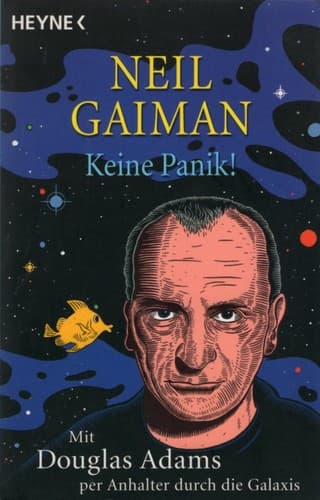
Keine Panik!: mit Douglas Adams per Anhalter durch die Galaxis,
by Neil Gaiman, David K. Dickson, M.J. Simpson, Gerald Jung, Ralf Schmitz
by Neil Gaiman, David K. Dickson, M.J. Simpson, Gerald Jung, Ralf Schmitz
by Neil Gaiman, David K. Dickson, M.J. Simpson, Gerald Jung, Ralf Schmitz
In 1971, a young man lay in a field in Innsbruck, Austria, staring up at the stars with a borrowed copy of a hitchhiker’s guide to Europe and a mind slightly clouded by local beer. In that moment of cosmic insignificance, an idea took root: someone should write a guide for the people traveling through the galaxy instead. Neil Gaiman tracks the erratic, often frantic trajectory of Douglas Adams from this initial spark through the technical and bureaucratic hurdles of 1970s British media. It is an exploration of how a writer plagued by chronic procrastination and a penchant for bathrobes managed to construct a universe held together by sheer absurdity and the occasional digital watch.
The narrative functions as an archaeological dig into the creative process, documenting the volatile transition of "The Hitchhiker's Guide to the Galaxy" from a late-night radio pitch to a multimedia juggernaut. Gaiman examines the specific, idiosyncratic philosophy that allowed Adams to find humor in the total destruction of Earth and the logistical nightmare of bringing such a vision to life. Rather than a formal, distant biography, the text operates as a mechanical breakdown of a cultural phenomenon, focusing on the friction between a creator’s imagination and the rigid structures of the BBC.
The setting of this account is not the far reaches of space, but the cramped recording studios and smoke-filled offices of the BBC in the late 1970s. Gaiman illustrates an era where science fiction was often viewed with skepticism and radio was the primary laboratory for avant-garde comedy. The "rules" of this world are governed by tight budgets, primitive sound-engineering techniques, and the peculiar creative culture of British comedy troupes. The atmosphere is one of organized chaos, where the sonic landscape of a galaxy had to be invented from scratch using analog synthesizers and everyday objects.
The focus remains on Adams’ initial professional development—a period defined by "professional and personal disorientation." Gaiman details the struggle of a man who loved the idea of writing but famously hated the act itself. The early arc focuses on the dynamic between Adams and his own mounting success; as the radio show gains a cult following, the pressure to adapt the material into novels and television creates a feedback loop of stress and brilliance. The central relationship is not between people, but between Adams and his ever-expanding universe, which he often felt was running away from him.
Gaiman subverts the traditional "cradle-to-grave" biography by leaning into the anecdotal and the technical. While many biographies focus on the private psyche, this work focuses on the evolution of the work itself. It utilizes the trope of the "Unauthorized Guide" but legitimizes it with deep archival access. By mirroring some of Adams’ own digressive and conversational style, Gaiman avoids the dry, chronological stagnation typical of the genre. The book treats the creation of a fictional world as a series of fortunate accidents and hard-fought battles against deadlines, stripping away the myth of the "effortless genius" to reveal the messy, human mechanics underneath.
In 1971, a young man lay in a field in Innsbruck, Austria, staring up at the stars with a borrowed copy of a hitchhiker’s guide to Europe and a mind slightly clouded by local beer. In that moment of cosmic insignificance, an idea took root: someone should write a guide for the people traveling through the galaxy instead. Neil Gaiman tracks the erratic, often frantic trajectory of Douglas Adams from this initial spark through the technical and bureaucratic hurdles of 1970s British media. It is an exploration of how a writer plagued by chronic procrastination and a penchant for bathrobes managed to construct a universe held together by sheer absurdity and the occasional digital watch.
The narrative functions as an archaeological dig into the creative process, documenting the volatile transition of "The Hitchhiker's Guide to the Galaxy" from a late-night radio pitch to a multimedia juggernaut. Gaiman examines the specific, idiosyncratic philosophy that allowed Adams to find humor in the total destruction of Earth and the logistical nightmare of bringing such a vision to life. Rather than a formal, distant biography, the text operates as a mechanical breakdown of a cultural phenomenon, focusing on the friction between a creator’s imagination and the rigid structures of the BBC.
The setting of this account is not the far reaches of space, but the cramped recording studios and smoke-filled offices of the BBC in the late 1970s. Gaiman illustrates an era where science fiction was often viewed with skepticism and radio was the primary laboratory for avant-garde comedy. The "rules" of this world are governed by tight budgets, primitive sound-engineering techniques, and the peculiar creative culture of British comedy troupes. The atmosphere is one of organized chaos, where the sonic landscape of a galaxy had to be invented from scratch using analog synthesizers and everyday objects.
The focus remains on Adams’ initial professional development—a period defined by "professional and personal disorientation." Gaiman details the struggle of a man who loved the idea of writing but famously hated the act itself. The early arc focuses on the dynamic between Adams and his own mounting success; as the radio show gains a cult following, the pressure to adapt the material into novels and television creates a feedback loop of stress and brilliance. The central relationship is not between people, but between Adams and his ever-expanding universe, which he often felt was running away from him.
Gaiman subverts the traditional "cradle-to-grave" biography by leaning into the anecdotal and the technical. While many biographies focus on the private psyche, this work focuses on the evolution of the work itself. It utilizes the trope of the "Unauthorized Guide" but legitimizes it with deep archival access. By mirroring some of Adams’ own digressive and conversational style, Gaiman avoids the dry, chronological stagnation typical of the genre. The book treats the creation of a fictional world as a series of fortunate accidents and hard-fought battles against deadlines, stripping away the myth of the "effortless genius" to reveal the messy, human mechanics underneath.
Add to your library to track progress and write reviews
Add to your library to track progress and write reviews

44 books in catalog
Groundbreaking dark fantasy comic books and dark, whimsical prose fiction have reshaped speculative literature, most famously through the comic book series The Sandman. English author Neil Gaiman, born Neil Richard Gaiman on 10 November 1960, created this influential series before publishing widely acclaimed fantasy novels including Stardust, American Gods, Coraline, and The Graveyard Book.
Born Neil Richard Gaiman in Portchester, Hampshire, UK, he spent much of his childhood reading in public libraries, where he discovered the works of C.S. Lewis, J.R.R. Tolkien, Edgar Allan Poe, Ursula K. LeGuin, and G.K. Chesterton. He began his professional career in journalism before transitioning into comic book writing in the late 1980s, gaining prominence with Black Orchid in 1988 and launching The Sandman series for DC Comics' Vertigo imprint in 1989. Over the subsequent decades, he expanded into writing novels, short fiction, audio theatre, screenplays, and films, eventually taking up residence in the United States near Minneapolis.
His fiction has earned widespread critical recognition, receiving Hugo, Nebula, and Bram Stoker awards. In 2008, he published The Graveyard Book, becoming the first author to win both the American Newbery Medal and the British Carnegie Medal for the same work. In 2013, his novel The Ocean at the End of the Lane was voted Book of the Year in the British National Book Awards. His extensive bibliography and media adaptations continued to draw major critical attention through 2017 and beyond.
Gaiman's literary work is noted for combining imaginative fantasy with a darkly humorous tone, fusing modern settings with classical mythology, folklore, and fairy tale motifs. His stories frequently explore themes of memory, childhood innocence, ancient gods navigating contemporary society, and the fundamental power of stories. Across all age categories, his narratives balance gothic atmosphere with warm human empathy and sharp observational wit.
44 books in catalog
Groundbreaking dark fantasy comic books and dark, whimsical prose fiction have reshaped speculative literature, most famously through the comic book series The Sandman. English author Neil Gaiman, born Neil Richard Gaiman on 10 November 1960, created this influential series before publishing widely acclaimed fantasy novels including Stardust, American Gods, Coraline, and The Graveyard Book.
Born Neil Richard Gaiman in Portchester, Hampshire, UK, he spent much of his childhood reading in public libraries, where he discovered the works of C.S. Lewis, J.R.R. Tolkien, Edgar Allan Poe, Ursula K. LeGuin, and G.K. Chesterton. He began his professional career in journalism before transitioning into comic book writing in the late 1980s, gaining prominence with Black Orchid in 1988 and launching The Sandman series for DC Comics' Vertigo imprint in 1989. Over the subsequent decades, he expanded into writing novels, short fiction, audio theatre, screenplays, and films, eventually taking up residence in the United States near Minneapolis.
His fiction has earned widespread critical recognition, receiving Hugo, Nebula, and Bram Stoker awards. In 2008, he published The Graveyard Book, becoming the first author to win both the American Newbery Medal and the British Carnegie Medal for the same work. In 2013, his novel The Ocean at the End of the Lane was voted Book of the Year in the British National Book Awards. His extensive bibliography and media adaptations continued to draw major critical attention through 2017 and beyond.
Gaiman's literary work is noted for combining imaginative fantasy with a darkly humorous tone, fusing modern settings with classical mythology, folklore, and fairy tale motifs. His stories frequently explore themes of memory, childhood innocence, ancient gods navigating contemporary society, and the fundamental power of stories. Across all age categories, his narratives balance gothic atmosphere with warm human empathy and sharp observational wit.
The Hitchhiker's Guide to the Galaxy

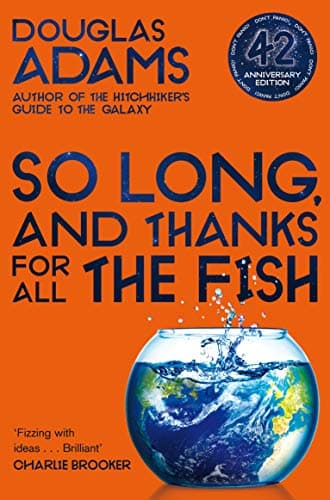
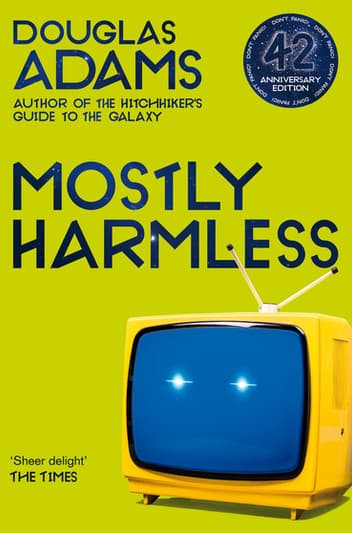
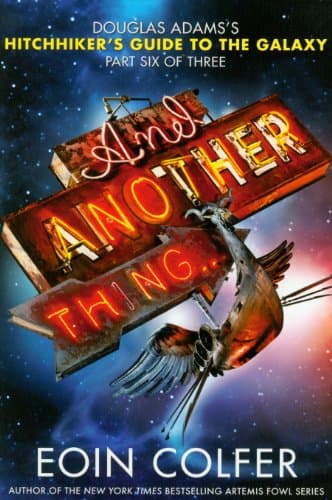
The Hitchhiker's Guide to the Galaxy