Dystopian fiction and incisive political commentary form the primary foundation of 1984, a chilling exploration of state surveillance, language manipulation, and totalitarian power. Written by George Orwell, these influential narratives analyze how authoritarian regimes erode individual freedom and distort reality to maintain control. Along with the satirical novella Animal Farm, his body of work continues to serve as an essential reference point for readers evaluating political power, propaganda, and democratic institutions across the modern world.
Through lucid prose and unsparing observational detail, Orwell documented the lives of the working class and marginalized communities while delivering systematic critiques of colonial power structures. His early reportage and fiction examine how economic necessity and administrative authority constrain human potential, establishing a framework for political commentary that prioritizes clarity and factual honesty over rhetorical decoration.
Career & Background
Born Eric Arthur Blair in 1903 in Motihari, Bengal Presidency, British India, the author was raised in what he later described as a lower-upper-middle-class family. His father worked in the Indian Civil Service overseeing local opium production. After moving to England as a young child and attending Eton College, he joined the Indian Imperial Police Force in Burma in 1922. Serving as a police officer exposed him directly to the administrative mechanisms of British imperialism, an experience that instilled in him a lifelong opposition to colonial rule and provided the foundational material for his early fiction and essays.
Upon resigning from the police force in 1927, he returned to Europe to embark on a full-time writing career, adopting the pen name George Orwell to protect his family from embarrassment, hedge against commercial failure, and distance himself from his given name. He spent extended periods living in low-income neighborhoods in Paris and London, working casual jobs and documenting the stark realities of severe poverty. He later reported on the economic conditions of industrial workers in northern England and traveled to Spain in 1936 to fight against fascist forces in the Spanish Civil War, where he served on the Aragon front and suffered a bullet wound to the neck.
Throughout the 1940s, Orwell worked extensively as a journalist, literary critic, radio broadcaster, and essayist. His experiences in Spain and his observations of European politics hardened his critique of both fascism and Soviet-style authoritarian communism, solidifying his commitment to democratic socialism. Despite declining health caused by a chronic pulmonary illness, he continued writing prolifically until his death from tuberculosis in London in 1950 at the age of 46.
Writing Style & Themes
Orwell is recognized for his unadorned, lucid prose style that prioritizes clarity, directness, and precision. In influential essays on language and politics, he argued that vague or inflated rhetoric serves to conceal political dishonesty and corrupt clear thought. His creative approach deliberately avoided stylistic ornamentation, relying instead on concrete details, sharp irony, and accessible narrative structures to convey complex ideological arguments to a broad readership.
Central to his literary output is an enduring commitment to democratic socialism, accompanied by an unwavering opposition to all forms of totalitarian control. His books repeatedly examine class consciousness, economic inequality, the moral compromises forced upon individuals by bureaucratic systems, and the systematic distortion of historical memory. By illustrating how power structures maintain dominance through psychological coercion and official censorship, his work offers a defense of intellectual freedom and individual integrity.
Major Works
- Down and Out in Paris and London — Published in 1933, this memoir and social study details Orwell's firsthand experiences of poverty, low-wage labor, and homelessness in two major European capitals, establishing his reputation for immersive investigative journalism.
- Burmese Days — Drawing directly on his service in the Indian Imperial Police, this 1934 novel critiques British imperialism through the story of a disillusioned timber merchant in colonial Burma who struggles against systemic corruption and societal hypocrisy.
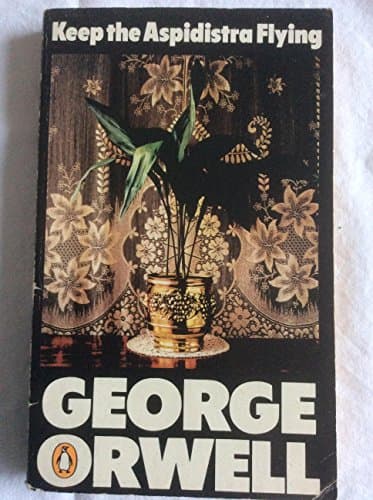
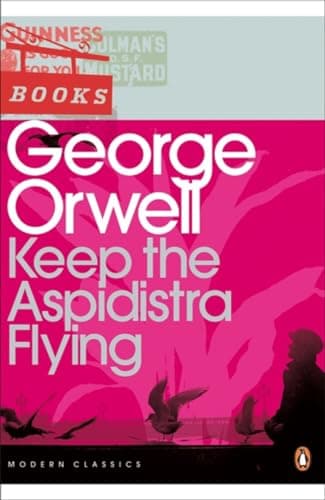
- Keep the Aspidistra Flying — This 1936 novel explores commercialism, financial hardship, and class ambition in London through the life of Gordon Comstock, a struggling poet who revolts against middle-class economic expectations.
- Coming Up for Air — First published in 1939 on the eve of World War II, this novel features middle-aged salesman George Bowling as he returns to his childhood village, contrasting idyllic pre-war English nostalgia with the looming dread of totalitarian conflict.
- Animal Farm — This 1945 allegorical novella uses a farmyard rebellion to satirize the betrayal of revolutionary ideals and the rise of Stalinist authoritarianism, demonstrating how political elites manipulate language to consolidate power.
- 1984 — Published in 1949, this landmark dystopian novel depicts Winston Smith's struggle against the totalitarian regime of Big Brother, introducing enduring concepts such as Newspeak, doublethink, and omnipresent state surveillance.