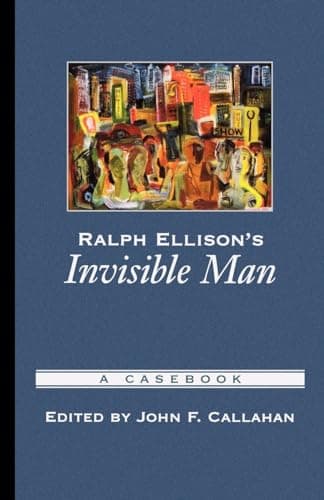
Invisible Man is the story of a young black man from the South who does not fully understand racism in the world. Filled with hope about his future, he goes to college, but gets expelled for showing one of the white benefactors the real and seamy side of black existence. He moves to Harlem and becomes an orator for the Communist party, known as the Brotherhood. In his position, he is both threatened and praised, swept up in a world he does not fully understand. As he works for the organization, he encounters many people and situations that slowly force him to face the truth about racism and his own lack of identity. As racial tensions in Harlem continue to build, he gets caught up in a riot that drives him to a manhole. In the darkness and solitude of the manhole, he begins to understand himself - his invisibility and his identity. He decides to write his story down (the body of the novel) and when he is finished, he vows to enter the world again.
Add to your library to track progress and write reviews
Find Ralph Ellison's Invisible Man: A Casebook Ralph Ellison in PDF, EPUB, ebook, audiobook, print, or library editions.

1 books in catalog
A landmark exploration of racial alienation, identity, and the African American experience in mid-twentieth-century America redefined the possibilities of modernist fiction. Ralph Waldo Ellison, an American novelist, literary critic, scholar, and writer, earned immediate national prominence with his masterpiece Invisible Man, which won the National Book Award in 1953. Born in Oklahoma City, Oklahoma, Ellison brought a deep knowledge of American folklore, jazz culture, and classical music to his literature and non-fiction, establishing a foundational body of work that interrogated race, individuality, and American social thought.
Ellison was born in Oklahoma City, Oklahoma, to Lewis Alfred and Ida Millsap Ellison. Research by Lawrence Jackson, one of Ellison's biographers, has established that he was born a year earlier than had been previously thought, in 1913 rather than 1914. After his father died during his early childhood, Ellison was raised by his mother under precarious economic conditions. He initially pursued music, playing the cornet and trumpet before enrolling in 1933 at Tuskegee Institute as a music major. Moving to New York City, he shifted his focus to writing and social commentary. In addition to his fiction, Ellison produced influential non-fiction, including Shadow and Act (1964), a collection of political, social, and critical essays, and Going to the Territory (1986).
Ellison's prose blends surrealist imagery, African American folklore, modernist narrative techniques, and the rhythmic cadences of jazz and blues. His fiction and cultural criticism examine the psychological and systemic dimensions of racial marginalization, personal identity, and the complex interplay between Black culture and broader American democracy. Rather than reducing social commentary to simple political slogans, Ellison constructed intricate, highly symbolic narratives that explore human individuality and the struggle for visibility within an indifferent or hostile society.