BooksInteraction of Color
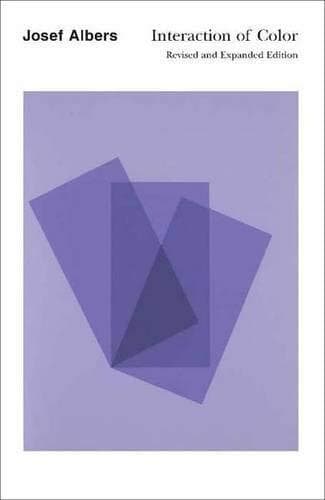
The masterworks of one of the most influential teacher-artists of the twentieth century, originally published as a limited, boxed edition in 1963, was conceived as a guide and teaching aid for artists, instructors, and students. A paperbound edition, containing the unabridged text of the original edition, plus ten representative color plates, chosen from the original silk-screen reproductions and printed by offset lithography, was published in 1971. Since those color plates have now been worn out in repeated reprintings, Mr. Albers has selected ten different color studies, with new comments, for this revised edition. "The text ofInteraction of Colorprovides the careful reader with the content of Josef Albers’ famous color course. His teaching is based on learning by direct perception, and not by theories or color systems. There are many books on color on the market, but no one combines eyesight with such profound insight as Josef Albers does inInteraction of Color."—Hannes Beckmann "The publication of this famous book in paperback is an event. . . . It is clearly written and easy to understand. . . . This book ought to be owned by any serious student or teacher, regardless of the kind of painting he does."—The Artist
Add to your library to track progress and write reviews
Find Interaction of Color Josef Albers in PDF, EPUB, ebook, audiobook, print, or library editions.
1 books in catalog
German artist and designer; prof. at the Bauhaus. Albers trained as an art teacher at Königliche Kunstgewerbschule in nearby Essen, Germany. In 1919 he went to Munich, Germany, to study at the Königliche Bayerische Akademie der Bildenden Kunst, where he was a pupil of Max Doerner and Frank Stuck. In 1920 he attended the preliminary course (Vorkurs) at the Bauhaus in Weimar, Germany, and was appointed a master in 1923 or 1925. In 1925 Albers moved with the Bauhaus to Dessau, Germany, where he was named master. From 1928 to 1930 he was also in charge of the furniture workshop. In 1932 he moved with the Bauhaus to Berlin. From 1933, after the closure of the Bauhaus in Berlin, until 1949, Albers taught at Black Mountain College in North Carolina. From 1948 to 1950 or from 1950 to 1958, Albers was professor and chairman of the Department of Design at Yale University, New Haven, Connecticut. He remained there as a visiting professor until 1960. After his retirement from Yale University, Albers continued to live in New Haven and to paint, monitor his own exhibitions and publications, write, lecture and work on large commissioned sculptures for architectural settings. (Source: Union List of Artist Names - Getty Research Institute)