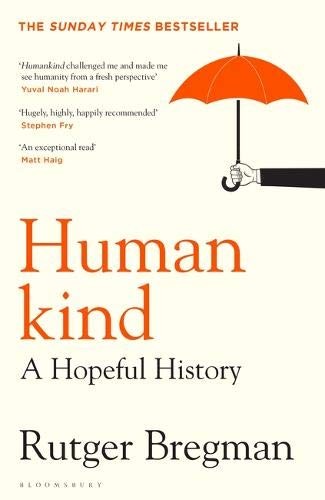
It's a belief that unites the left and right, psychologists and philosophers, writers and historians. It drives the headlines that surround us and the laws that touch our lives. From Machiavelli to Hobbes, Freud to Dawkins, the roots of this belief have sunk deep into Western thought. Human beings, we're taught, are by nature selfish and governed by self-interest. Humankind makes a new argument: that it is realistic, as well as revolutionary, to assume that people are good. The instinct to cooperate rather than compete, trust rather than distrust, has an evolutionary basis going right back to the beginning of Homo sapiens. By thinking the worst of others, we bring out the worst in our politics and economics too. In this major book, internationally bestselling author Rutger Bregman takes some of the world's most famous studies and events and reframes them, providing a new perspective on the last 200,000 years of human history. From the real-life Lord of the Flies to the Blitz, a Siberian fox farm to an infamous New York murder, Stanley Milgram's Yale shock machine to the Stanford prison experiment, Bregman shows how believing in human kindness and altruism can be a new way to think - and act as the foundation for achieving true change in our society. It is time for a new view of human nature.
Add to your library to track progress and write reviews
Find Humankind Rutger Bregman in PDF, EPUB, ebook, audiobook, print, or library editions.
1 books in catalog
By challenging conventional assumptions about human nature, economics, and social progress, books on history and philosophy can reshape public debate. Dutch historian and author Rutger Bregman has gained widespread international recognition through his evidence-based examinations of societal reform and human behavior. His major works, including Humankind: A Hopeful History (2020) and Utopia for Realists: And How We Can Get There (2017), became both Sunday Times and New York Times bestsellers and have been translated into 46 languages.
Born in 1988, Rutger Christiaan Bregman studied history at Utrecht University and the University of California, Los Angeles (UCLA). Although he initially considered an academic career, he transitioned into journalism and wrote extensively for the Dutch online platform The Correspondent, where his reporting earned two nominations for the European Press Prize. Bregman achieved broader international prominence following his 2017 TED Talk on basic income and poverty alleviation, as well as an appearance at the World Economic Forum in Davos where he addressed global tax avoidance. He later co-founded The School for Moral Ambition to encourage professionals to dedicate their careers to tackling urgent societal problems.
Bregman's writing integrates historical case studies, economic research, and social psychology to argue for practical utopian reforms. A core thesis in his work is that major historical advancements—including the abolition of slavery, women's suffrage, and the eight-hour workday—were initially dismissed as unrealistic before gaining widespread adoption. His work challenges cynical views of human nature, contending that people are fundamentally inclined toward cooperation, and advocates for institutional designs built on trust, universal basic income, and ethical career alignment.
1 books in catalog
By challenging conventional assumptions about human nature, economics, and social progress, books on history and philosophy can reshape public debate. Dutch historian and author Rutger Bregman has gained widespread international recognition through his evidence-based examinations of societal reform and human behavior. His major works, including Humankind: A Hopeful History (2020) and Utopia for Realists: And How We Can Get There (2017), became both Sunday Times and New York Times bestsellers and have been translated into 46 languages.
Born in 1988, Rutger Christiaan Bregman studied history at Utrecht University and the University of California, Los Angeles (UCLA). Although he initially considered an academic career, he transitioned into journalism and wrote extensively for the Dutch online platform The Correspondent, where his reporting earned two nominations for the European Press Prize. Bregman achieved broader international prominence following his 2017 TED Talk on basic income and poverty alleviation, as well as an appearance at the World Economic Forum in Davos where he addressed global tax avoidance. He later co-founded The School for Moral Ambition to encourage professionals to dedicate their careers to tackling urgent societal problems.
Bregman's writing integrates historical case studies, economic research, and social psychology to argue for practical utopian reforms. A core thesis in his work is that major historical advancements—including the abolition of slavery, women's suffrage, and the eight-hour workday—were initially dismissed as unrealistic before gaining widespread adoption. His work challenges cynical views of human nature, contending that people are fundamentally inclined toward cooperation, and advocates for institutional designs built on trust, universal basic income, and ethical career alignment.