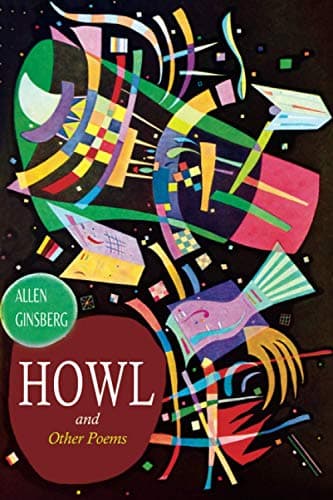
"Howl" is a poem written by Allen Ginsberg in 1955, published as part of his 1956 collection of poetry titled "Howl and Other Poems." Ginsberg began work on "Howl" as early as 1954. "Howl" is considered to be one of the great works of American literature. It came to be associated with the group of writers known as the Beat Generation, which included Jack Kerouac and William S. Burroughs. There is no foundation to the myth that "Howl" was written as a performance piece and later published by poet Lawrence Ferlinghetti of City Lights Books. This myth was perpetuated by Ferlinghetti as part of the defense's case during the poem's obscenity trial, as detailed below. Upon the poem's release, Ferlinghetti and the bookstore's manager, Shigeyoshi Murao, were charged with disseminating obscene literature, and both were arrested. On October 3, 1957, Judge Clayton W. Horn ruled that the poem was not obscene. Poems include: Howl -- Footnote To Howl -- A Supermarket in California -- Transcription of Organ Music -- Sunflower Sutra -- America -- In the Baggage Room at Greyhound; Earlier Poems: An Asphodel -- Song -- Wild Orphan -- In Back of the Real.
"Howl" is a poem written by Allen Ginsberg in 1955, published as part of his 1956 collection of poetry titled "Howl and Other Poems." Ginsberg began work on "Howl" as early as 1954. "Howl" is considered to be one of the great works of American literature. It came to be associated with the group of writers known as the Beat Generation, which included Jack Kerouac and William S. Burroughs. There is no foundation to the myth that "Howl" was written as a performance piece and later published by poet Lawrence Ferlinghetti of City Lights Books. This myth was perpetuated by Ferlinghetti as part of the defense's case during the poem's obscenity trial, as detailed below. Upon the poem's release, Ferlinghetti and the bookstore's manager, Shigeyoshi Murao, were charged with disseminating obscene literature, and both were arrested. On October 3, 1957, Judge Clayton W. Horn ruled that the poem was not obscene. Poems include: Howl -- Footnote To Howl -- A Supermarket in California -- Transcription of Organ Music -- Sunflower Sutra -- America -- In the Baggage Room at Greyhound; Earlier Poems: An Asphodel -- Song -- Wild Orphan -- In Back of the Real.
Add to your library to track progress and write reviews
Add to your library to track progress and write reviews
Find Howl, and Other Poems Allen Ginsberg in PDF, EPUB, ebook, audiobook, print, or library editions.
Find Howl, and Other Poems Allen Ginsberg in PDF, EPUB, ebook, audiobook, print, or library editions.

2 books in catalog
The literary movement known as the Beat Generation reshaped mid-twentieth-century poetry through candid social criticism, spontaneous composition, and explicit personal narrative. Allen Ginsberg emerged as one of its central figures following his famous 1955 reading of "Howl" in San Francisco. His landmark collection Howl, and Other Poems challenged prevailing censorship laws and established an influential precedent for open countercultural expression in American literature.
Irwin Allen Ginsberg was born on June 3, 1926, in Newark, New Jersey, and grew up in nearby Paterson. His father, Louis Ginsberg, was a high school teacher and published poet, while his mother, Naomi Ginsberg, was a political activist who suffered from severe mental illness—an experience that deeply influenced Ginsberg's worldview and poetic themes. In 1944, Ginsberg enrolled at Columbia University, where he met fellow aspiring writers Jack Kerouac and William S. Burroughs, as well as Neal Cassady and Herbert Huncke. During this period, Ginsberg offered crucial encouragement and editing support for Burroughs's early autobiographical writing, including the novel Junky. Mentored by New Jersey poet William Carlos Williams, Ginsberg refined his open-form verse before moving to California, where his public readings and publications in the 1950s helped launch the Beat movement on a national scale.
Drawing inspiration from Walt Whitman, Ginsberg rejected tight traditional meters in favor of long, chanting lines dictated by natural speech rhythms and breath patterns. His poetry engaged directly with themes of anti-militarism, economic materialism, sexual liberation, and Eastern spirituality. In long-form elegies such as Kaddish—written in memory of his mother—and in his extensive political verse, Ginsberg combined personal confession, social protest, and visionary imagery to address the complexities of postwar society.
2 books in catalog
The literary movement known as the Beat Generation reshaped mid-twentieth-century poetry through candid social criticism, spontaneous composition, and explicit personal narrative. Allen Ginsberg emerged as one of its central figures following his famous 1955 reading of "Howl" in San Francisco. His landmark collection Howl, and Other Poems challenged prevailing censorship laws and established an influential precedent for open countercultural expression in American literature.
Irwin Allen Ginsberg was born on June 3, 1926, in Newark, New Jersey, and grew up in nearby Paterson. His father, Louis Ginsberg, was a high school teacher and published poet, while his mother, Naomi Ginsberg, was a political activist who suffered from severe mental illness—an experience that deeply influenced Ginsberg's worldview and poetic themes. In 1944, Ginsberg enrolled at Columbia University, where he met fellow aspiring writers Jack Kerouac and William S. Burroughs, as well as Neal Cassady and Herbert Huncke. During this period, Ginsberg offered crucial encouragement and editing support for Burroughs's early autobiographical writing, including the novel Junky. Mentored by New Jersey poet William Carlos Williams, Ginsberg refined his open-form verse before moving to California, where his public readings and publications in the 1950s helped launch the Beat movement on a national scale.
Drawing inspiration from Walt Whitman, Ginsberg rejected tight traditional meters in favor of long, chanting lines dictated by natural speech rhythms and breath patterns. His poetry engaged directly with themes of anti-militarism, economic materialism, sexual liberation, and Eastern spirituality. In long-form elegies such as Kaddish—written in memory of his mother—and in his extensive political verse, Ginsberg combined personal confession, social protest, and visionary imagery to address the complexities of postwar society.