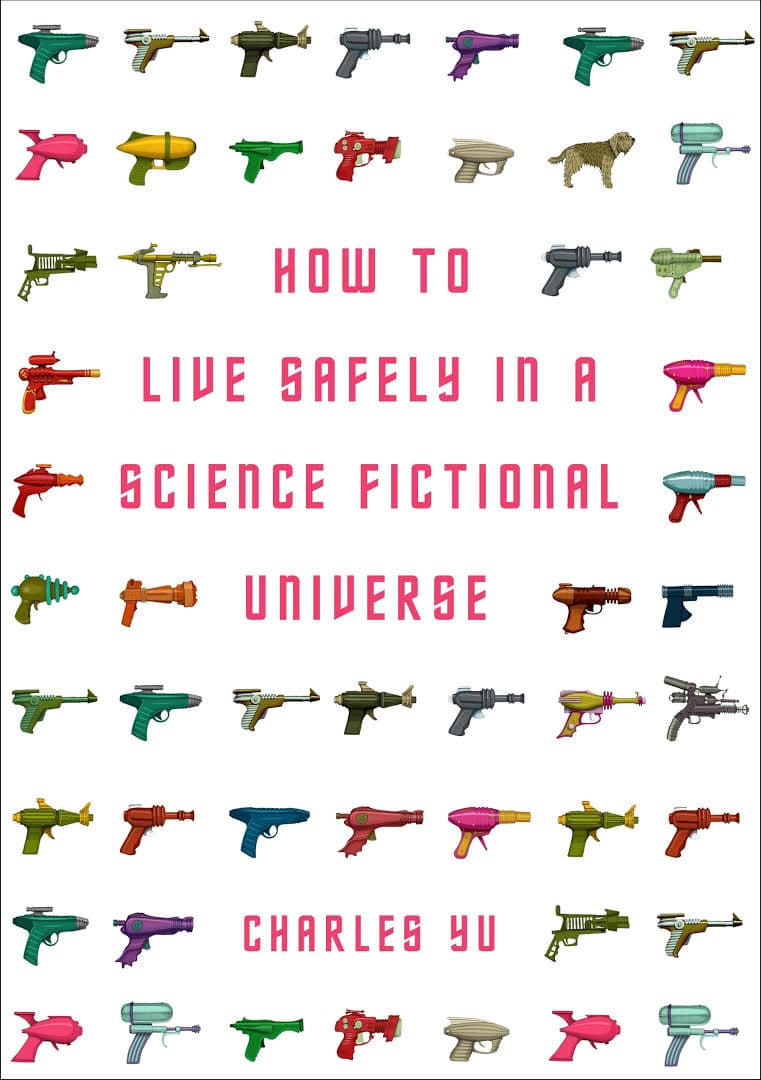
Minor Universe 31 is a vast story-space on the outskirts of fiction, where paradox fluctuates like the stock market, lonely sexbots beckon failed protagonists, and time travel is serious business. Every day, people get into time machines and try to do the one thing they should never do: change the past. That’s where Charles Yu, time travel technician—part counselor, part gadget repair man—steps in. He helps save people from themselves. Literally. When he’s not taking client calls or consoling his boss, Phil, who could really use an upgrade, Yu visits his mother (stuck in a one-hour cycle of time, she makes dinner over and over and over) and searches for his father, who invented time travel and then vanished. Accompanied by TAMMY, an operating system with low self-esteem, and Ed, a nonexistent but ontologically valid dog, Yu sets out, and back, and beyond, in order to find the one day where he and his father can meet in memory. He learns that the key may be found in a book he got from his future self. It’s called How to Live Safely in a Science Fictional Universe, and he’s the author. And somewhere inside it is the information that could help him—in fact it may even save his life.
Add to your library to track progress and write reviews
Find How to Live Safely in a Science Fictional Universe Charles Yu in PDF, EPUB, ebook, audiobook, print, or library editions.

3 books in catalog
Navigating the intersection of speculative fiction, metafiction, and cultural satire, speculative writing often reveals the surreal absurdity of contemporary systems and media tropes. American author Charles Yu has earned wide acclaim for blending high-concept science fiction frameworks with sharp reflections on identity, Asian American representation, and the mechanics of storytelling. His novel Interior Chinatown captured national attention by using a screenplay format to dissect Hollywood stereotypes, winning the 2020 National Book Award for Fiction.
Born in Los Angeles, California, in 1976 to parents who emigrated from Taiwan, Charles Chowkai Yu pursued a background in science and law before turning fully to creative writing. He graduated from UC Berkeley in 1997 with a degree in molecular and cell biology, followed by a law degree from Columbia Law School in 2001. Yu practiced law for over a decade at firms such as Sullivan & Cromwell and Bryan Cave, and served as corporate counsel for technology and digital media companies. After releasing his debut story collection Third Class Superhero in 2006—which earned him a 5 Under 35 designation from the National Book Foundation in 2007—he published his celebrated debut novel How to Live Safely in a Science Fictional Universe in 2010. In 2014, Yu transitioned full-time into Hollywood television writing, joining the staff of HBO's Westworld, for which he received two Writers Guild of America Award nominations. He went on to write for series on AMC, FX, Facebook Watch, and Adult Swim, as well as contributing short fiction to anthologies such as From a Certain Point of View: The Empire Strikes Back.
Yu's writing style is characterized by self-reflexive humor, formal experimentation, and a poignant exploration of isolation within complex bureaucratic or technological systems. Whether utilizing user manuals, flowcharts, or screenplay layouts, he frequently uses genre conventions—such as time travel and virtual reality—as metaphors for human emotional detachment, family dynamics, and societal marginalization. His fiction and non-fiction have appeared in prominent publications including The New Yorker, The New York Times Magazine, The Atlantic, Wired, Time, and Ploughshares. In Interior Chinatown, which was shortlisted for Le Prix Médicis étranger and longlisted for the Andrew Carnegie Medal for Excellence in Fiction, Yu transformed the tropes of television police procedurals into a moving critique of Asian American visibility, later creating and executive producing the 2024 television adaptation of the novel.