Pioneering hard science fiction through rigorous scientific accuracy and engineering plausibility, the speculative fiction of Stranger in a Strange Land helped establish modern mass-market science fiction. Robert A. Heinlein became widely known as the "dean of science fiction writers" and was celebrated alongside Isaac Asimov and Arthur C. Clarke as part of the genre's recognized "Big Three."
His work raised the standards of literary quality in speculative fiction, breaking into mainstream general periodicals such as The Saturday Evening Post in the late 1940s with unvarnished science fiction. As one of the most popular, influential, and controversial authors in the genre, he helped pioneer bestselling novel-length science fiction for modern readers.
Career & Background
Born in Butler, Missouri, in 1907 and raised in Kansas City, Robert Anson Heinlein graduated from the U.S. Naval Academy in 1929. After five years of naval service, he retired due to ill health in 1934 and studied physics and mathematics at the University of California, Los Angeles. He began publishing science fiction professionally in August 1939 with the short story "Life-Line" in Astounding Science Fiction. During World War II, he served as a civilian engineer at the Naval Air Experimental Station in Philadelphia before returning to writing full-time, eventually authoring more than thirty novels, writing the screenplay for the 1950 film Destination Moon, and earning six Hugo Awards over a career spanning nearly five decades.
Writing Style & Themes
Heinlein's writing is distinguished by its emphasis on technical plausibility, personal self-reliance, and critical thinking. His plots frequently introduced provocative scenarios that questioned conventional social mores, exploring themes of individual liberty, competence, military duty, and social organization. To manage his prolific output across pulp magazines and anthologies, he also published under several pen names, including Anson MacDonald, Lyle Monroe, John Riverside, and Caleb Saunders.
Major Works
- Stranger in a Strange Land — First published in 1961, this Hugo Award-winning novel examines human culture, religion, and social customs through the perspective of a human raised by Martians on Mars.
- The Moon Is a Harsh Mistress — A Hugo Award-winning narrative detailing a lunar colony's revolution against Earth, focusing on political philosophy, artificial intelligence, and orbital logistics.
- Double Star — This Hugo Award-winning story follows a down-on-his-luck actor hired to impersonate an influential interstellar politician during a sensitive diplomatic crisis.
- Time Enough for Love — An ambitious novel following the long life and philosophical musings of Lazarus Long, a central character in Heinlein's Future History setting.
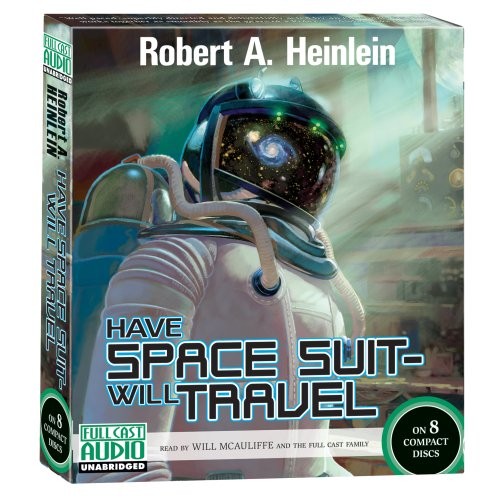
- Have Space Suit—Will Travel — A popular juvenile science fiction novel centering on a high school student who wins a functional space suit and becomes involved in an interstellar journey.
- Starman Jones — A juvenile adventure following a young farm boy who uses his mathematical aptitude to serve as an astrogator aboard interstellar transport ships.