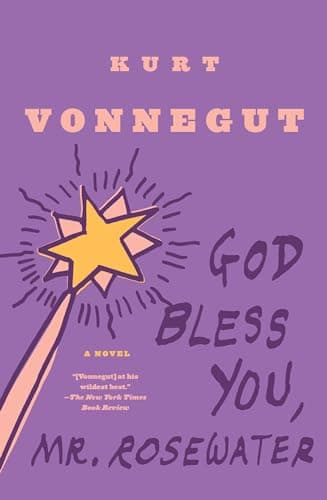
Second only to Slaughterhouse-Five of Vonnegut's canon in its prominence and influence, God Bless You, Mr. Rosewater (1965) presents Eliot Rosewater, an itinerant, semi-crazed millionaire wandering the country in search of heritage and philanthropic outcome, introducing the science fiction writer Kilgore Trout to the world and Vonnegut to the collegiate audience which would soon make him a cult writer.
Trout, modeled according to Vonnegut on the science fiction writer Theodore Sturgeon (with whom Vonnegut had an occasional relationship) is a desperate, impoverished but visionary hack writer who functions for Eliot Rosewater as both conscience and horrid example. Rosewater, seeking to put his inheritance to some meaningful use (his father was an entrepreneur), tries to do good within the context of almost illimitable cynicism and corruption.
It is in this novel that Rosewater wanders into a science fiction conference – an actual annual event in Milford, Pennsylvania – and at the motel delivers his famous monologue evoked by science fiction writers and critics for almost half a century: "None of you can write for sour apples... but you're the only people trying to come to terms with the really terrific things which are happening today." Money does not drive Mr. Rosewater (or the corrupt lawyer who tries to shape the Rosewater fortune) so much as outrage at the human condition.
The novel was adapted for a 1979 Alan Menken musical. The novel is told mostly thru a collection of short stories dealing with Eliot's interactions with the citizens of Rosewater County, usually with the last sentence serving as a punch line. The antagonist's tale, Mushari's, is told in a similar short essay fashion. The stories reveal different hypocrisies of humankind in a darkly humorous fashion.
Second only to Slaughterhouse-Five of Vonnegut's canon in its prominence and influence, God Bless You, Mr. Rosewater (1965) presents Eliot Rosewater, an itinerant, semi-crazed millionaire wandering the country in search of heritage and philanthropic outcome, introducing the science fiction writer Kilgore Trout to the world and Vonnegut to the collegiate audience which would soon make him a cult writer.
Trout, modeled according to Vonnegut on the science fiction writer Theodore Sturgeon (with whom Vonnegut had an occasional relationship) is a desperate, impoverished but visionary hack writer who functions for Eliot Rosewater as both conscience and horrid example. Rosewater, seeking to put his inheritance to some meaningful use (his father was an entrepreneur), tries to do good within the context of almost illimitable cynicism and corruption.
It is in this novel that Rosewater wanders into a science fiction conference – an actual annual event in Milford, Pennsylvania – and at the motel delivers his famous monologue evoked by science fiction writers and critics for almost half a century: "None of you can write for sour apples... but you're the only people trying to come to terms with the really terrific things which are happening today." Money does not drive Mr. Rosewater (or the corrupt lawyer who tries to shape the Rosewater fortune) so much as outrage at the human condition.
The novel was adapted for a 1979 Alan Menken musical. The novel is told mostly thru a collection of short stories dealing with Eliot's interactions with the citizens of Rosewater County, usually with the last sentence serving as a punch line. The antagonist's tale, Mushari's, is told in a similar short essay fashion. The stories reveal different hypocrisies of humankind in a darkly humorous fashion.
Add to your library to track progress and write reviews
Add to your library to track progress and write reviews
Find God Bless You, Mr. Rosewater Kurt Vonnegut in PDF, EPUB, ebook, audiobook, print, or library editions.
Find God Bless You, Mr. Rosewater Kurt Vonnegut in PDF, EPUB, ebook, audiobook, print, or library editions.

8 books in catalog
Blending satirical social commentary, dark comedy, and speculative elements, the groundbreaking 1969 novel Slaughterhouse-Five transformed modern American fiction by confronting war through a disjointed, non-linear lens. Its creator, Kurt Vonnegut, produced fourteen novels, short story collections, plays, and works of nonfiction across a career spanning more than five decades. His writing frequently used absurdist science fiction tropes to examine human cruelty, morality, and social inequality.
Born on November 11, 1922, in Indianapolis, Indiana, Kurt Vonnegut Jr. developed his early writing skills through student journalism, serving on the staff of Shortridge High School's paper, The Echo, and later working as managing editor for Cornell University's The Sun. The straightforward rules of reporting—focusing on facts and clear declarative sentences—permanently shaped his literary style. During World War II, Vonnegut served in the U.S. Army, was captured by German forces, and survived the 1945 Allied firebombing of Dresden as a prisoner of war. This horrific firsthand experience provided the core foundation for Slaughterhouse-Five (1969), which brought him widespread critical and commercial acclaim. He also served as honorary president of the American Humanist Association, reflecting his lifelong commitment to humanist principles until his death on April 11, 2007, in New York City.
Vonnegut's signature style relies on economical prose, short chapters, dark humor, and a skeptic's eye toward modern technology and institutional authority. His work frequently features recurring characters, such as the fictional science fiction writer Kilgore Trout, and fuses philosophical queries with surreal storytelling. In works like Cat's Cradle (1963) and Breakfast of Champions (1973), he satirized scientific arrogance, religious dogma, and economic disparity. By pairing bleak themes of destruction and human frailty with offbeat absurdity, Vonnegut offered a distinctly humanist critique of twentieth-century society.
8 books in catalog
Blending satirical social commentary, dark comedy, and speculative elements, the groundbreaking 1969 novel Slaughterhouse-Five transformed modern American fiction by confronting war through a disjointed, non-linear lens. Its creator, Kurt Vonnegut, produced fourteen novels, short story collections, plays, and works of nonfiction across a career spanning more than five decades. His writing frequently used absurdist science fiction tropes to examine human cruelty, morality, and social inequality.
Born on November 11, 1922, in Indianapolis, Indiana, Kurt Vonnegut Jr. developed his early writing skills through student journalism, serving on the staff of Shortridge High School's paper, The Echo, and later working as managing editor for Cornell University's The Sun. The straightforward rules of reporting—focusing on facts and clear declarative sentences—permanently shaped his literary style. During World War II, Vonnegut served in the U.S. Army, was captured by German forces, and survived the 1945 Allied firebombing of Dresden as a prisoner of war. This horrific firsthand experience provided the core foundation for Slaughterhouse-Five (1969), which brought him widespread critical and commercial acclaim. He also served as honorary president of the American Humanist Association, reflecting his lifelong commitment to humanist principles until his death on April 11, 2007, in New York City.
Vonnegut's signature style relies on economical prose, short chapters, dark humor, and a skeptic's eye toward modern technology and institutional authority. His work frequently features recurring characters, such as the fictional science fiction writer Kilgore Trout, and fuses philosophical queries with surreal storytelling. In works like Cat's Cradle (1963) and Breakfast of Champions (1973), he satirized scientific arrogance, religious dogma, and economic disparity. By pairing bleak themes of destruction and human frailty with offbeat absurdity, Vonnegut offered a distinctly humanist critique of twentieth-century society.