Hard science fiction exploring biological elevation, near-future technology, and societal resilience has defined major developments in speculative literature, most notably through the Hugo and Nebula Award-winning Uplift universe and post-apocalyptic classics like The Postman. Glen David Brin, writing as David Brin, established his reputation by combining rigorous backgrounds in astrophysics and optics with high-concept speculative storytelling that addresses cosmic and societal challenges.
Career & Background
Born on October 6, 1950, in Glendale, California, Brin earned a Bachelor of Science degree in astronomy from the California Institute of Technology in 1973, followed by a Master of Science in optics and a Ph.D. in space science from the University of California, San Diego in 1981. Before dedicating himself primarily to writing, he worked as an electrical engineer in semiconductor development at Hughes Aircraft Research Laboratories and served as a university instructor. Beyond his career as an author, Brin has served as a technical consultant for NASA and participated on advisory boards covering space exploration, SETI, national defense, homeland security, and future technologies. In addition to his fiction, his 1998 nonfiction work The Transparent Society earned the American Library Association's Freedom of Speech Award for examining privacy, openness, and technological accountability.
Writing Style & Themes
Brin's fiction is known for hard-science plausibility, vast galactic scope, and detailed examinations of political, social, and technological dilemmas. A signature concept in his work is biological uplift, a scenario where established galactic patron species genetically modify client species to full sentience. Across his standalone novels and short fiction, Brin frequently explores artificial intelligence, surveillance, information democracy, and planetary survival. In predictive near-future novels like Earth, he anticipated technological and environmental developments including global networks and cyberwarfare, while short fiction collections such as Tomorrow Happens highlight his engagement with rapid speculative ideas.
Major Works
- Sundiver — Published in 1980, this debut novel introduced the Uplift universe, following a scientific expedition into the outer atmosphere of the Sun that discovers unexpected entities amidst interstellar diplomacy.
- Startide Rising — This 1983 novel won both the Hugo and Nebula Awards, depicting the crew of the Earthship Streaker—composed of humans and uplifted dolphins—who discover an ancient cosmic secret and must evade hostile alien fleets.
- The Uplift War — Winning the Hugo Award in 1987, this novel focuses on the planet Garth, where uplifted chimpanzees and their human partners organize a guerilla resistance against invading alien forces.
- The Postman — Set in a post-apocalyptic United States, this 1985 novel follows a solitary wanderer who assumes the uniform of a postal carrier, inadvertently reestablishing communication and civic hope across isolated communities; it was adapted into a 1997 feature film.
- Earth — This 1990 near-future thriller centers on a crisis involving an artificial microscopic black hole trapped inside the planet, widely noted for predicting global digital communication networks and ecological challenges.
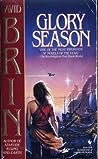
- Glory Season — Published in 1993, this speculative novel explores human social structures and genetics on the planet Stratos, focusing on a civilization dominated by female clones and seasonal reproduction.
- Brightness Reef — This 1995 novel launched a second Uplift trilogy, depicting a multi-species community of galactic refugees hiding illegally on the restricted planet Jijo.
- Kiln People — This 2002 novel presents a future where people project their consciousness into short-lived clay duplicates, combining hard speculative concepts with a hardboiled detective mystery.
- Contacting Aliens: An Illustrated Guide to David Brin's Uplift Universe — Co-authored with Kevin Lenagh, this illustrated reference companion details the alien biology, cultural histories, and planetary backgrounds of species across the Uplift series.