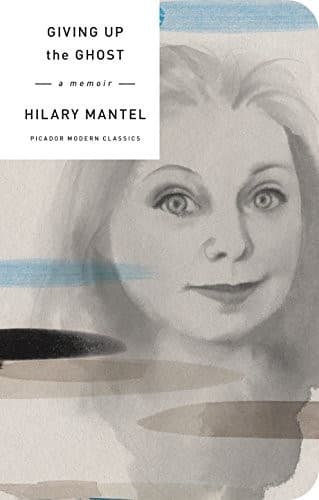
At no. 58 the top of my head comes to the outermost curve of my great-aunt, Annie Connor. Her shape is like the full moon, her smile is beaming; the outer rim of her is covered by her pinny, woven with tiny flowers. It is soft from washing; her hands are hard and chapped; it is barely ten o'clock and she is getting the cabbage on. 'Hello, Our Ilary,' she says; my family has named me aspirationally, but aspiration doesn't stretch to the 'H'.Giving Up the Ghost is award-winning novelist Hilary Mantel's wry, shocking and uniquely unusual five-part autobiography of childhood, ghosts, illness and family.It opens in 1995 with 'A Second Home', in which Mantel describes the death of her stepfather, a death which leaves her deeply troubled by the unresolved events of childhood. 'Now Geoffrey Don't Torment Her' begins in typical, gripping Mantel fashion: 'Two of my relatives have died by fire.' Set during the 1950s, it takes the reader into the muffled consciousness of her early childhood, culminating with the birth of a younger brother and the strange candlelit ceremony of her mother's 'churching'. In 'The Secret Garden' Mantel moves to a haunted house and mysteriously gains a stepfather. When she is almost eleven, her family flee the gossips and the ghosts, and resolve to start a new life. 'Smile' is an account of teenage perplexity, in a household where the keeping of secrets has become a way of life. Convent school provides a certain sanctuary, with tacit assistance from the fearsome 'Top Nun.' In the final section, the author tells how, through medical misunderstandings and neglect, she came to be childless, and how the ghosts of the unborn, like chances missed or pages unturned, have come to haunt her life as a writer.
Add to your library to track progress and write reviews
Find Giving Up the Ghost: A Memoir Hilary Mantel in PDF, EPUB, ebook, audiobook, print, or library editions.
4 books in catalog
Historical fiction reached new narrative depths through an immersive reimagining of Tudor politics in Wolf Hall. Hilary Mantel brought detailed psychological perspective and immediate present-tense realism to the story of Thomas Cromwell, turning sixteenth-century royal administration into a subtle examination of power, loyalty, and self-preservation.
Born Hilary Mary Thompson on July 6, 1952, in Glossop, Derbyshire, she grew up in a working-class Roman Catholic family. She studied law at the London School of Economics and the University of Sheffield, graduating with a Bachelor of Jurisprudence in 1973. Before devoting herself fully to literature, she worked as a social worker and lived abroad in Botswana for five years and Saudi Arabia for four years. Her time in Saudi Arabia informed her 1988 novel Eight Months on Ghazzah Street, and she later served as film critic for The Spectator from 1987 to 1991. Her debut novel, Every Day Is Mother's Day, was published in 1985.
Across a career encompassing seventeen books—including twelve novels, short story collections, and the memoir Giving Up the Ghost: A Memoir—she received extensive critical recognition. Her accolades included the Hawthornden Prize, the National Book Critics Circle Award for Fiction, the Walter Scott Prize, and the Costa Book Award, along with Booker Prizes for both Wolf Hall and Bring Up The Bodies. In 2014, Mantel was appointed Dame Commander of the Order of the British Empire for services to literature. She died at age seventy in 2022 in Exeter, Devon.
Her writing is characterized by sharp wit, bleakly comic observation, and socially probing examinations of personal vulnerability. Across contemporary settings and historical historical contexts, her work explores how institutional pressures and private memories shape human behavior. Her historical technique avoids nostalgia, placing readers directly into the immediate sensory experience and moral complexity of her characters' lives.