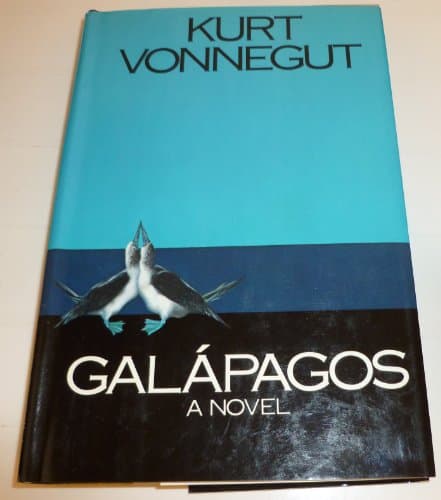
“A madcap genealogical adventure . . . Vonnegut is a postmodern Mark Twain.”—The New York Times Book Review Galápagos takes the reader back one million years, to A.D. 1986. A simple vacation cruise suddenly becomes an evolutionary journey. Thanks to an apocalypse, a small group of survivors stranded on the Galápagos Islands are about to become the progenitors of a brave, new, and totally different human race. In this inimitable novel, America’ s master satirist looks at our world and shows us all that is sadly, madly awry–and all that is worth saving. Praise for Galápagos “The best Vonnegut novel yet!”—John Irving “Beautiful . . . provocative, arresting reading.”—USA Today “A satire in the classic tradition . . . a dark vision, a heartfelt warning.”—The Detroit Free Press “Interesting, engaging, sad and yet very funny . . . Vonnegut is still in top form. If he has no prescription for alleviating the pain of the human condition, at least he is a first-rate diagnostician.”—Susan Isaacs, Newsday “Dark . . . original and funny.”—People “A triumph of style, originality and warped yet consistent logic . . . a condensation, an evolution of Vonnegut’s entire career, including all the issues and questions he has pursued relentlessly for four decades.”—The Philadelphia Inquirer “Wild details, wry humor, outrageous characters . . . Galápagos is a comic lament, a sadly ironic vison.”—St. Louis Post-Dispatch “A work of high comedy, sadness and imagination.”—The Denver Post “Wacky wit and irreverent imagination . . . and the full range of technical innovations have made [Vonnegut] America’s preeminent experimental novelist.”—The Minneapolis Star and Tribune
“A madcap genealogical adventure . . . Vonnegut is a postmodern Mark Twain.”—The New York Times Book Review Galápagos takes the reader back one million years, to A.D. 1986. A simple vacation cruise suddenly becomes an evolutionary journey. Thanks to an apocalypse, a small group of survivors stranded on the Galápagos Islands are about to become the progenitors of a brave, new, and totally different human race. In this inimitable novel, America’ s master satirist looks at our world and shows us all that is sadly, madly awry–and all that is worth saving. Praise for Galápagos “The best Vonnegut novel yet!”—John Irving “Beautiful . . . provocative, arresting reading.”—USA Today “A satire in the classic tradition . . . a dark vision, a heartfelt warning.”—The Detroit Free Press “Interesting, engaging, sad and yet very funny . . . Vonnegut is still in top form. If he has no prescription for alleviating the pain of the human condition, at least he is a first-rate diagnostician.”—Susan Isaacs, Newsday “Dark . . . original and funny.”—People “A triumph of style, originality and warped yet consistent logic . . . a condensation, an evolution of Vonnegut’s entire career, including all the issues and questions he has pursued relentlessly for four decades.”—The Philadelphia Inquirer “Wild details, wry humor, outrageous characters . . . Galápagos is a comic lament, a sadly ironic vison.”—St. Louis Post-Dispatch “A work of high comedy, sadness and imagination.”—The Denver Post “Wacky wit and irreverent imagination . . . and the full range of technical innovations have made [Vonnegut] America’s preeminent experimental novelist.”—The Minneapolis Star and Tribune
Add to your library to track progress and write reviews
Add to your library to track progress and write reviews
Find Galápagos Kurt Vonnegut in PDF, EPUB, ebook, audiobook, print, or library editions.
Find Galápagos Kurt Vonnegut in PDF, EPUB, ebook, audiobook, print, or library editions.

8 books in catalog
Blending satirical social commentary, dark comedy, and speculative elements, the groundbreaking 1969 novel Slaughterhouse-Five transformed modern American fiction by confronting war through a disjointed, non-linear lens. Its creator, Kurt Vonnegut, produced fourteen novels, short story collections, plays, and works of nonfiction across a career spanning more than five decades. His writing frequently used absurdist science fiction tropes to examine human cruelty, morality, and social inequality.
Born on November 11, 1922, in Indianapolis, Indiana, Kurt Vonnegut Jr. developed his early writing skills through student journalism, serving on the staff of Shortridge High School's paper, The Echo, and later working as managing editor for Cornell University's The Sun. The straightforward rules of reporting—focusing on facts and clear declarative sentences—permanently shaped his literary style. During World War II, Vonnegut served in the U.S. Army, was captured by German forces, and survived the 1945 Allied firebombing of Dresden as a prisoner of war. This horrific firsthand experience provided the core foundation for Slaughterhouse-Five (1969), which brought him widespread critical and commercial acclaim. He also served as honorary president of the American Humanist Association, reflecting his lifelong commitment to humanist principles until his death on April 11, 2007, in New York City.
Vonnegut's signature style relies on economical prose, short chapters, dark humor, and a skeptic's eye toward modern technology and institutional authority. His work frequently features recurring characters, such as the fictional science fiction writer Kilgore Trout, and fuses philosophical queries with surreal storytelling. In works like Cat's Cradle (1963) and Breakfast of Champions (1973), he satirized scientific arrogance, religious dogma, and economic disparity. By pairing bleak themes of destruction and human frailty with offbeat absurdity, Vonnegut offered a distinctly humanist critique of twentieth-century society.
8 books in catalog
Blending satirical social commentary, dark comedy, and speculative elements, the groundbreaking 1969 novel Slaughterhouse-Five transformed modern American fiction by confronting war through a disjointed, non-linear lens. Its creator, Kurt Vonnegut, produced fourteen novels, short story collections, plays, and works of nonfiction across a career spanning more than five decades. His writing frequently used absurdist science fiction tropes to examine human cruelty, morality, and social inequality.
Born on November 11, 1922, in Indianapolis, Indiana, Kurt Vonnegut Jr. developed his early writing skills through student journalism, serving on the staff of Shortridge High School's paper, The Echo, and later working as managing editor for Cornell University's The Sun. The straightforward rules of reporting—focusing on facts and clear declarative sentences—permanently shaped his literary style. During World War II, Vonnegut served in the U.S. Army, was captured by German forces, and survived the 1945 Allied firebombing of Dresden as a prisoner of war. This horrific firsthand experience provided the core foundation for Slaughterhouse-Five (1969), which brought him widespread critical and commercial acclaim. He also served as honorary president of the American Humanist Association, reflecting his lifelong commitment to humanist principles until his death on April 11, 2007, in New York City.
Vonnegut's signature style relies on economical prose, short chapters, dark humor, and a skeptic's eye toward modern technology and institutional authority. His work frequently features recurring characters, such as the fictional science fiction writer Kilgore Trout, and fuses philosophical queries with surreal storytelling. In works like Cat's Cradle (1963) and Breakfast of Champions (1973), he satirized scientific arrogance, religious dogma, and economic disparity. By pairing bleak themes of destruction and human frailty with offbeat absurdity, Vonnegut offered a distinctly humanist critique of twentieth-century society.