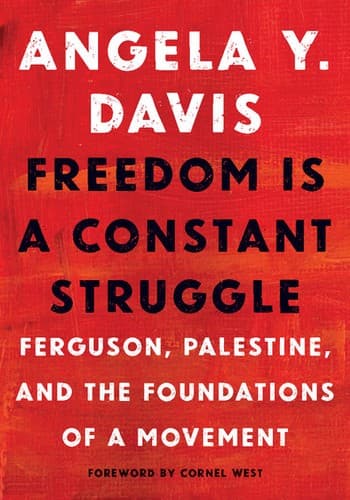
In these newly collected essays, interviews, and speeches, world-renowned activist and scholar Angela Y. Davis illuminates the connections between struggles against state violence and oppression throughout history and around the world.
Reflecting on the importance of black feminism, intersectionality, and prison abolitionism for today's struggles, Davis discusses the legacies of previous liberation struggles, from the Black Freedom Movement to the South African anti-Apartheid movement. She highlights connections and analyzes today's struggles against state terror, from Ferguson to Palestine.
Facing a world of outrageous injustice, Davis challenges us to imagine and build the movement for human liberation. And in doing so, she reminds us that "Freedom is a constant struggle." Angela Y. Davis is a political activist, scholar, author, and speaker. She is an outspoken advocate for the oppressed and exploited, writing on Black liberation, prison abolition, the intersections of race, gender, and class, and international solidarity with Palestine. She is the author of several books, including Women, Race, and Class and Are Prisons Obsolete? She is the subject of the acclaimed documentary Free Angela and All Political Prisoners and is Distinguished Professor Emerita at the University of California, Santa Cruz.
One of America's most provocative public intellectuals, Dr. Cornel West has been a champion for racial justice since childhood. His writing, speaking, and teaching weave together the traditions of the black Baptist Church, progressive politics, and jazz. The New York Times has praised his "ferocious moral vision." His many books include Race Matters, Democracy Matters, and his autobiography, Brother West: Living and Loving Out Loud.
Frank Barat is a human rights activist and author. He was the coordinator of the Russell Tribunal on Palestine and is now the president of the Palestine Legal Action Network. His books include Gaza in Crisis and Corporate Complicity in Israel's Occupation.
In these newly collected essays, interviews, and speeches, world-renowned activist and scholar Angela Y. Davis illuminates the connections between struggles against state violence and oppression throughout history and around the world.
Reflecting on the importance of black feminism, intersectionality, and prison abolitionism for today's struggles, Davis discusses the legacies of previous liberation struggles, from the Black Freedom Movement to the South African anti-Apartheid movement. She highlights connections and analyzes today's struggles against state terror, from Ferguson to Palestine.
Facing a world of outrageous injustice, Davis challenges us to imagine and build the movement for human liberation. And in doing so, she reminds us that "Freedom is a constant struggle." Angela Y. Davis is a political activist, scholar, author, and speaker. She is an outspoken advocate for the oppressed and exploited, writing on Black liberation, prison abolition, the intersections of race, gender, and class, and international solidarity with Palestine. She is the author of several books, including Women, Race, and Class and Are Prisons Obsolete? She is the subject of the acclaimed documentary Free Angela and All Political Prisoners and is Distinguished Professor Emerita at the University of California, Santa Cruz.
One of America's most provocative public intellectuals, Dr. Cornel West has been a champion for racial justice since childhood. His writing, speaking, and teaching weave together the traditions of the black Baptist Church, progressive politics, and jazz. The New York Times has praised his "ferocious moral vision." His many books include Race Matters, Democracy Matters, and his autobiography, Brother West: Living and Loving Out Loud.
Frank Barat is a human rights activist and author. He was the coordinator of the Russell Tribunal on Palestine and is now the president of the Palestine Legal Action Network. His books include Gaza in Crisis and Corporate Complicity in Israel's Occupation.
Add to your library to track progress and write reviews
Add to your library to track progress and write reviews
Find Freedom Is a Constant Struggle Angela Y. Davis in PDF, EPUB, ebook, audiobook, print, or library editions.
Find Freedom Is a Constant Struggle Angela Y. Davis in PDF, EPUB, ebook, audiobook, print, or library editions.

3 books in catalog
Critical analyses of systemic racism, prison abolition, and political activism anchor seminal social theory, notably established in the study Women, Race & Class. Writing as a Marxist feminist, philosopher, and social theorist, Angela Y. Davis examines how intersections of race, gender, and economic class shape historical and contemporary struggles for liberation.
Through foundational books such as Freedom Is a Constant Struggle and Women, Culture, and Politics, her work illuminates the historical ties between civil rights movements, state violence, and global liberation struggles, offering readers analytical frameworks for understanding social reform.
Born on January 26, 1944, in Birmingham, Alabama, Davis grew up in a middle-class neighborhood known as Dynamite Hill due to frequent bombings by the Ku Klux Klan. Her political activism began early in Birmingham and continued through her high school years in New York. She pursued higher education in philosophy and later joined the faculty of the Philosophy Department at the University of California, Los Angeles (UCLA). In 1969, she came to national attention after being removed from her UCLA teaching position because of her membership in the Communist Party USA. She was also associated with the Black Panther Party and the Soledad Brothers, gaining an international reputation during her 1970–1972 imprisonment and trial on conspiracy charges, from which she was acquitted.
Following her trial, Davis continued her dual path as an academic and political organizer. She served as a longtime member of the Communist Party USA, running as its candidate for Vice President in 1980 and 1984, and later co-founded the Committees of Correspondence for Democracy and Socialism. Over her academic career, she became Distinguished Professor Emerita of Feminist Studies and History of Consciousness at the University of California, Santa Cruz. Her 1974 book An Autobiography, edited by Toni Morrison, documented her early childhood, political activities, and high-profile trial, establishing her narrative alongside her scholarly contributions.
Davis writes with a distinct focus on historical materialism, intersectional feminist theory, and institutional critiques of the penal system. Her texts frequently dissect how capitalism, racial oppression, and patriarchy reinforce one another, drawing direct lines between historical slavery, racialized labor practices, and the modern prison-industrial complex. In works like Are Prisons Obsolete?, she challenges conventional assumptions about incarceration, arguing for structural abolition and transformative justice instead of reformative measures.
Her prose style combines rigorous academic theory with accessible political analysis, bridging scholarly discourse and grassroots activism. By framing local struggles within broader anti-imperialist and internationalist perspectives, Davis emphasizes collective action and solidarity. Her writings routinely interrogate historical movements, literature, and culture—including her foreword to I, Tituba, Black Witch of Salem—to demonstrate how social consciousness evolves through sustained resistance.
3 books in catalog
Critical analyses of systemic racism, prison abolition, and political activism anchor seminal social theory, notably established in the study Women, Race & Class. Writing as a Marxist feminist, philosopher, and social theorist, Angela Y. Davis examines how intersections of race, gender, and economic class shape historical and contemporary struggles for liberation.
Through foundational books such as Freedom Is a Constant Struggle and Women, Culture, and Politics, her work illuminates the historical ties between civil rights movements, state violence, and global liberation struggles, offering readers analytical frameworks for understanding social reform.
Born on January 26, 1944, in Birmingham, Alabama, Davis grew up in a middle-class neighborhood known as Dynamite Hill due to frequent bombings by the Ku Klux Klan. Her political activism began early in Birmingham and continued through her high school years in New York. She pursued higher education in philosophy and later joined the faculty of the Philosophy Department at the University of California, Los Angeles (UCLA). In 1969, she came to national attention after being removed from her UCLA teaching position because of her membership in the Communist Party USA. She was also associated with the Black Panther Party and the Soledad Brothers, gaining an international reputation during her 1970–1972 imprisonment and trial on conspiracy charges, from which she was acquitted.
Following her trial, Davis continued her dual path as an academic and political organizer. She served as a longtime member of the Communist Party USA, running as its candidate for Vice President in 1980 and 1984, and later co-founded the Committees of Correspondence for Democracy and Socialism. Over her academic career, she became Distinguished Professor Emerita of Feminist Studies and History of Consciousness at the University of California, Santa Cruz. Her 1974 book An Autobiography, edited by Toni Morrison, documented her early childhood, political activities, and high-profile trial, establishing her narrative alongside her scholarly contributions.
Davis writes with a distinct focus on historical materialism, intersectional feminist theory, and institutional critiques of the penal system. Her texts frequently dissect how capitalism, racial oppression, and patriarchy reinforce one another, drawing direct lines between historical slavery, racialized labor practices, and the modern prison-industrial complex. In works like Are Prisons Obsolete?, she challenges conventional assumptions about incarceration, arguing for structural abolition and transformative justice instead of reformative measures.
Her prose style combines rigorous academic theory with accessible political analysis, bridging scholarly discourse and grassroots activism. By framing local struggles within broader anti-imperialist and internationalist perspectives, Davis emphasizes collective action and solidarity. Her writings routinely interrogate historical movements, literature, and culture—including her foreword to I, Tituba, Black Witch of Salem—to demonstrate how social consciousness evolves through sustained resistance.