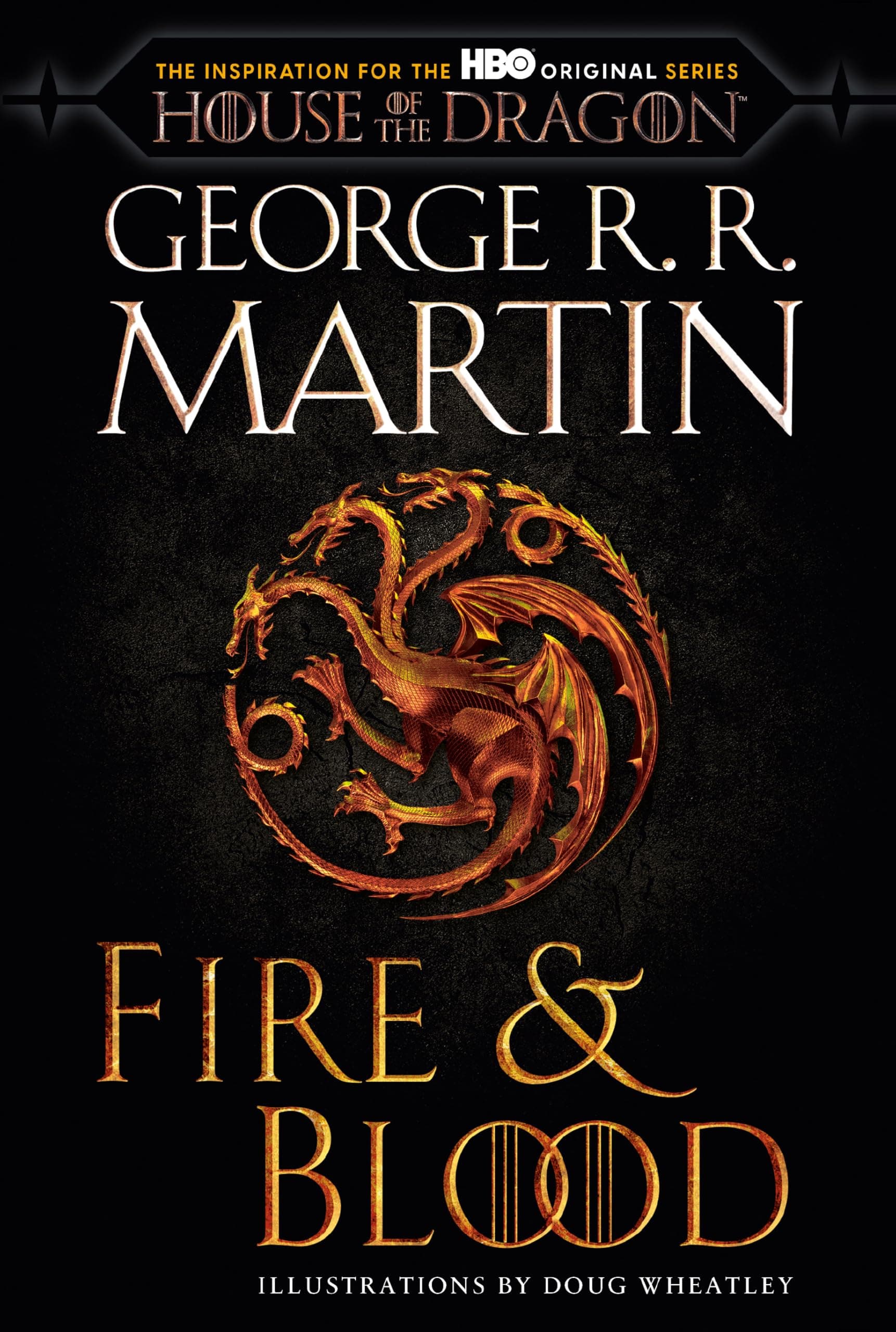
Three hundred years before the War of the Five Kings, a single family of dragonlords fled the cataclysmic Doom of Valyria to settle on the volcanic outpost of Dragonstone. Fire & Blood is not a traditional novel but a sweeping fictional chronicle that documents the bloody ascent of House Targaryen as they transform seven independent, warring kingdoms into a single, fragile empire. Through the eyes of Archmaester Gyldayn, the narrative explores the paradox of absolute power: the dragons that make conquest possible are the same terrifying tools that make peaceful governance nearly impossible.
The story pivots on the brutal mechanics of state-building and the inherent instability of a dynasty built on fire. As Aegon the Conqueror and his sisters establish the Iron Throne, the focus shifts from the glory of the battlefield to the gritty reality of administrative survival. The transition from Aegon’s raw dominance to the reigns of his successors reveals the vulnerabilities of the Targaryen line, testing whether a family defined by their proximity to monsters can maintain order once the initial terror of their arrival begins to fade.
The world-building in this volume focuses on the transition from a collection of disparate cultures—the ironborn of the west, the Reach’s chivalric traditions, and the North’s ancient isolation—into a central bureaucracy. The atmosphere is one of profound cultural friction. Martin details the establishment of the Kingsguard, the construction of the Red Keep, and the creation of the Small Council as desperate attempts to codify power that was initially won through dragonfire. The setting is defined by the physical presence of these dragons; they are the ultimate "nuclear" deterrent, yet their presence complicates the Targaryens' relationship with the Faith of the Seven and the local lords who view the newcomers as incestuous, foreign invaders.
The character development in the first half of the book centers on the psychological burden of inheriting a legend. While Aegon I is a figure of mythic stability, his sons, Aenys and Maegor, represent two extremes of leadership: the weak-willed diplomat and the iron-fisted tyrant. Their development is defined by their relationship to their father’s legacy and their diverging methods of handling the "Faith Militant" uprising. The central dynamic is the struggle between the Targaryen desire for exceptionalism—maintaining their Valyrian customs—and the political necessity of assimilating into the Westerosi social order.
Fire & Blood utilizes the "Fictional History" trope to subvert the typical hero’s journey. By using an unreliable narrator like Archmaester Gyldayn, the book critiques the "Great Man Theory" of history. Instead of clear-cut victories, the text highlights how historical accounts are often contradictory, shaped by the biases and agendas of the people who survive to write them. It also subverts the trope of the "Benevolent King" by showing that even the most well-intentioned rulers must often choose between moral purity and the survival of their house. The dragons themselves are treated less like magical companions and more like high-maintenance weapons of mass destruction that require constant management and territorial control.
This is not a novel, and the people who enjoy it are the ones who accept that on page one. Martin writes it as an in-world history by Archmaester Gyldayn, who may not be telling the whole truth, and the book sometimes hands you competing versions of the same event. That's either its best trick or its biggest drawback.
The pitch is power. Dragons win the war, then make peace almost impossible, and the sons who inherit Aegon's legend are a weak-willed diplomat and an iron-fisted tyrant. Because the book covers nearly three centuries, characters flash past and the genealogies get thick. Some readers find that propulsive. Others find it a dry slog across 700 pages. Plenty of early opinions were really about The Winds of Winter, which isn't fair to the book.
Add to your library to track progress and write reviews
The reviews land at opposite ends. Dan Jones in the Sunday Times praised it as a high point of popular historical fiction, while The Independent found homework in its pages. The Irish News split the difference: enthralling, but uneven and hard to follow genealogically.
Find Fire & Blood George R.R. Martin in PDF, EPUB, ebook, audiobook, print, or library editions.
1 books in catalog
A Targaryen History