
From Princeton sociologist and MacArthur "Genius" Matthew Desmond, a landmark work of scholarship and reportage that will forever change the way we look at poverty in America
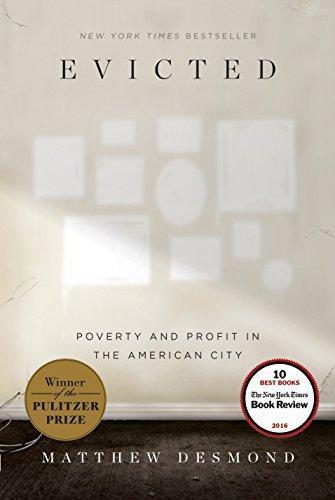
In this brilliant, heartbreaking book, Matthew Desmond takes us into the poorest neighborhoods of Milwaukee to tell the story of eight families on the edge. Arleen is a single mother trying to raise her two sons on the $20 a month she has left after paying for their rundown apartment. Scott is a gentle nurse consumed by a heroin addiction. Lamar, a man with no legs and a neighborhood full of boys to look after, tries to work his way out of debt. Vanetta participates in a botched stickup after her hours are cut. All are spending almost everything they have on rent, and all have fallen behind.
The fates of these families are in the hands of two landlords: Sherrena Tarver, a former schoolteacher turned inner-city entrepreneur, and Tobin Charney, who runs one of the worst trailer parks in Milwaukee. They loathe some of their tenants and are fond of others, but as Sherrena puts it, “Love don’t pay the bills.” She moves to evict Arleen and her boys a few days before Christmas.
Even in the most desolate areas of American cities, evictions used to be rare. But today, most poor renting families are spending more than half of their income on housing, and eviction has become ordinary, especially for single mothers. In vivid, intimate prose, Desmond provides a ground-level view of one of the most urgent issues facing America today. As we see families forced into shelters, squalid apartments, or more dangerous neighborhoods, we bear witness to the human cost of America’s vast inequality—and to people’s determination and intelligence in the face of hardship.
Based on years of embedded fieldwork and painstakingly gathered data, this masterful book transforms our understanding of extreme poverty and economic exploitation while providing fresh ideas for solving a devastating, uniquely American problem. Its unforgettable scenes of hope and loss remind us of the centrality of home, without which nothing else is possible. (source)
From Princeton sociologist and MacArthur "Genius" Matthew Desmond, a landmark work of scholarship and reportage that will forever change the way we look at poverty in America
In this brilliant, heartbreaking book, Matthew Desmond takes us into the poorest neighborhoods of Milwaukee to tell the story of eight families on the edge. Arleen is a single mother trying to raise her two sons on the $20 a month she has left after paying for their rundown apartment. Scott is a gentle nurse consumed by a heroin addiction. Lamar, a man with no legs and a neighborhood full of boys to look after, tries to work his way out of debt. Vanetta participates in a botched stickup after her hours are cut. All are spending almost everything they have on rent, and all have fallen behind.
The fates of these families are in the hands of two landlords: Sherrena Tarver, a former schoolteacher turned inner-city entrepreneur, and Tobin Charney, who runs one of the worst trailer parks in Milwaukee. They loathe some of their tenants and are fond of others, but as Sherrena puts it, “Love don’t pay the bills.” She moves to evict Arleen and her boys a few days before Christmas.
Even in the most desolate areas of American cities, evictions used to be rare. But today, most poor renting families are spending more than half of their income on housing, and eviction has become ordinary, especially for single mothers. In vivid, intimate prose, Desmond provides a ground-level view of one of the most urgent issues facing America today. As we see families forced into shelters, squalid apartments, or more dangerous neighborhoods, we bear witness to the human cost of America’s vast inequality—and to people’s determination and intelligence in the face of hardship.
Based on years of embedded fieldwork and painstakingly gathered data, this masterful book transforms our understanding of extreme poverty and economic exploitation while providing fresh ideas for solving a devastating, uniquely American problem. Its unforgettable scenes of hope and loss remind us of the centrality of home, without which nothing else is possible. (source)
Add to your library to track progress and write reviews

Find Evicted: Poverty and Profit in the American City Matthew Desmond in PDF, EPUB, ebook, audiobook, print, or library editions.

1 books in catalog
Rigorous sociological fieldwork and data-driven analysis of urban housing insecurity transformed contemporary understandings of American poverty through the landmark book Evicted: Poverty and Profit in the American City. Sociologist Matthew Desmond combined immersive ethnography with extensive quantitative research to demonstrate how housing loss serves as a driver, rather than merely a symptom, of economic deprivation across the United States.
His work provides an influential examination of how low-income rental markets, systemic eviction, and public policy intersect to shape the daily survival strategies of vulnerable households.
Desmond completed his undergraduate studies at Arizona State University before earning his Master of Arts and his Ph.D. in 2010 from the University of Wisconsin at Madison, where he studied under sociologist Mustafa Emirbayer. Following his doctoral studies, he joined the Harvard Society of Fellows as a Junior Fellow and later served as the John L. Loeb Associate Professor of the Social Sciences at Harvard University. He subsequently joined the faculty at Princeton University, where he serves as the Maurice P. During Professor of Sociology. At Princeton, he founded and acts as the principal investigator for The Eviction Lab, a research initiative devoted to building nationwide data on eviction and housing hardship. His academic distinctions include receiving a MacArthur "Genius" grant in 2015 and election to the American Philosophical Society in 2022.
Desmond's research and writing focus heavily on urban sociology, social theory, ethnography, race and ethnicity, and the dynamics of organizations and work. His methodological approach pairs deeply personal human narratives from direct field observation with empirical analysis of broader social structures. Across his scholarship, he explores topics ranging from extreme workplace hazards and educational inequality to network-based survival strategies among urban residents and the consequences of new crime control policies on inner-city women. His academic writing has appeared in major publications including the American Journal of Sociology, American Sociological Review, Social Forces, and Demography.

1 books in catalog
Rigorous sociological fieldwork and data-driven analysis of urban housing insecurity transformed contemporary understandings of American poverty through the landmark book Evicted: Poverty and Profit in the American City. Sociologist Matthew Desmond combined immersive ethnography with extensive quantitative research to demonstrate how housing loss serves as a driver, rather than merely a symptom, of economic deprivation across the United States.
His work provides an influential examination of how low-income rental markets, systemic eviction, and public policy intersect to shape the daily survival strategies of vulnerable households.
Desmond completed his undergraduate studies at Arizona State University before earning his Master of Arts and his Ph.D. in 2010 from the University of Wisconsin at Madison, where he studied under sociologist Mustafa Emirbayer. Following his doctoral studies, he joined the Harvard Society of Fellows as a Junior Fellow and later served as the John L. Loeb Associate Professor of the Social Sciences at Harvard University. He subsequently joined the faculty at Princeton University, where he serves as the Maurice P. During Professor of Sociology. At Princeton, he founded and acts as the principal investigator for The Eviction Lab, a research initiative devoted to building nationwide data on eviction and housing hardship. His academic distinctions include receiving a MacArthur "Genius" grant in 2015 and election to the American Philosophical Society in 2022.
Desmond's research and writing focus heavily on urban sociology, social theory, ethnography, race and ethnicity, and the dynamics of organizations and work. His methodological approach pairs deeply personal human narratives from direct field observation with empirical analysis of broader social structures. Across his scholarship, he explores topics ranging from extreme workplace hazards and educational inequality to network-based survival strategies among urban residents and the consequences of new crime control policies on inner-city women. His academic writing has appeared in major publications including the American Journal of Sociology, American Sociological Review, Social Forces, and Demography.