Elective Affinities,
by Johann Wolfgang von Goethe, Maria Assunção Pinto Correia, João Barrento
by Johann Wolfgang von Goethe, Maria Assunção Pinto Correia, João Barrento
by Johann Wolfgang von Goethe, Maria Assunção Pinto Correia, João Barrento
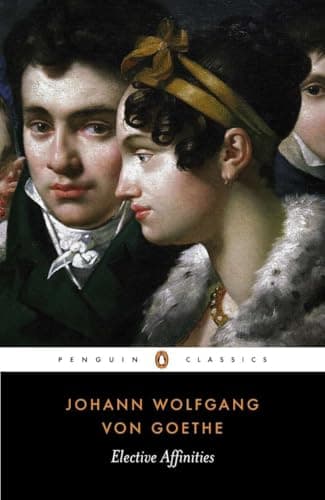
German writer Johann Goethe's novella "Elective Affinities" is a singular book which attracts both creative minds and pragmatic minds. Romantics at heart will be drawn to the convoluted love affair; married couple Eduard and Charlotte invite two close friends to live with them on their idyllic estate for a short time. The innocent invitation takes an unexpected turn though, as each of the spouses become attracted to their guests. Eduard falls in love with Ottilie, the young and attractive niece of Charlotte, and Charlotte finds herself drawn to Captain, the down-on-his-luck friend of Eduard. What draws science-minded readers to the story is Goethe's theory of elective affinities, or the relationship between certain compounds which means that they only react with each other under very unique circumstances. Goethe draws comparisons of science with sociology, allowing his characters to act and react with each other based on the elective affinity principle. The characters pairing up under the circumstances of their living condition creates a passionate, secretive environment that causes each person to reconsider their own morals. They want love, but how far are they willing to go to obtain it? Goethe pits two opposing ideas against each other: that people are slave to their desires and their own agents of free will. It is a dichotomy that has captivated audiences to return to "Elective Affinities" for over two-hundred years.
German writer Johann Goethe's novella "Elective Affinities" is a singular book which attracts both creative minds and pragmatic minds. Romantics at heart will be drawn to the convoluted love affair; married couple Eduard and Charlotte invite two close friends to live with them on their idyllic estate for a short time. The innocent invitation takes an unexpected turn though, as each of the spouses become attracted to their guests. Eduard falls in love with Ottilie, the young and attractive niece of Charlotte, and Charlotte finds herself drawn to Captain, the down-on-his-luck friend of Eduard. What draws science-minded readers to the story is Goethe's theory of elective affinities, or the relationship between certain compounds which means that they only react with each other under very unique circumstances. Goethe draws comparisons of science with sociology, allowing his characters to act and react with each other based on the elective affinity principle. The characters pairing up under the circumstances of their living condition creates a passionate, secretive environment that causes each person to reconsider their own morals. They want love, but how far are they willing to go to obtain it? Goethe pits two opposing ideas against each other: that people are slave to their desires and their own agents of free will. It is a dichotomy that has captivated audiences to return to "Elective Affinities" for over two-hundred years.
Add to your library to track progress and write reviews
Add to your library to track progress and write reviews
Find Elective Affinities Johann Wolfgang von Goethe in PDF, EPUB, ebook, audiobook, print, or library editions.
Find Elective Affinities Johann Wolfgang von Goethe in PDF, EPUB, ebook, audiobook, print, or library editions.

2 books in catalog
The two-part tragedy Faust remains one of the seminal works of European drama, examining human ambition, morality, and spiritual longing through a scholar's pact with Mephistopheles. German writer and polymath Johann Wolfgang von Goethe created an extensive body of work that encompassed poetry, theater, epistolary fiction, and foundational entries in the Bildungsroman genre. His writings transformed late eighteenth- and early nineteenth-century European literature while reflecting his wide-ranging intellectual pursuits across philosophy, aesthetics, and natural science.
Born on August 28, 1749, in Frankfurt am Main, Goethe was raised in a prosperous home where he and his sister Cornelia were educated by a private tutor in history, Latin, and Greek. Encouraged by his father, a lawyer and state councillor, he pursued legal studies, traveling to Strassburg in 1770 to complete his degree. There he met Johann Gottfried Herder, a leading figure in the Sturm und Drang movement, who encouraged his deep engagement with poetry and classical literature. Over the following decades, Goethe developed a multifaceted career as a civil servant, statesman, and theater director in Weimar alongside his writing. Elevated to the nobility in 1782, he maintained administrative duties for the duchy while conducting scientific studies in botany, anatomy, and optics until his death on March 22, 1832.
Goethe's literary style evolved from the intense passion and individualism of the Sturm und Drang movement to the balanced, reflective principles of Weimar Classicism. His narratives and lyric poetry frequently explore themes of personal development, human passion, intellectual curiosity, and the conflict between individual desires and social expectations. In The Sorrows of Young Werther, he employed the epistolary form to portray psychological distress, while Wilhelm Meister's Apprenticeship established major conventions for coming-of-age novels. In his 1809 novel Elective Affinities, Goethe combined psychological observation with scientific concepts, drawing on chemical theories to analyze marriage and human attraction.
2 books in catalog
The two-part tragedy Faust remains one of the seminal works of European drama, examining human ambition, morality, and spiritual longing through a scholar's pact with Mephistopheles. German writer and polymath Johann Wolfgang von Goethe created an extensive body of work that encompassed poetry, theater, epistolary fiction, and foundational entries in the Bildungsroman genre. His writings transformed late eighteenth- and early nineteenth-century European literature while reflecting his wide-ranging intellectual pursuits across philosophy, aesthetics, and natural science.
Born on August 28, 1749, in Frankfurt am Main, Goethe was raised in a prosperous home where he and his sister Cornelia were educated by a private tutor in history, Latin, and Greek. Encouraged by his father, a lawyer and state councillor, he pursued legal studies, traveling to Strassburg in 1770 to complete his degree. There he met Johann Gottfried Herder, a leading figure in the Sturm und Drang movement, who encouraged his deep engagement with poetry and classical literature. Over the following decades, Goethe developed a multifaceted career as a civil servant, statesman, and theater director in Weimar alongside his writing. Elevated to the nobility in 1782, he maintained administrative duties for the duchy while conducting scientific studies in botany, anatomy, and optics until his death on March 22, 1832.
Goethe's literary style evolved from the intense passion and individualism of the Sturm und Drang movement to the balanced, reflective principles of Weimar Classicism. His narratives and lyric poetry frequently explore themes of personal development, human passion, intellectual curiosity, and the conflict between individual desires and social expectations. In The Sorrows of Young Werther, he employed the epistolary form to portray psychological distress, while Wilhelm Meister's Apprenticeship established major conventions for coming-of-age novels. In his 1809 novel Elective Affinities, Goethe combined psychological observation with scientific concepts, drawing on chemical theories to analyze marriage and human attraction.