SSansFiction
The libraryCollectionsJournalStatsFor authors
Sign inJoin now
Sansfiction,

A digital library for books. Made by readers, for readers.

v 2.0 · 2026
The library
  • Discover
  • Collections
  • Book tracker
  • Journal
  • Stats
For authors
  • SF Links
  • Analytics
  • How it works
  • FAQ
Elsewhere
  • X / @sansfiction
  • Privacy
  • Terms
  • Contact
© 2026 SansFiction · Digital · GlobalA quiet room for your reading life.
The libraryCollectionsJournalStatsFor authors
Sign inJoin now →
Navigation
Library
Bookshelf
Journal
Discover
Collections
Tierlists
Stats
Profile
Author Page
Link Builder
Account
Sign in
S
G
Booksзарубежная фантастикаДюна. Мессия Дюны. Дети Дюны
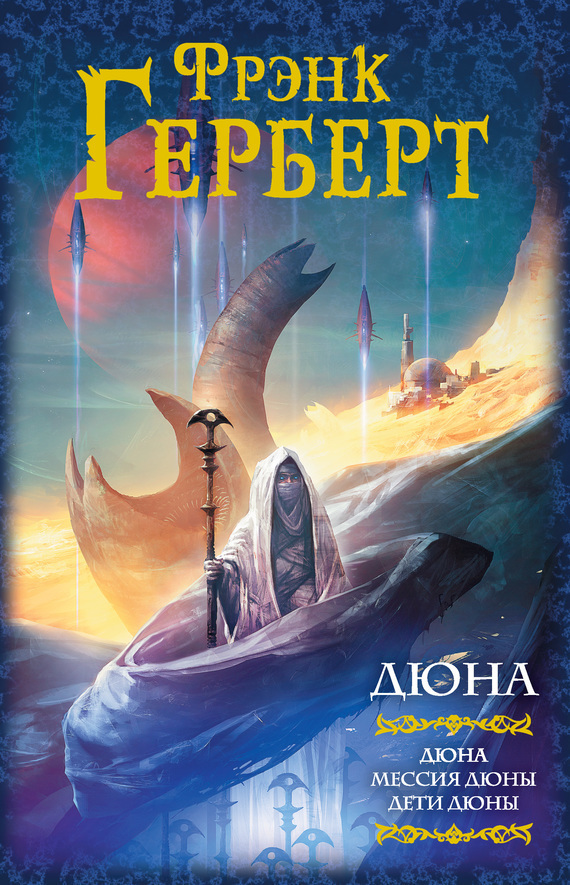
Cover of Дюна. Мессия Дюны. Дети Дюны by Frank Herbert

Дюна. Мессия Дюны. Дети Дюны,

by Frank Herbert

Ask AI
Rating4.4/ 5
Ratings93
Pages1500
Reading Hours31h
Published1976
Language—

§Synopsis

01

Frank Herbert’s initial trilogy is a profound meditation on the intersection of ecology, religion, and political power. Set in a distant future where humanity has spread across the stars, the narrative centers on Arrakis—a harsh, desert world that is the sole source of Melange, the most valuable substance in the universe. This "Spice" not only extends life and enables interstellar travel but also grants its users heightened awareness and, in rare cases, glimpses of the future. The story begins with House Atreides taking control of this volatile planet, unaware that they are stepping into a meticulously crafted trap set by their rivals and the Emperor himself.

What elevates this saga beyond standard space opera is its deconstruction of the "chosen one" narrative. As the young Paul Atreides is thrust into the brutal survival culture of the desert-dwelling Fremen, he is forced to navigate the heavy burden of prophecy. The trilogy explores the terrifying consequences of absolute power and the way charismatic leaders can inadvertently lead their followers toward catastrophe. It is a world where every action is a calculated move in a multi-generational game of chess, and where the survival of the species often hinges on the fragile balance of a single planet's ecosystem.

The Ecology of Arrakis and the Spice Monopoly

The setting of Arrakis is more than a backdrop; it is a mechanical force that dictates the behavior of every character. In this world, water is the ultimate currency, and the "stillsuit"—a garment designed to recycle the body's moisture—is essential for survival. The rules of the desert are absolute: one must master the rhythm of the sands to avoid the attention of the colossal sandworms. The "Spice Melange" acts as the pivot point for the galactic economy, creating a precarious dependency for the Spacing Guild and the Great Houses. This scarcity creates a high-stakes environment where environmental engineering is as much a weapon as any blade or laser.

Main Characters

  • Paul Atreides: The heir to a noble house who must adapt to the unforgiving desert while managing the terrifying emergence of his prescient abilities.
  • Lady Jessica: A member of the secretive Bene Gesserit sisterhood who defies her orders to protect her son and guide him through ancient religious myths.
  • Baron Vladimir Harkonnen: The cold, calculating antagonist whose obsession with destroying House Atreides drives the initial political conflict.
  • Stilgar: A Fremen Naib who represents the soul of Arrakis, balancing deep traditional spirituality with the pragmatic ruthlessness required to survive the deep desert.
  • Alia Atreides: Paul’s younger sister, born with an unsettling level of awareness and the ancestral memories of thousands, making her a figure of both awe and fear.

The Burden of Prescience and Political Intrigue

As the narrative progresses from the initial conflict into the complexities of governance, the protagonist's development shifts from survival to the management of destiny. Prescience—the ability to see the future—is presented not as a superpower, but as a trap. The characters find themselves locked into "time-paths" where their attempts to avoid a dark future often bring it closer. The relationship dynamics are defined by secrecy; even among allies, every word is weighed for its political implications and its alignment with ancient prophecies planted generations ago by the Bene Gesserit.

Subverting the Heroic Archetype

Herbert utilizes the "Hero’s Journey" trope only to systematically dismantle it. While many science fiction works celebrate the rise of a savior, this trilogy serves as a cautionary tale about the dangers of surrendering personal agency to a messianic figure. It subverts the "civilized vs. primitive" trope by showing the Fremen not as a people in need of saving, but as a highly sophisticated society with a superior understanding of their environment. The conflict is not a simple battle of good versus evil, but a clash of competing systems—ecological, religious, and imperial—where every victory comes with a devastating long-term cost.

Track this book

Add to your library to track progress and write reviews

§Genres
зарубежная фантастика1космическая фантастика1
§Tags
#внеземные цивилизации1#генетические эксперименты1#далёкое будущее1#звездная империя1#космоопера1#терраформирование1#философская фантастика1

§About the Author

Frank Herbert
Frank Herbert

22 books in catalog

The desert planet of Arrakis, with its giant sandworms, complex ecology, and political factions vying for control over the spice melange, remains one of the most thoroughly detailed world-building achievements in speculative fiction. American author Frank Herbert introduced this setting in his seminal 1965 novel Dune, creating an expansive universe that transformed epic science fiction by weaving together ecology, philosophy, religion, and political intrigue.

Career & Background

Born in Tacoma, Washington in 1920, Herbert spent his youth in the Pacific Northwest and worked on local newspapers as a teenager. He attended the University of Washington in Seattle and worked a wide variety of jobs throughout his early adult life, including time as a TV cameraman, radio commentator, oyster diver, jungle survival instructor, lay analyst, and creative writing teacher. He also worked as a reporter and later editor of a number of West Coast newspapers before becoming a full-time writer. Herbert began publishing science fiction in 1952 with his short story 'Looking for Something?' in Startling Stories. His research into the Oregon Dunes during the 1950s served as a primary catalyst for his ecological themes. He achieved widespread fame more than ten years later following the serial publication in Analog of 'Dune World' and 'The Prophet of Dune', which were amalgamated into the novel Dune in 1965.

Writing Style & Themes

Herbert's fiction is distinguished by its intricate world-building, ecological awareness, and deep examination of human potential and institutional vulnerability. Rather than relying solely on technological advancement, his narrative focus often centers on human adaptability, psychological conditioning, religious mythmaking, and the perilous consequences of messianic leadership. He frequently explored how harsh environments shape cultures, social structures, and survival strategies, a focus prominently displayed in novels such as Destination: Void and The Jesus Incident alongside his desert sagas.

Major Works

  • Dune — Published in 1965 after being serialized in Analog as 'Dune World' and 'The Prophet of Dune', this novel explores Paul Atreides's journey on the desert planet Arrakis amid feudal galactic politics and ecological struggle.
  • Dune Messiah — The second novel in the series continues the narrative of Paul Atreides, examining the tragic consequences of imperial power and religious fervor.
  • Children of Dune — The third installment focuses on Paul's twin children, Leto II and Ghanima, as they navigate the shifting ecological and political landscape of Arrakis.
  • Destination: Void — A standalone science fiction novel exploring artificial intelligence, human consciousness, and survival aboard a crewed starship.
  • The Jesus Incident — Co-authored with Bill Ransom, this novel expands upon the themes of artificial intelligence, worship, and ecological adaptation on an alien ocean world.
§Genres
зарубежная фантастика1космическая фантастика1
§Tags
#внеземные цивилизации1#генетические эксперименты1#далёкое будущее1#звездная империя1#космоопера1#терраформирование1#философская фантастика1