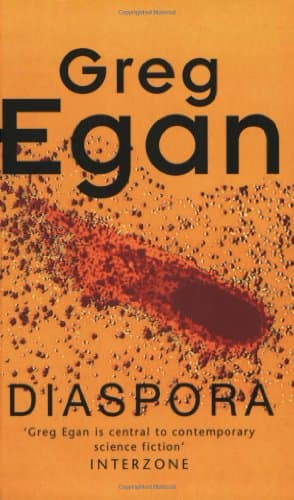
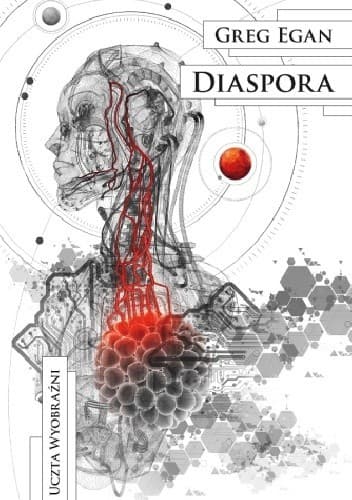
In 2975, the orphan Yatima is grown from a randomly mutated digital mind seed in the conceptory of Konishi polis. Yatima explores the Coalition of Polises, the network of computers where most life in the solar system now resides, and joins a friend, Inoshiro, to borrow an abandoned robot body and meet a thriving community of “fleshers” in the enclave of Atlanta. Twenty-one years later, news arrives from a lunar observatory: gravitational waves from Lac G-1, a nearby pair of neutron stars, show that the Earth is about to be bathed in a gamma-ray flash created by the stars’ collision — an event that was not expected to take place for seven million years. Yatima and Inoshiro return to Atlanta to try to warn the fleshers, but meet suspicion and disbelief. Some lives are saved, but the Earth is ravaged. In the aftermath of the disaster, the survivors resolve to discover the cause of the neutron stars’ premature collision, and they launch a thousand polises into interstellar space in search of answers. This diaspora eventually reaches a planet subtly transformed to encode a message from an older group of travellers: a greater danger than Lac G-1 is imminent, and the only escape route leads beyond the visible universe.
Add to your library to track progress and write reviews
Find Diaspora Greg Egan in PDF, EPUB, ebook, audiobook, print, or library editions.

3 books in catalog
Rigorous hard science fiction centered on mathematical physics, quantum ontology, and digital consciousness defines a major body of late-twentieth and twenty-first-century speculative literature. Greg Egan, an Australian science fiction writer and mathematician, has earned widespread critical acclaim for intellectually demanding novels such as Permutation City and Diaspora, which explore the fundamental physics of reality and simulated human minds.
Born on August 20, 1961, in Perth, Western Australia, Gregory Mark Egan earned a Bachelor of Science in Mathematics from the University of Western Australia. He subsequently worked as a computer programmer while publishing speculative fiction. His debut novel, An Unusual Angle, appeared in 1983, followed by his first genre short story, "Artifact," in the same year. Over a career starting in the 1980s, Egan emerged as a premier author of hard science fiction, winning prestigious honours such as the Hugo Award, the John W. Campbell Memorial Award, and the Locus Award.
Egan's writing focuses on rigorous hard science fiction, incorporating sophisticated concepts from mathematics, theoretical physics, biology, cybernetics, and artificial intelligence. His narratives frequently investigate quantum ontology, mind transfer, simulated reality, posthumanism, genetics, and the philosophical implications of rational naturalism. Although third-party bibliographies sometimes group certain novels into a sequence called "The Subjective Cosmology Cycle," Egan clarified that those books share thematic similarities noticed in retrospect rather than an intentional series. Alongside full-length novels like Morphotrophic, Egan creates applets, science articles, and mathematical notes on his personal website to supplement his fiction.