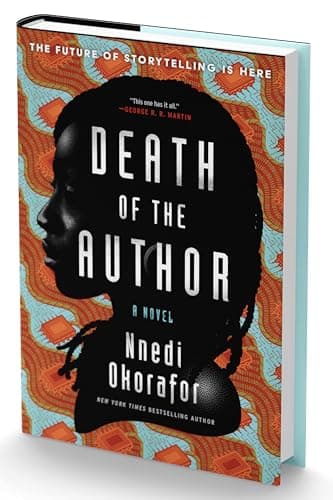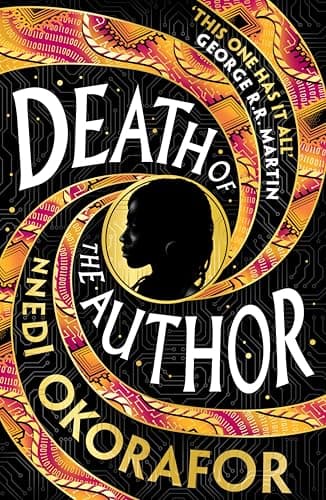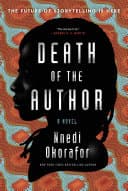
Disabled, disinclined to marry, and more interested in writing than a lucrative career in medicine or law, Zelu has always felt like the outcast of her large Nigerian family. Then her life is upended when, in the middle of her sister’s lavish Caribbean wedding, she’s unceremoniously fired from her university job and, to add insult to injury, her novel is rejected by yet another publisher. With her career and dreams crushed in one fell swoop, she decides to write something just for herself. What comes out is nothing like the quiet, literary novels that have so far peppered her unremarkable career. It’s a far-future epic where androids and AI wage war in the grown-over ruins of human civilization. She calls it Rusted Robots.
When Zelu finds the courage to share her strange novel, she does not realize she is about to embark on a life-altering journey—one that will catapult her into literary stardom, but also perhaps obliterate everything her book was meant to be. From Chicago to Lagos to the far reaches of space, Zelu’s novel will change the future not only for humanity, but for the robots who come next.
A book-within-a-book that blends the line between writing and being written, Death of the Author is a masterpiece of metafiction that manages to combine the razor-sharp commentary of Yellowface with the heartfelt humanity of Tomorrow and Tomorrow and Tomorrow. Surprisingly funny, deeply poignant, and endlessly discussable, this is at once the tale of a woman on the margins risking everything to be heard and a testament to the power of storytelling to shape the world as we know it.
Add to your library to track progress and write reviews
Find Death of the Author Nnedi Okorafor in PDF, EPUB, ebook, audiobook, print, or library editions.

10 books in catalog
Speculative fiction rooted in African culture and mythology defines the speculative fiction landscape through subgenres coined as Africanfuturism and Africanjujuism. Nnedi Okorafor is a New York Times bestselling author of science fiction and fantasy for both children and adults whose work bridges African heritage with futuristic and magical narratives. Her award-winning novella Binti and her post-apocalyptic novel Who Fears Death demonstrate her distinct approach to combining indigenous African traditions with advanced technology and fantasy elements.
Through her expansive bibliography of novels, novellas, graphic novels, and children's books, Okorafor has redefined contemporary science fiction by centering African perspectives and complex Black female protagonists.
Born Nnedimma Nkemdili Okorafor on April 8, 1974, in Cincinnati, Ohio, to Igbo Nigerian immigrant parents who came to the United States in the late 1960s, she grew up primarily in the southern suburbs of Chicago while taking frequent trips to Nigeria to visit family. These visits deeply shaped her creative vision and grounded her understanding of her cultural roots. She earned a Bachelor of Arts in rhetoric from the University of Illinois, a Master of Arts in journalism from Michigan State University, an MA in English from the University of Chicago, and completed a PhD in literature in 2007. An alumna of the Clarion science fiction and fantasy writers' workshop, she began publishing acclaimed fiction across multiple age categories.
Okorafor's debut novel, Zahrah the Windseeker, won the Wole Soyinka Prize for Literature, while her children's book Long Juju Man received the Macmillan Writer's Prize for Africa. Her novel Who Fears Death won the World Fantasy Award for Best Novel and was placed in development at HBO for a television series adaptation. She continued to expand her bibliography with The Book of Phoenix, the Binti novella trilogy—which won both Hugo and Nebula awards and was optioned for television by Media Res—and the Nsibidi Scripts series, which includes Akata Warrior and Akata Woman. She has also authored graphic novels such as LaGuardia, which won Hugo and Eisner awards, written comic series for Marvel including Shuri and Wakanda Forever, published the novellas Remote Control and One Way Witch, and released novels such as She Who Knows and Death of the Author. She resides in Phoenix, Arizona, with her daughter, Anyaugo.
Okorafor explicitly differentiates her writing from traditional Western Afrofuturism through her custom definitions of Africanfuturism and Africanjujuism. Africanfuturism is science fiction directly rooted in African culture, history, mythology, and perspectives on the African continent rather than from a Western diaspora standpoint. Africanjujuism, conversely, refers to fantasy that weaves seamless magic into contemporary or historic African life, drawing upon traditional spiritual belief systems and folklore.
Her stories regularly explore themes of racial inequality, gender, identity, sexual violence, social justice, and ecological consciousness. She frequently features young Black female protagonists who navigate alien technology, mystical abilities, and societal expectations. By drawing inspiration from everyday African life, environmental phenomena, and rich oral traditions, Okorafor constructs intricate worlds that highlight African agency and cultural continuity in future and magical settings.