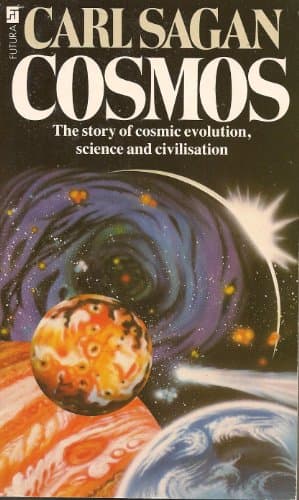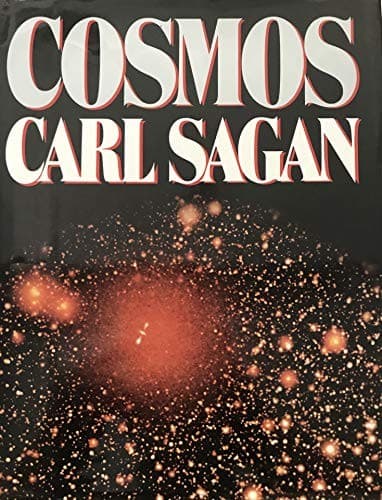
This book is about science in its broadest human context, how science and civilization grew up together. It is the story of our long journey of discovery and the forces and individuals who helped to shape modern science, including Democritus, Hypatia, Kepler, Newton, Huygens, Champollion, Lowell and Humason. The book also explores spacecraft missions of discovery of the nearby planets, the research in the Library of ancient Alexandria, the human brain, Egyptian hieroglyphics, the origin of life, the death of the Sun, the evolution of galaxies and the origins of matter, suns and worlds. The author retraces the fifteen billion years of cosmic evolution that have transformed matter into life and consciousness, enabling the cosmos to wonder about itself. He considers the latest findings on life elsewhere and how we might communicate with the beings of other worlds. ~ WorldCat.org
This book is about science in its broadest human context, how science and civilization grew up together. It is the story of our long journey of discovery and the forces and individuals who helped to shape modern science, including Democritus, Hypatia, Kepler, Newton, Huygens, Champollion, Lowell and Humason. The book also explores spacecraft missions of discovery of the nearby planets, the research in the Library of ancient Alexandria, the human brain, Egyptian hieroglyphics, the origin of life, the death of the Sun, the evolution of galaxies and the origins of matter, suns and worlds. The author retraces the fifteen billion years of cosmic evolution that have transformed matter into life and consciousness, enabling the cosmos to wonder about itself. He considers the latest findings on life elsewhere and how we might communicate with the beings of other worlds. ~ WorldCat.org
Add to your library to track progress and write reviews
Add to your library to track progress and write reviews
Find Cosmos Carl Sagan in PDF, EPUB, ebook, audiobook, print, or library editions.
Find Cosmos Carl Sagan in PDF, EPUB, ebook, audiobook, print, or library editions.

5 books in catalog
Bridging rigorous planetary astronomy and popular science communication, non-fiction literature about the universe achieved unprecedented public reach through books like Cosmos. Carl Sagan transformed complex concepts in astrophysics, planetary science, and the search for extraterrestrial intelligence into accessible, evocative prose for readers worldwide.
Born in Brooklyn, New York, in 1934, Sagan developed a fascination with astronomy during childhood after learning that stars were distant suns. He pursued higher education at the University of Chicago, earning degrees in physics, astronomy, and astrophysics. Early in his academic career, he served as an assistant professor at Harvard University before moving to Cornell University in 1968. At Cornell, he became the David Duncan Professor of Astronomy and Space Sciences and directed the Laboratory for Planetary Studies.
Beyond his academic faculty responsibilities, Sagan played an active role in the American space program from its earliest decades. He served as a NASA consultant starting in the late 1950s, briefed Apollo astronauts, and made critical research contributions to the Mariner, Viking, Pioneer, and Voyager missions. He helped design the interstellar messages affixed to the Pioneer plaque and Voyager Golden Record, and co-founded The Planetary Society to advocate for space exploration. In 1983, he also co-authored research on the atmospheric consequences of nuclear war, introducing the concept of nuclear winter.
Sagan's writing combines scientific precision with humanist philosophy, emphasizing empirical reasoning, critical thinking, and the wonder of scientific discovery. His non-fiction works frequently explore planetary science, the origins of life, and the search for extraterrestrial intelligence, encouraging readers to view humanity from a cosmic perspective. In works like The Demon-Haunted World: Science as a Candle in the Dark, he advocated for skepticism and scientific literacy as vital defenses against pseudoscience and dogmatism.
In addition to his prolific science writing, Sagan authored the 1985 science fiction novel Contact (also published internationally as Contacto), which grounded speculative interstellar communication in realistic physics, radio astronomy, and political diplomacy. Across both fiction and non-fiction, including Shadows of Forgotten Ancestors: Earth Before Human, he consistently examined human origins, evolutionary history, and the moral responsibilities that accompany technological progress.
5 books in catalog
Bridging rigorous planetary astronomy and popular science communication, non-fiction literature about the universe achieved unprecedented public reach through books like Cosmos. Carl Sagan transformed complex concepts in astrophysics, planetary science, and the search for extraterrestrial intelligence into accessible, evocative prose for readers worldwide.
Born in Brooklyn, New York, in 1934, Sagan developed a fascination with astronomy during childhood after learning that stars were distant suns. He pursued higher education at the University of Chicago, earning degrees in physics, astronomy, and astrophysics. Early in his academic career, he served as an assistant professor at Harvard University before moving to Cornell University in 1968. At Cornell, he became the David Duncan Professor of Astronomy and Space Sciences and directed the Laboratory for Planetary Studies.
Beyond his academic faculty responsibilities, Sagan played an active role in the American space program from its earliest decades. He served as a NASA consultant starting in the late 1950s, briefed Apollo astronauts, and made critical research contributions to the Mariner, Viking, Pioneer, and Voyager missions. He helped design the interstellar messages affixed to the Pioneer plaque and Voyager Golden Record, and co-founded The Planetary Society to advocate for space exploration. In 1983, he also co-authored research on the atmospheric consequences of nuclear war, introducing the concept of nuclear winter.
Sagan's writing combines scientific precision with humanist philosophy, emphasizing empirical reasoning, critical thinking, and the wonder of scientific discovery. His non-fiction works frequently explore planetary science, the origins of life, and the search for extraterrestrial intelligence, encouraging readers to view humanity from a cosmic perspective. In works like The Demon-Haunted World: Science as a Candle in the Dark, he advocated for skepticism and scientific literacy as vital defenses against pseudoscience and dogmatism.
In addition to his prolific science writing, Sagan authored the 1985 science fiction novel Contact (also published internationally as Contacto), which grounded speculative interstellar communication in realistic physics, radio astronomy, and political diplomacy. Across both fiction and non-fiction, including Shadows of Forgotten Ancestors: Earth Before Human, he consistently examined human origins, evolutionary history, and the moral responsibilities that accompany technological progress.