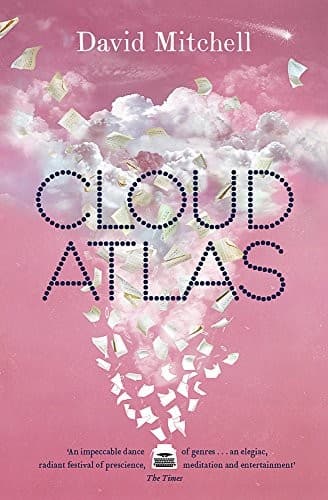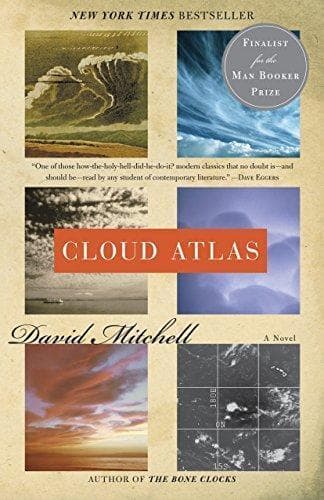
Cloud Atlas begins in 1850 with Adam Ewing, an American notary voyaging from the Chatham Isles to his home in California. Along the way, Ewing is befriended by a physician, Dr. Goose, who begins to treat him for a rare species of brain parasite. . . .
Abruptly, the action jumps to Belgium in 1931, where Robert Frobisher, a disinherited bisexual composer, contrives his way into the household of an infirm maestro who has a beguiling wife and a nubile daughter. . . . From there we jump to the West Coast in the 1970s and a troubled reporter named Luisa Rey, who stumbles upon a web of corporate greed and murder that threatens to claim her life. . . . And onward, with dazzling virtuosity, to an inglorious present-day England; to a Korean superstate of the near future where neocapitalism has run amok; and, finally, to a postapocalyptic Iron Age Hawaii in the last days of history.
But the story doesn’t end even there. The narrative then boomerangs back through centuries and space, returning by the same route, in reverse, to its starting point. Along the way, Mitchell reveals how his disparate characters connect, how their fates intertwine, and how their souls drift across time like clouds across the sky.
Add to your library to track progress and write reviews
Find Cloud Atlas David Mitchell in PDF, EPUB, ebook, audiobook, print, or library editions.

2 books in catalog
Intricate, multi-layered structures spanning diverse historical periods and speculative futures characterize the narrative design of Cloud Atlas. David Mitchell established a distinct reputation through complex nested storytelling that bridges genre boundaries, linking disparate historical vignettes, contemporary realism, and futuristic fiction into single overarching works. Born in 1969, the English author and screenwriter frequently connects his novels through shared characters and sprawling fictional mythologies.
Born in 1969 in Southport, Lancashire, Mitchell grew up in Malvern, Worcestershire. During childhood, he did not speak until age five and subsequently developed a stammer. He went on to study English and American literature at the University of Kent before spending eight years teaching English in Japan, where he committed himself to creative writing. His debut novel, Ghostwritten (1999), earned the John Llewellyn Rhys Prize. Over the course of his career, Mitchell has been shortlisted twice for the Booker Prize and has won the Geoffrey Faber Memorial Prize, the South Bank Show Literature Prize, and the World Fantasy Award.
In 2018, Mitchell received the Sunday Times Award for Literary Excellence in recognition of his entire body of work. Beyond his original fiction, he collaborated with KA Yoshida to translate two non-fiction books from Japanese by Naoki Higashida: The Reason I Jump: The Inner Voice of a Thirteen-Year-Old Boy with Autism and Fall Down 7 Times Get Up 8: A Young Man’s Voice from the Silence of Autism. Mitchell has also expanded into screenwriting, co-writing the film script for The Matrix Resurrections and contributing to television and stage adaptations. He lives in Ireland with his wife and their two children.
Mitchell's fiction is recognized for its stylistic versatility, shifting seamlessly between historical fiction, coming-of-age narrative, dystopian science fiction, and dark fantasy. A defining feature of his oeuvre is the thematic and character continuity that spans across multiple books, creating a unified macro-narrative universe. Whether depicting a adolescent in 1980s Worcestershire in Black Swan Green or chronicling an immortal conflict in The Bone Clocks, his prose focuses on memory, power dynamics, mortality, and human connection across time.