BooksCapitalist Realism: Is There No Alternative?
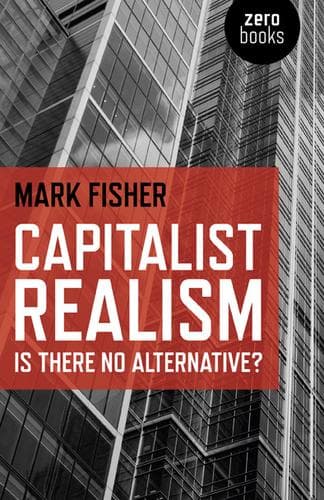
It is easier to imagine the end of the world than the end of capitalism. After 1989, capitalism has successfully presented itself as the only realistic political-economic system - a situation that the bank crisis of 2008, far from ending, actually compounded. The book analyses the development and principal features of this capitalist realism as a lived ideological framework. Using examples from politics, film (Children Of Men, Jason Bourne, Supernanny), fiction (Le Guin and Kafka), work and education, it argues that capitalist realism colours all areas of contemporary experience, is anything but realistic and asks how capitalism and its inconsistencies can be challenged. It is a sharp analysis of the post-ideological malaise that suggests that the economics and politics of free market neo-liberalism are givens rather than constructions.
It is easier to imagine the end of the world than the end of capitalism. After 1989, capitalism has successfully presented itself as the only realistic political-economic system - a situation that the bank crisis of 2008, far from ending, actually compounded. The book analyses the development and principal features of this capitalist realism as a lived ideological framework. Using examples from politics, film (Children Of Men, Jason Bourne, Supernanny), fiction (Le Guin and Kafka), work and education, it argues that capitalist realism colours all areas of contemporary experience, is anything but realistic and asks how capitalism and its inconsistencies can be challenged. It is a sharp analysis of the post-ideological malaise that suggests that the economics and politics of free market neo-liberalism are givens rather than constructions.
Add to your library to track progress and write reviews
Add to your library to track progress and write reviews
Find Capitalist Realism: Is There No Alternative? Mark Fisher in PDF, EPUB, ebook, audiobook, print, or library editions.
Find Capitalist Realism: Is There No Alternative? Mark Fisher in PDF, EPUB, ebook, audiobook, print, or library editions.
1 books in catalog
Cultural theory and political criticism in the early twenty-first century were profoundly shaped by analysis of post-capitalist ideology, music, and media. Mark Fisher made an enduring contribution to contemporary cultural analysis through his influential writings on political theory, popular culture, and hauntology, most notably in his seminal 2009 work Capitalist Realism: Is There No Alternative?.
Born on July 11, 1968, in Leicestershire, England, Fisher pursued higher education at the University of Warwick during the 1990s. While at Warwick, he was instrumental in establishing the Cybernetic Culture Research Unit (CCRU), an experimental collective that explored cyberpunk theory, media subcultures, and radical philosophy outside traditional academic boundaries. In the early 2000s, he established his widely read blog under the pseudonym k-punk, which became a major intellectual platform for music criticism, political commentary, and cultural analysis. Fisher later served as a lecturer in the Department of Visual Cultures at Goldsmiths, University of London, and co-founded the independent publishing imprints Zero Books and Repeater Books.
Fisher's writing combined theoretical rigor with engagement in popular culture, music, film, and literature. His central theoretical concept, capitalist realism, interrogated the widespread cultural sense that capitalism represents the only viable political and economic system. He frequently examined themes of hauntology, lost futures, mental health, and the intersection of politics and aesthetics. Across his essays and books, including Ghosts of My Life and The Weird and the Eerie, Fisher analyzed how contemporary social structures impact collective imagination, artistic production, and individual consciousness.
1 books in catalog
Cultural theory and political criticism in the early twenty-first century were profoundly shaped by analysis of post-capitalist ideology, music, and media. Mark Fisher made an enduring contribution to contemporary cultural analysis through his influential writings on political theory, popular culture, and hauntology, most notably in his seminal 2009 work Capitalist Realism: Is There No Alternative?.
Born on July 11, 1968, in Leicestershire, England, Fisher pursued higher education at the University of Warwick during the 1990s. While at Warwick, he was instrumental in establishing the Cybernetic Culture Research Unit (CCRU), an experimental collective that explored cyberpunk theory, media subcultures, and radical philosophy outside traditional academic boundaries. In the early 2000s, he established his widely read blog under the pseudonym k-punk, which became a major intellectual platform for music criticism, political commentary, and cultural analysis. Fisher later served as a lecturer in the Department of Visual Cultures at Goldsmiths, University of London, and co-founded the independent publishing imprints Zero Books and Repeater Books.
Fisher's writing combined theoretical rigor with engagement in popular culture, music, film, and literature. His central theoretical concept, capitalist realism, interrogated the widespread cultural sense that capitalism represents the only viable political and economic system. He frequently examined themes of hauntology, lost futures, mental health, and the intersection of politics and aesthetics. Across his essays and books, including Ghosts of My Life and The Weird and the Eerie, Fisher analyzed how contemporary social structures impact collective imagination, artistic production, and individual consciousness.