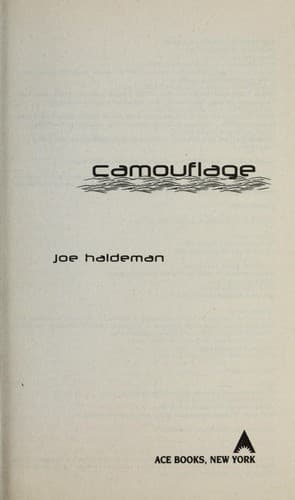
"The artifact is found seven miles below the surface of the sea and beneath forty more feet of sand. The Navy's efforts to raise a wrecked submarine uncover it - and set in motion a scientific race to retrieve it, to discover just what it is and where it came from. Denser than any substance known to man, it has broken every drill bit they've tried on it and will not budge an inch. It resists every effort to breach it - or communicate with it. So the governmenet turns to marine biologist Russell Sutton for help." "Meanwhile, unknown to any of them, two creatures have wandered the earth for generations. The aliens have no knowledge of each other, but possess a residual memory of the artifact - and an affinity for deep water. One, which calls itself the changeling, has survived by adaptation, by taking on many different forms: man, woman, snake, shark. The other, which calls itself the chameleon, has survived solely by destroying anything or anyone that threatens it." "Now, finally brought up from the bottom of the sea, the artifact calls them both...to come home. For all these generations there have been two invincible creatures on Earth. But the chameleon has decided there's only room for one."--BOOK JACKET.
"The artifact is found seven miles below the surface of the sea and beneath forty more feet of sand. The Navy's efforts to raise a wrecked submarine uncover it - and set in motion a scientific race to retrieve it, to discover just what it is and where it came from. Denser than any substance known to man, it has broken every drill bit they've tried on it and will not budge an inch. It resists every effort to breach it - or communicate with it. So the governmenet turns to marine biologist Russell Sutton for help." "Meanwhile, unknown to any of them, two creatures have wandered the earth for generations. The aliens have no knowledge of each other, but possess a residual memory of the artifact - and an affinity for deep water. One, which calls itself the changeling, has survived by adaptation, by taking on many different forms: man, woman, snake, shark. The other, which calls itself the chameleon, has survived solely by destroying anything or anyone that threatens it." "Now, finally brought up from the bottom of the sea, the artifact calls them both...to come home. For all these generations there have been two invincible creatures on Earth. But the chameleon has decided there's only room for one."--BOOK JACKET.
Add to your library to track progress and write reviews
Add to your library to track progress and write reviews
Find Camouflage Joe Haldeman in PDF, EPUB, ebook, audiobook, print, or library editions.
Find Camouflage Joe Haldeman in PDF, EPUB, ebook, audiobook, print, or library editions.

7 books in catalog
Military science fiction reached a defining turning point with the publication of The Forever War, a relentless exploration of interstellar conflict and relativistic time dilation. Author Joe Haldeman drew directly from his personal background as a combat engineer in the Vietnam War to shape this novel, crafting a stark counterpoint to idealized heroic space battles.
Beyond his signature novel, Haldeman established himself as one of speculative fiction's most honored authors, accumulating multiple Hugo, Nebula, and Locus awards across a creative career spanning more than five decades.
Born in Oklahoma City, Oklahoma, on June 9, 1943, Joe William Haldeman spent his youth living in Puerto Rico, New Orleans, Washington, D.C., and Alaska. He pursued higher education in technical disciplines, earning degrees in physics and astronomy before turning his primary focus toward writing. In 1967, Haldeman was drafted into the United States Army and served in the Central Highlands of Vietnam as a combat engineer with the 4th Infantry Division. He was severely wounded during his deployment and received a Purple Heart, an experience that profoundly influenced his worldview and literary vision.
Following his military service, Haldeman translated his trauma and observations into speculative fiction, publishing The Forever War in the mid-1970s to widespread critical acclaim. He extended his literary output across short stories and novels, including major works such as Mindbridge, Forever Peace, and Camouflage. In addition to his creative accomplishments, Haldeman served for three decades as a professor of creative writing at the Massachusetts Institute of Technology from 1983 to 2014. His long-term contributions earned him the Damon Knight Memorial Grand Master Award from the Science Fiction and Fantasy Writers of America in 2009, followed by induction into the Science Fiction Hall of Fame in 2012.
Haldeman's writing is characterized by technical accuracy, psychological honesty, and vivid verisimilitude. Drawing on his academic background in physics and astronomy alongside his military experiences, his narrative style combines rigorous scientific realism with an acute awareness of human vulnerability under stress. Rather than relying on simple heroic tropes, his speculative scenarios explore the psychological costs of conflict, the alienating consequences of relativistic travel, and the absurdities of human social institutions when confronted with cosmic realities.
Central themes across Haldeman's bibliography include the lingering trauma of combat, the challenge of communication across species barriers, and the tension between individual ethics and military bureaucracy. Novels like Forever Peace revisit philosophical questions of conflict and human nature through distinct speculative mechanisms, while short fiction collections such as A Separate War and Other Stories deepen the personal dimensions of his primary story universes. His ability to ground high-concept speculative dilemmas in authentic human reactions remains a central element of his work.
7 books in catalog
Military science fiction reached a defining turning point with the publication of The Forever War, a relentless exploration of interstellar conflict and relativistic time dilation. Author Joe Haldeman drew directly from his personal background as a combat engineer in the Vietnam War to shape this novel, crafting a stark counterpoint to idealized heroic space battles.
Beyond his signature novel, Haldeman established himself as one of speculative fiction's most honored authors, accumulating multiple Hugo, Nebula, and Locus awards across a creative career spanning more than five decades.
Born in Oklahoma City, Oklahoma, on June 9, 1943, Joe William Haldeman spent his youth living in Puerto Rico, New Orleans, Washington, D.C., and Alaska. He pursued higher education in technical disciplines, earning degrees in physics and astronomy before turning his primary focus toward writing. In 1967, Haldeman was drafted into the United States Army and served in the Central Highlands of Vietnam as a combat engineer with the 4th Infantry Division. He was severely wounded during his deployment and received a Purple Heart, an experience that profoundly influenced his worldview and literary vision.
Following his military service, Haldeman translated his trauma and observations into speculative fiction, publishing The Forever War in the mid-1970s to widespread critical acclaim. He extended his literary output across short stories and novels, including major works such as Mindbridge, Forever Peace, and Camouflage. In addition to his creative accomplishments, Haldeman served for three decades as a professor of creative writing at the Massachusetts Institute of Technology from 1983 to 2014. His long-term contributions earned him the Damon Knight Memorial Grand Master Award from the Science Fiction and Fantasy Writers of America in 2009, followed by induction into the Science Fiction Hall of Fame in 2012.
Haldeman's writing is characterized by technical accuracy, psychological honesty, and vivid verisimilitude. Drawing on his academic background in physics and astronomy alongside his military experiences, his narrative style combines rigorous scientific realism with an acute awareness of human vulnerability under stress. Rather than relying on simple heroic tropes, his speculative scenarios explore the psychological costs of conflict, the alienating consequences of relativistic travel, and the absurdities of human social institutions when confronted with cosmic realities.
Central themes across Haldeman's bibliography include the lingering trauma of combat, the challenge of communication across species barriers, and the tension between individual ethics and military bureaucracy. Novels like Forever Peace revisit philosophical questions of conflict and human nature through distinct speculative mechanisms, while short fiction collections such as A Separate War and Other Stories deepen the personal dimensions of his primary story universes. His ability to ground high-concept speculative dilemmas in authentic human reactions remains a central element of his work.