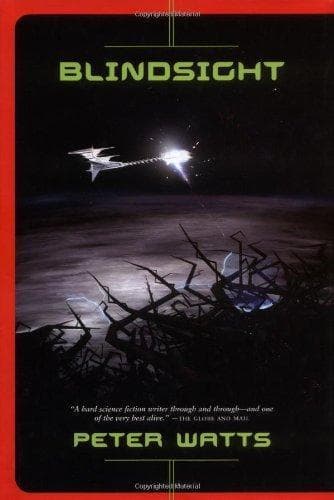
Two months since the stars fell...
Two months since sixty-five thousand alien objects clenched around the Earth like a luminous fist, screaming to the heavens as the atmosphere burned them to ash. Two months since that moment of brief, bright surveillance by agents unknown.
Two months of silence while a world holds its breath.
Now some half-derelict space probe, sparking fitfully past Neptune's orbit, hears a whisper from the edge of the solar system: a faint signal sweeping the cosmos like a lighthouse beam. Whatever's out there isn't talking to us. It's talking to some distant star, perhaps. Or perhaps to something closer, something en route.
So who do you send to force introductions on an intelligence with motives unknown, maybe unknowable? Who do you send to meet the alien when the alien doesn't want to meet?
You send a linguist with multiple personalities, her brain surgically partitioned into separate, sentient processing cores. You send a biologist so radically interfaced with machinery that he sees X-rays and tastes ultrasound, so compromised by grafts and splices that he no longer feels his own flesh. You send a pacifist warrior in the faint hope she won't be needed, and a fainter hope that she'll do any good if she is needed. You send a monster to command them all, an extinct hominid predator once called "vampire," recalled from the grave with the voodoo of recombinant genetics and the blood of sociopaths. And you send a synthesist—an informational topologist with half his mind gone—as an interface between here and there, a conduit through which the Dead Center might hope to understand the Bleeding Edge.
You send them all to the edge of interstellar space, praying you can trust such freaks and retrofits with the fate of a world. You fear they may be more alien than the thing they've been sent to find.
But you'd give anything for that to be true, if you only knew what was waiting for them....
Add to your library to track progress and write reviews
Find Blindsight Peter Watts in PDF, EPUB, ebook, audiobook, print, or library editions.
Firefall

1 books in catalog
Rigorous biological concepts, deep-sea ecology, and hard science fiction collide in speculative novels that explore consciousness, post-human evolution, and first contact. Canadian author and marine-mammal biologist Peter Watts gained widespread recognition with his novel Blindsight, which examines the nature of mind and self-awareness through a tense interstellar encounter.
Born in Calgary, Alberta, in 1958, Watts pursued higher education in marine biology, earning a B.Sc. and M.Sc. from the University of Guelph before completing a Ph.D. at the University of British Columbia in 1991 with a doctoral thesis on harbour seal hauling-out behavior. He began publishing speculative short fiction in 1990 with the story 'A Niche', which served as the foundation for his 1999 debut novel Starfish. The novel inaugurated the Rifters sequence, continuing in Maelstrom and concluding in the two-volume release Behemoth. Over his career, Watts has survived a life-threatening bout of necrotizing fasciitis and faced a high-profile legal dispute following an incident at the United States border. His fiction has been translated into more than twenty languages and honored with major genre awards, including the Hugo Award and the Shirley Jackson Award.
Watts is recognized for his hard science fiction, drawing directly on his academic background in biology and neuroscience to build grounded yet disturbing speculative scenarios. His prose frequently interrogates human cognition, asking whether sentience and self-awareness are evolutionary advantages or maladaptive flaws. Rather than relying on traditional space-opera tropes, his narratives integrate advanced concepts in artificial intelligence, deep-sea microbiology, theoretical neurology, and evolutionary biology, depicting alienated or altered humans grappling with extreme environments and non-human intelligences.