.I Quand la caissiere lui eut rendu la monnaie de sa piece de cent sous, Georges Duroy sortit du restaurant. Comme il portait beau, par nature et par pose d'ancien sous-officier, il cambra sa taille, frisa sa moustache d'un geste militaire et familier, et jeta sur les dineurs attardes un regard rapide et circulaire, un de ces regards de joli garcon qui s'etendent comme des coups d'epervier. Les femmes avaient leve la tete vers lui, trois petites ouvrieres, une maitresse de musique entre deux ages, mal peignee, negligee, coiffee d'un chapeau toujours poussiereux et vetue d'une robe toujours de travers, et deux bourgeoises avec leurs maris, habituees de cette gargote a prix fixe. Lorsqu'il fut sur le trottoir, il demeura un instant immobile se demandant ce qu'il allait faire. On etait au 28 juin, et il lui restait juste en poche trois francs quarante pour finir le mois. Cela representait deux diners sans dejeuners, ou deux dejeuners sans diners, au choix. Il reflechit que les repas du matin etant de vingt-deux sous, au lieu de trente que coutaient ceux du soir, il lui resterait, en se contentant des dejeuners, un franc vingt centimes de boni, ce qui representait encore deux collations au pain et au saucisson, plus deux bocks sur le boulevard. C'etait la sa grande depense et son grand plaisir des nuits, et il se mit a descendre la rue Notre-Dame de Lorette.
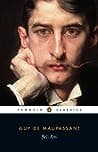
Maupassant's second novel, Bel-Ami (1885), is the story of a ruthlessly ambitious young man (Georges Duroy, christened "Bel-Ami" by his female admirers) making it to the top in fin-de-siecle Paris. It is a novel about money, sex, and power, set against the background of the politics of the French colonization of North Africa. It explores the dynamics of an urban society uncomfortably close to our own and is a devastating satire of the sleaziness of contemporary journalism. Bel-Ami enjoys the status of an authentic record of the apotheosis of bourgeois capitalism under the Third Republic. But the creative tension between its analysis of modern behavior and its identifiably late nineteenth-century fabric is one of the reasons why Bel-Ami remains one of the finest French novels of its time, as well as being recognized as Maupassant's greatest achievement as a novelist. - Back cover.
Add to your library to track progress and write reviews
Find Bel-Ami Guy de Maupassant in PDF, EPUB, ebook, audiobook, print, or library editions.
4 books in catalog
(Henry René Albert) Guy De Maupassant is generally considered to be the greatest French writer of short stories. One account says the location of his birth was the Château de Miromesnil, in Dieppe, though this is not certain. His paternal ancestors were of the minor aristocracy, and his maternal grandfather, Paul Le Poittevin, was Gustave Flaubert's godfather. His parents separated when he was 11 years old.
Maupassant was gifted with a photographic memory, which aided him in recollecting events and characters for his stories. As a teenager, Maupassant was shown, by the poet Algernon Swinburne (1837-1909), a mummified hand. He used this haunting image in his early short story La Main Ecorchée (1875). In 1869 Maupassant started to study law in Paris, but soon, at age 20, he volunteered to serve in the army during Franco-Prussian War. After his return to Paris, Maupassant joined the literary circle of Gustave Flaubert, who introduced him to some of the leading writers of his day, including Emile Zola, Ivan Turgenev, and Henry James. Flaubert saw Maupassant regularly and schooled him in the craft of being a writer.
From 1872 to 1880, Maupassant worked as a civil servant, first at the ministry of maritime affairs, then at the ministry of education. Toward the end of this time, Maupassant published his first poetry, Des Vers (1880). Later the same year he published his short story masterpiece, "Boule de Suif" (Ball of Fat) in the anthology Soirées de Medan (1880), edited by Emile Zola. The story, set during the Franco-Prussian War, is about passengers on a coach, one of whom is a well-known prostitute, nicknamed 'Boule de Suif.' The story later inspired director John Ford's Western film Stagecoach (1945).
During the 1880s Maupassant created some 300 short stories, six novels, three travel books, and one volume of verse. In tone, his tales were marked by precision of style and a range of expression. Although his stories range from moving drama to sometimes bizarre comedy, it is his macabre horror stories that have received much attention.
Among Maupassant's best known books is Une Vie (A Woman's Life, 1883), about the frustrating existence of a Norman wife, Bel-Ami (1885), which depicts an unscrupulous journalist. Pierre et Jean (1888) was a psychological study of two brothers. The novel was thought to be immoral, according to the classic definition, because the hero succeeds by doing wrong. Maupassant's most upsetting horror story, "Le Horla" (1887) (not to be confused with another of Maupassant's stories called "The Trip of Le Horla", which is about a hot air balloon), was about vampire-like ghouls, madness and suicide.
Maupassant had suffered from syphilis since his 20's, which caused him neurological and mental problem in his later years, and which undoubtedly accounts for his shortened lifespan. Some critics have alleged that Maupassant's developing illness can be seen through a growing preocuppation with mental illness in his stories. However, the theme of mental illness is present even in his first collection, La Maison Tellier (1881), published at the height of his health. Maupassant's horror fiction consists of some 39 stories, only a tenth of his total work. A recurring theme in these is madness: "A Queer Night in Paris" is a paranoid nightmare: its narrator feels compelled to walk the streets. In "Who Knows?" the subject suffers from delusions about the furniture in his house. "Diary of a Madman" is a story about a judge, who commits murder, just for the experience, and condemns an innocent man to death for the crime. "The Inn" has many similarities with Stephen King's novel The Shining. His story, "The Hand," based on his teenage recollection, has inspired later authors and movie directors. Maupassant's writing is sometimes compared with that of Edgar Allen Poe.
On January 2, 1892, Maupassant tried to commit suicide by cutting his throat and was committed to the celebrated private asylum of Dr. Esprit Blanche at Passy, in Paris, where he died next year. Maupassant's style has been imitated by countless writers, and his influence can be seen on such masters of the short story as W. Somerset Maugham and O. Henry.