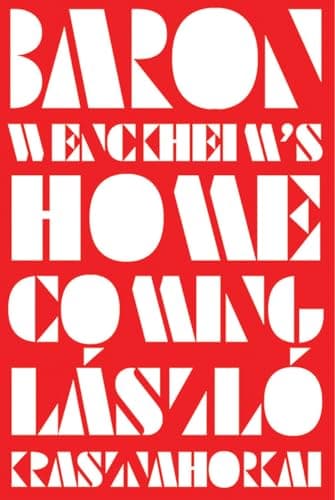
Baron Bela Wenckheim decides to return at the end of his life to the provincial Hungarian town of his birth. Having escaped from his many casino debts in Buenos Aires, where he was living in exile, he wishes to be reunited with his high school sweetheart Marika. What follows is an endless storm of gossip, con men, and local politicians, vividly evoking the small town's alternately drab and absurd existence

Baron Bela Wenckheim decides to return at the end of his life to the provincial Hungarian town of his birth. Having escaped from his many casino debts in Buenos Aires, where he was living in exile, he wishes to be reunited with his high school sweetheart Marika. What follows is an endless storm of gossip, con men, and local politicians, vividly evoking the small town's alternately drab and absurd existence
Add to your library to track progress and write reviews
Find Baron Wenckheim's Homecoming László Krasznahorkai in PDF, EPUB, ebook, audiobook, print, or library editions.
2 books in catalog
László Krasznahorkai (Hungarian: [ˈlaːsloː ˈkrɒsnɒɦorkɒi]; born 5 January 1954) is a Hungarian writer, novelist and screenwriter. Krasznahorkai is known for his difficult and demanding novels, often labelled postmodern, which explore dystopian and melancholic themes. Several of his works, including his novels Satantango (1985) and The Melancholy of Resistance (1989), have been adapted into feature films by the director Béla Tarr.
In 2025, he was awarded the Nobel Prize in Literature "for his compelling and visionary oeuvre that, in the midst of apocalyptic terror, reaffirms the power of art".
His novel The Melancholy of Resistance (1989) received the German Bestenliste-Prize for the best literary work of the year in 1993. In 1996, he was a fellow at the Wissenschaftskolleg in Berlin.
Beginning with Sátántangó (1994), filmmaker Béla Tarr, a close friend, adapted several of Krasznahorkai's works into films, including Werckmeister Harmonies (2000), which adapts The Melancholy of Resistance. Krasznahorkai stated that their 2011 film, The Turin Horse, would be their final collaboration. He has also collaborated with artist Max Neumann on illustrated works, including the novella Chasing Homer (2021), released with an original score by jazz musician Szilveszter Miklós.
His novel Seiobo There Below won the Best Translated Book Award in 2014. In 2015, he became the first Hungarian author to receive the Man Booker International Prize.
Krasznahorkai's work has received significant critical acclaim. Susan Sontag described him as "the contemporary Hungarian master of apocalypse who inspires comparison with Gogol and Melville", while W. G. Sebald wrote that "the universality of Krasznahorkai's vision rivals that of Gogol's Dead Souls and far surpasses all the lesser concerns of contemporary writing".
In 2024, the Austrian National Library in Vienna acquired Krasznahorkai’s literary archive (Vorlass), which is now preserved in its Literature Archives.
2 books in catalog
László Krasznahorkai (Hungarian: [ˈlaːsloː ˈkrɒsnɒɦorkɒi]; born 5 January 1954) is a Hungarian writer, novelist and screenwriter. Krasznahorkai is known for his difficult and demanding novels, often labelled postmodern, which explore dystopian and melancholic themes. Several of his works, including his novels Satantango (1985) and The Melancholy of Resistance (1989), have been adapted into feature films by the director Béla Tarr.
In 2025, he was awarded the Nobel Prize in Literature "for his compelling and visionary oeuvre that, in the midst of apocalyptic terror, reaffirms the power of art".
His novel The Melancholy of Resistance (1989) received the German Bestenliste-Prize for the best literary work of the year in 1993. In 1996, he was a fellow at the Wissenschaftskolleg in Berlin.
Beginning with Sátántangó (1994), filmmaker Béla Tarr, a close friend, adapted several of Krasznahorkai's works into films, including Werckmeister Harmonies (2000), which adapts The Melancholy of Resistance. Krasznahorkai stated that their 2011 film, The Turin Horse, would be their final collaboration. He has also collaborated with artist Max Neumann on illustrated works, including the novella Chasing Homer (2021), released with an original score by jazz musician Szilveszter Miklós.
His novel Seiobo There Below won the Best Translated Book Award in 2014. In 2015, he became the first Hungarian author to receive the Man Booker International Prize.
Krasznahorkai's work has received significant critical acclaim. Susan Sontag described him as "the contemporary Hungarian master of apocalypse who inspires comparison with Gogol and Melville", while W. G. Sebald wrote that "the universality of Krasznahorkai's vision rivals that of Gogol's Dead Souls and far surpasses all the lesser concerns of contemporary writing".
In 2024, the Austrian National Library in Vienna acquired Krasznahorkai’s literary archive (Vorlass), which is now preserved in its Literature Archives.