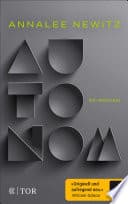
When anything can be owned, how can we be free
Earth, 2144. Jack is an anti-patent scientist turned drug pirate, traversing the world in a submarine as a pharmaceutical Robin Hood, fabricating cheap scrips for poor people who can’t otherwise afford them. But her latest drug hack has left a trail of lethal overdoses as people become addicted to their work, doing repetitive tasks until they become unsafe or insane.
Hot on her trail, an unlikely pair: Eliasz, a brooding military agent, and his robotic partner, Paladin. As they race to stop information about the sinister origins of Jack’s drug from getting out, they begin to form an uncommonly close bond that neither of them fully understand.
And underlying it all is one fundamental question: Is freedom possible in a culture where everything, even people, can be owned?
Add to your library to track progress and write reviews
Find Autonom Annalee Newitz in PDF, EPUB, ebook, audiobook, print, or library editions.

3 books in catalog
Exploration of biotechnology, environmental terraforming, and speculative social evolution defines contemporary science fiction at the intersection of journalism and imaginative literature. Annalee Newitz has emerged as a prominent voice in both science journalism and speculative fiction, creating acclaimed works that examine complex socio-technological futures. Their debut novel Autonomous won the Lambda Literary Award, establishing a reputation for thought-provoking narratives about artificial intelligence, corporate ownership, and human agency.
Born in Santa Monica, California, in 1969, Newitz grew up in Irvine and studied English at UC Berkeley. They began their professional media career writing the syndicated tech column Techsploitation from 1999 to 2008 and serving as culture editor at the San Francisco Bay Guardian between 2000 and 2004. Newitz co-founded Other magazine with Charlie Jane Anders in 2002 and worked as a policy analyst at the Electronic Frontier Foundation in 2004. In 2008, they founded the popular science fiction and technology publication io9, later serving as editor-in-chief of Gizmodo and an editor-at-large for Ars Technica. Beyond journalism, Newitz co-hosts the Hugo Award-winning podcast Our Opinions Are Correct and has contributed to public radio shows including Science Friday, On the Media, KQED Forum, and Here and Now. Their science reporting and opinion essays appear in publications such as The New York Times, The Washington Post, Slate, Scientific American, The New Yorker, Technology Review, and New Scientist, where they write a monthly column, as well as the Flaming Hydra collective.
Newitz seamlessly blends rigorous investigative journalism with speculative worldbuilding to examine how technology, political economy, and ecology shape human and non-human communities. Their fiction frequently investigates themes of labor rights, corporate power, identity, and environmental engineering, as seen in The Terraformers, which earned a nomination for the Nebula Award. In nonfiction works such as Scatter, Adapt, and Remember: How Humans Will Survive a Mass Extinction (a finalist for the LA Times Book Prize) and Four Lost Cities: A Secret History of the Urban Age, Newitz explores historical urban resilience, climate survival strategies, and cultural evolution.