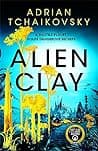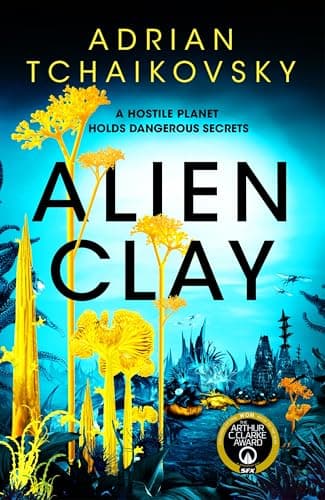
The planet of Kiln is where the tyrannical Mandate keeps its prison colony, and for inmates, the journey there is always a one-way trip. One such prisoner is Professor Arton Daghdev, xeno-ecologist and political dissident. Soon after arrival, he discovers that Kiln has a secret. Humanity is not the first intelligent life to set foot there.
In the midst of a ravenous, chaotic ecosystem are the ruins of a civilization, but who were the vanished builders and where did they go? If he can survive both the harsh rule of the camp commandant and the alien horrors of the world around him, then Arton has a chance at making a discovery that might just transform not only Kiln, but distant Earth as well.
Add to your library to track progress and write reviews
Find Alien Clay Adrian Tchaikovsky in PDF, EPUB, ebook, audiobook, print, or library editions.

7 books in catalog
Speculative fiction exploring non-human intelligence, evolutionary biology, and complex alien minds has been redefined in modern science fiction through award-winning sagas like Children of Time. British author Adrian Tchaikovsky gained widespread acclaim with this Arthur C. Clarke Award-winning novel, which depicts the multi-generational evolution of an arachnid civilization on a terraformed planet alongside humanity's desperate search for a new home.
From ten-book insect-inspired fantasy epics to far-future space operas and satirical explorations of artificial intelligence, Tchaikovsky's prolific bibliography bridges biological concepts with imaginative worldbuilding. Works such as Shards of Earth and Alien Clay demonstrate his ability to construct complex galactic ecosystems and convey truly foreign perspectives to readers.
Born Adrian Czajkowski in June 1972 in Woodhall Spa, Lincolnshire, he studied zoology and psychology at the University of Reading. Before transitioning to writing full-time in late 2018, he worked for years as a legal executive specializing in debt collection, litigation, and landlord and tenant law after initially working with the Legal Aid Board in the mid-1990s. His professional publishing path was established in 2007 when he sold his debut ten-book fantasy series, Shadows of the Apt, which launched in 2008 with Empire in Black and Gold.
Beyond his legal and academic background, Tchaikovsky is an avid tabletop role-player and board gamer whose early passion for world-building was ignited by campaign-based fantasy novels such as the Dragonlance series. He has also trained in stage-fighting and participated in amateur dramatics. His literary influences span major figures in speculative fiction, including Gene Wolfe, Mervyn Peake, China Mi)vie, Steven Erikson, Naomi Novik, Scott Lynch, and Alan Campbell.
Tchaikovsky's narrative signature stems directly from his academic studies in zoology and psychology, driving a consistent focus on non-human minds, uplifted species, and alien awareness. He frequently constructs plots around artificial intelligence, entomology, and evolutionary adaptation, showing a particular penchant for spiders, insects, and marine organisms. His stories challenge anthropocentric viewpoints by forcing human characters to communicate and negotiate with intelligences operating under distinct biological imperatives.
In addition to deep ecological and technological themes, his writing spans epic galactic settings and intricate fantasy realms. Novels like Service Model examine artificial intelligence and robotic servitude through dark satire, while Eyes of the Void and Lords of Uncreation build vast cosmic opera conflicts around ancient, planet-reshaping entities. Across his bibliography, Tchaikovsky balances detailed social and biological systems with character-driven survival narratives.