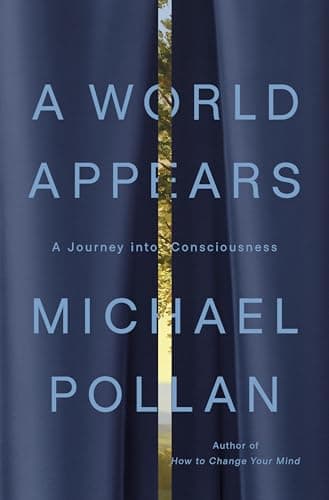
From the #1 New York Times bestselling author of How to Change Your Mind, a panoptic exploration of consciousness—what it is, who has it, and why—and a meditation on the essence of our humanity When it comes to the phenomenon that is consciousness, there is one point on which scientists, philosophers, and artists all agree: that it feels like something to be us. Yet the fact we have subjective experience of the world remains one of nature’s greatest mysteries. How is it that our mental operations are accompanied by feelings, thoughts, and a sense of self? What would a scientific investigation of our inner life look like, considering we have as little distance and perspective on it as fish do of the sea? In A World Appears, Michael Pollan traces the unmapped continent that is consciousness, bringing radically different perspectives—scientific, philosophical, literary, spiritual and psychedelic—to see what each can teach us about this central fact of life. When neuroscientists began studying consciousness in the early 1990s, they sought to explain how and why three pounds of spongy grey matter could generate a subjective point of view—assuming that the brain is the source of our felt reality. Pollan takes us to the cutting edge of the field, where scientists are entertaining more radical (and less materialist) theories of consciousness. He introduces us to “plant neurobiologists” searching for the first flicker of consciousness in plants; scientists striving to engineer feelings into AI, and psychologists and novelists seeking to capture the felt experience of our slippery stream of consciousness. In Pollan’s dazzling exploration of consciousness, he discovers a world far deeper and stranger than our everyday reality. Eye-opening and mind-expanding, A World Appears takes us into the laboratories of our own minds, ultimately showing us how we might make better use of the gift of awareness to more meaningfully connect with our deepest selves.
Add to your library to track progress and write reviews
Find A World Appears: A Journey into Consciousness Michael Pollan in PDF, EPUB, ebook, audiobook, print, or library editions.

3 books in catalog
Examining the complex intersections of nature, culture, agriculture, and human consciousness has reshaped modern understanding of food systems and mind-altering plants. Journalist, activist, and professor Michael Pollan has spent over three decades writing about the places where the human and natural worlds meet: on our plates, in our farms and gardens, in the built environment, and within our minds. Through best-selling books and investigative reporting, his work examines how human choices and natural systems continuously shape one another.
Pollan earned his bachelor's degree from Bennington College in 1977, studied at Oxford University, and completed a master's degree in English at Columbia University in 1981. He served as executive editor and contributing editor at Harper's Magazine and became a long-time contributing writer for The New York Times Magazine in 1995. In academia, he served for many years as the Knight Professor of Journalism at the UC Berkeley Graduate School of Journalism and co-founded the UC Berkeley Center for the Science of Psychedelics in 2020. He also serves as the Lewis K. Chan Arts Lecturer and professor at Harvard University, bringing investigative rigor to both teaching and writing.
Pollan's literary technique combines investigative journalism, historical analysis, personal memoir, and scientific reporting. Rather than adopting an authoritative posture, he frequently introduces readers to a central cognitive dilemma by placing himself directly inside the inquiry—such as evaluating the ethics of eating meat while dining at a steakhouse. His work routinely traces how plants, animals, and natural compounds co-evolve with human desire, exploring the historical and cultural forces behind dietary habits, architectural choices, and alterations of human consciousness.